

Breaking the Compute Bottleneck: How FriendliAI’s Qwen3.6 Deployment is Rewriting the Rules of GPU Economics and Agentic AI
In the rapidly evolving landscape of artificial intelligence, the ultimate bottleneck for enterprise adoption in the United States frequently boils down to two critical factors: the exorbitant costs of GPU compute and the challenge of reliably executing complex, multi-step automated tasks. Tech leaders in Silicon Valley and across the broader US enterprise ecosystem are constantly searching for platforms that bridge the gap between high performance and sustainable economics.
According to a highly anticipated recent LinkedIn announcement from FriendliAI, the generative AI infrastructure company is stepping up to address this exact market gap. The company has officially emphasized its robust support for Alibaba Cloud’s powerful Qwen3.6 family of agentic large language models (LLMs). Delivered seamlessly via Friendli Dedicated Endpoints, this integration is not just a technical update; it is a massive leap forward for open-weight deployment.
By offering one-click deployment for these state-of-the-art open-weight models, FriendliAI is aggressively positioning itself as the go-to infrastructure backbone for American developers, automation-centric businesses, and enterprise investors who are laser-focused on optimizing their AI compute margins.
The Qwen3.6 Lineup: Navigating the Sparse vs. Dense Architecture Divide
A major highlight of FriendliAI’s deployment strategy is the nuanced support for two distinct but highly complementary variants within the Qwen3.6 ecosystem. The strategic contrast between these models provides US enterprises with the ultimate flexibility to tailor their AI infrastructure to their specific workload requirements.
- Qwen3.6-35B-A3B (The Sparse Champion): This model leverages a highly optimized sparse Mixture-of-Experts (MoE) architecture. FriendliAI positions the 35B-A3B variant directly at enterprise teams looking for cost-efficient, high-throughput use cases. Because it only activates a subset of its parameters (around 3 billion) during any given inference request, it significantly reduces the computational overhead. For US tech companies scaling customer-facing applications or handling massive daily token volumes, this translates to lightning-fast responsiveness without breaking the cloud budget.
- Qwen3.6-27B (The Dense Powerhouse): On the other end of the spectrum, the dense Qwen3.6-27B model is meticulously engineered to target higher-end agentic coding and complex performance workloads. FriendliAI indicates that this dense model achieves benchmark scores that make it highly competitive with today's leading closed-source frontier models. For software engineering teams building advanced internal tools or autonomous coding assistants, the 27B model delivers the raw, uncompromised reasoning power required to execute flawless logic.
Revolutionizing Automation with "Thinking Preservation"
One of the most compelling technological breakthroughs highlighted in FriendliAI’s report is the native support for “Thinking Preservation.” In the current AI meta, deploying models for simple Q&A is no longer enough. The market has shifted toward multi-step agent loops—autonomous AI systems that can plan, execute, evaluate, and iterate on complex tasks over extended periods. "Thinking Preservation" ensures that the model's internal reasoning chains and contextual memory remain intact across these prolonged, multi-step loops.
For the US software development industry, this signals a massive shift. Developers can now build highly complex automation and software engineering workflows where the AI agent doesn't lose its "train of thought" halfway through debugging a codebase or orchestrating a cloud deployment. This hyper-focus on robust agentic behavior is exactly what automation-centric customers require to move LLMs from experimental sandboxes into core production environments.
By the Numbers: Benchmarking the Future of Enterprise AI
Enterprise AI deployment decisions in the United States are driven by empirical data and rigorous benchmarking. FriendliAI’s post aggressively validates the Qwen3.6 models by citing top-tier performance metrics across several industry-standard evaluations. These metrics are specifically curated to appeal to enterprises evaluating the viability of open-weight models:
- SWE-bench Verified (Coding): Proves the models' ability to resolve real-world software engineering issues pulled directly from platforms like GitHub. Strong performance here assures US tech firms that these models can act as legitimate co-pilots or autonomous software engineers.
- Terminal-Bench 2.0 (Agents): Measures the LLM's capability to navigate command-line interfaces and execute OS-level operations, proving its worth for true infrastructural automation.
- MMMU (Multimodal): Tests advanced reasoning across interleaved text and images, critical for modern applications that process diverse data types.
- AIME26 (Math): Validates the underlying logical and mathematical reasoning capabilities, a core proxy for an AI’s ability to handle complex, abstract problem-solving.
Shattering the GPU Cost Barrier
While the capabilities of the Qwen3.6 models are impressive, the true disruptor here is the underlying delivery mechanism: Friendli Dedicated Endpoints. Serving models on reserved GPU capacity, FriendliAI is making bold, highly attractive claims regarding its infrastructure efficiency.
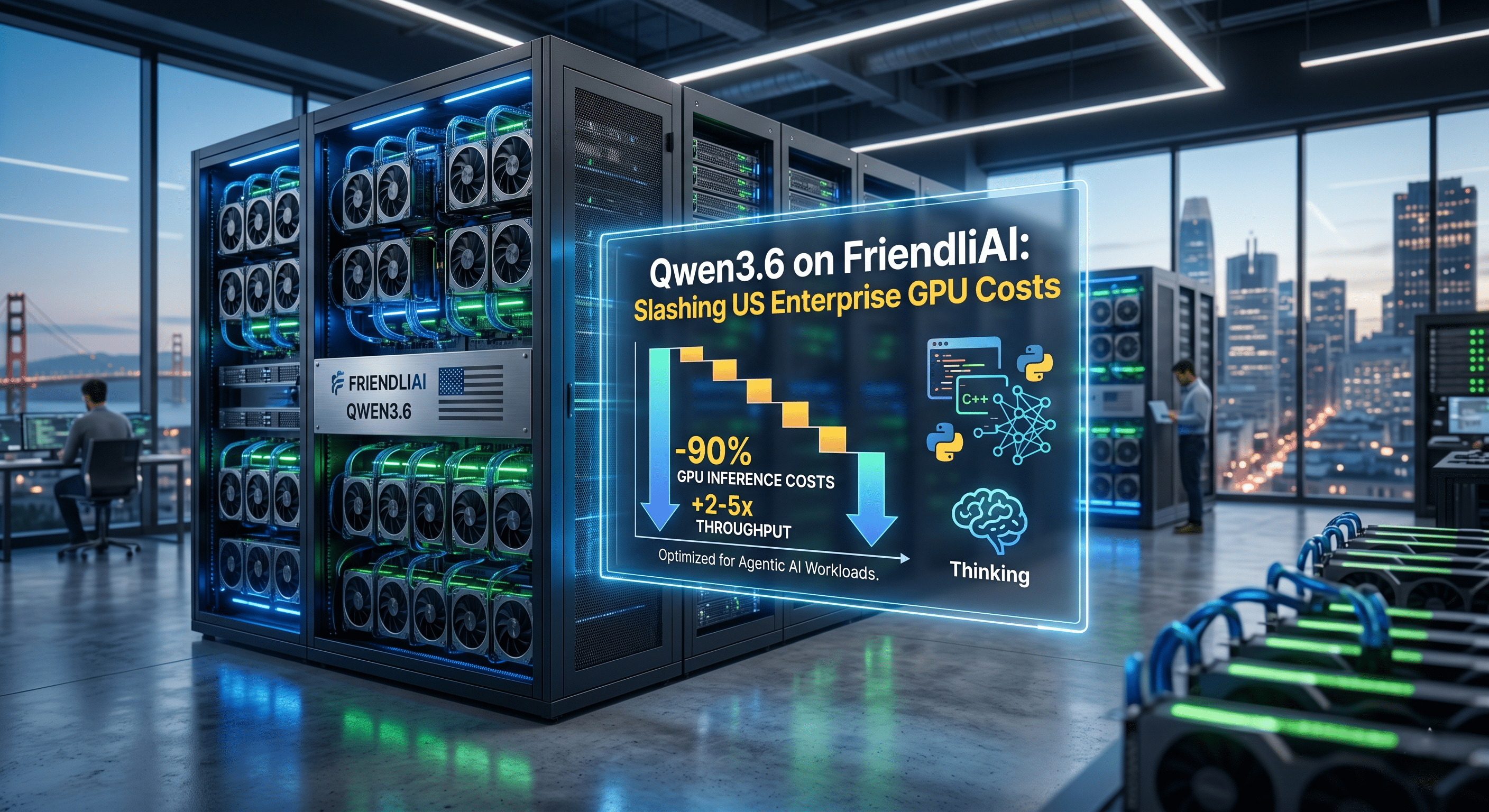
The company asserts that its platform delivers throughput improvements of 2–5x, coupled with staggering GPU cost reductions of 50–90%. Crucially, this is all backed by an enterprise-grade guarantee of 99.99% uptime.
In an era where American businesses are facing massive cloud compute bills and frequent hardware shortages, these figures are game-changing. If these metrics consistently hold true in live production environments, FriendliAI’s value proposition vastly outshines traditional legacy inference providers. By maximizing GPU utilization—extracting every ounce of performance out of the silicon—they empower businesses to achieve rapid margin expansion and scale their AI initiatives without proportional cost explosions.
The Investor Perspective: Capturing the AI Hosting Market
For institutional investors, venture capitalists, and market analysts observing the AI space, FriendliAI’s strategic embrace of the Qwen3.6 family signals a highly lucrative trajectory.
The company is decisively deepening its role as a premier infrastructure provider for open-weight and agentic LLMs. By solving the most painful pain points in the market—cost, scalability, and complex multi-step reasoning—FriendliAI is fundamentally expanding its addressable market in the AI application hosting sector.
Stronger support for high-performance, cost-optimized models inevitably leads to improved customer stickiness. When a US enterprise integrates an automated workflow using FriendliAI’s endpoints and experiences a 90% reduction in inference costs, the switching costs become phenomenally high. This dynamic paves the way for exceptional recurring revenue potential. By aligning its core technology with the skyrocketing demand for scalable AI inference across coding, multimodal, and autonomous agent use cases, FriendliAI is securing its position at the absolute forefront of the generative AI infrastructure race.




Comments
No comments yet. Be the first to share your thoughts!
Leave a Comment