

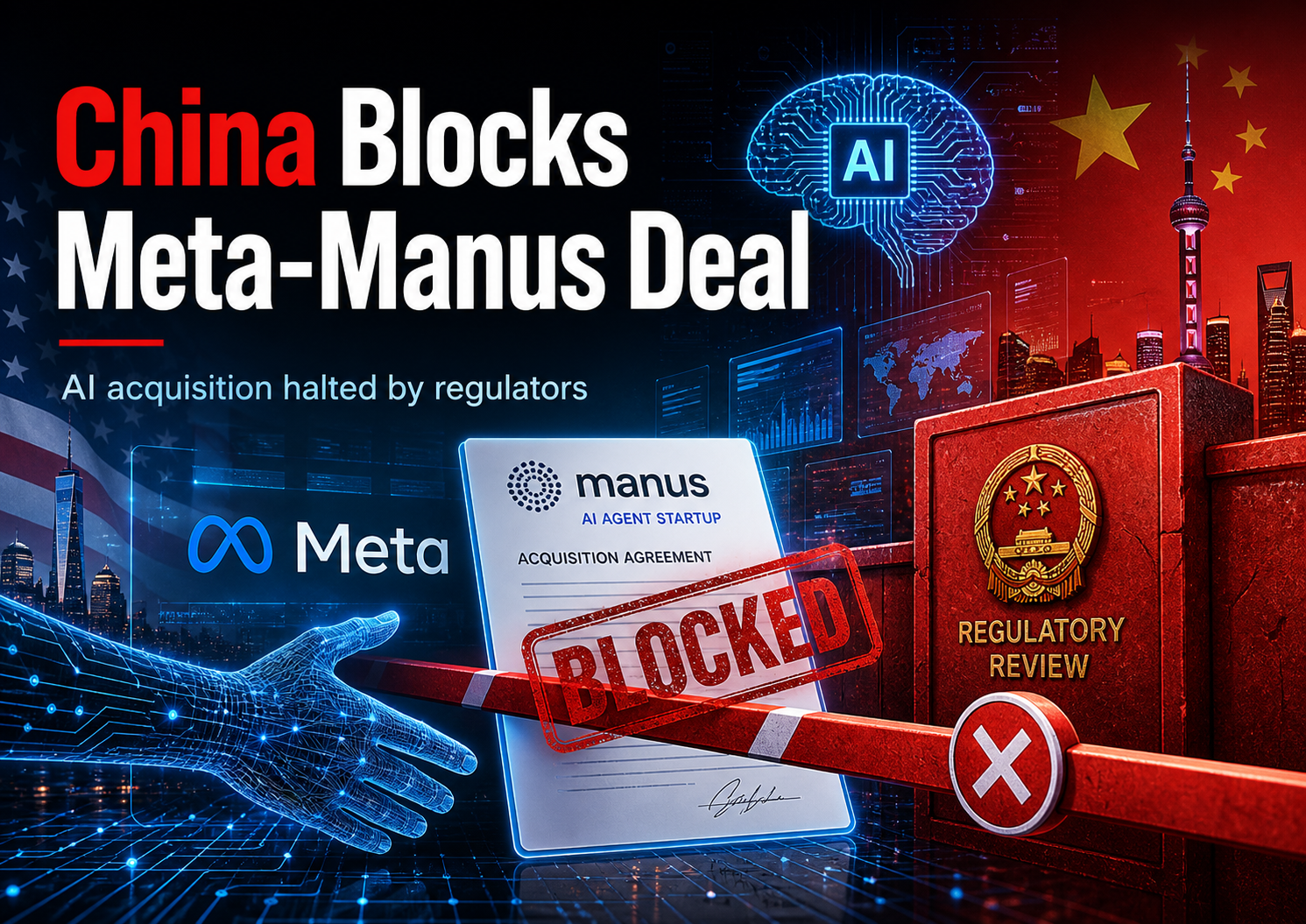
China Blocks Meta’s Acquisition of Manus, Raising New Questions for AI Startups and U.S. Tech Investors
Chinese regulators have moved to block Meta’s reported acquisition of Manus, an artificial intelligence agent startup with roots in Wuhan and Beijing, in a decision that could reshape how global technology companies approach AI investments connected to China. The move, reported by international media on April 27, highlights the growing tension between national technology policy, cross-border mergers, and the global race to control advanced AI platforms.
According to reports, an organization operating under China’s National Development and Reform Commission, widely known as the NDRC, ordered that the acquisition be treated as if it had never taken place. The regulator said it had decided, in accordance with Chinese laws and regulations, to prohibit a foreign company from acquiring the Manus project. Although the announcement did not directly name Meta, the order instructed the parties involved to terminate and cancel the acquisition agreement.
Meta had announced in December of last year that it had reached an agreement to acquire Butterfly Effect, the company behind Manus. The financial terms were not officially disclosed, but the Wall Street Journal previously reported that the transaction was valued at more than $2 billion. For a young AI startup, that valuation placed Manus among the most closely watched companies in the emerging AI agent market.
Manus attracted significant attention after its public unveiling in March 2025. The company positioned itself in the rapidly growing field of AI agents, a category of artificial intelligence tools designed to perform tasks, manage workflows, and operate with a higher level of autonomy than traditional chatbots. This type of technology has become a major priority for U.S. technology giants, including Meta, Google, Microsoft, Amazon, and OpenAI-backed ecosystems.
The startup also gained investor confidence quickly. Manus reportedly raised $75 million in a funding round led by Silicon Valley venture capital firm Benchmark. That investment signaled strong U.S. interest in the company’s technology and suggested that Manus had the potential to become a major player in the AI agent economy.
However, the company’s China connection appears to have complicated the transaction. Manus was originally founded in Wuhan and Beijing, two important technology hubs in China. Later, the company moved its headquarters and core engineering team to Singapore and shut down its China office. This relocation was widely viewed as an effort to reduce the company’s China profile and make itself more accessible to global investors, partners, and potential acquirers.
Despite that move, Chinese regulators began investigating the acquisition earlier this year. Their final decision to block the deal has raised concern among founders, investors, and analysts who follow China-linked technology startups. The message appears clear: even if a startup moves operations outside mainland China, Chinese authorities may still claim regulatory interest if the company’s technology, founding history, personnel, or intellectual property are connected to China.
For Meta, the blocked acquisition represents a setback in its effort to strengthen its artificial intelligence capabilities. The company has been investing heavily in AI infrastructure, large language models, AI assistants, and agent-based tools. Acquiring Manus could have given Meta access to advanced talent and technology in one of the most competitive areas of AI development.
The timing is especially important for the U.S. market. American technology companies are racing to integrate AI agents into consumer platforms, enterprise software, advertising systems, social media tools, and productivity applications. Meta, which operates Facebook, Instagram, WhatsApp, and Threads, has strong incentives to develop AI systems that can assist users, automate content creation, support businesses, and improve digital advertising performance.
AI agents are increasingly seen as the next major stage of artificial intelligence. Unlike simple chatbots that respond to prompts, AI agents are designed to plan, execute, and manage multi-step tasks. In business settings, they may help schedule meetings, analyze data, generate reports, manage customer service, or support software development. In consumer applications, they may assist with shopping, travel planning, communication, and personal productivity.
Because of this potential, startups working on AI agents have become valuable acquisition targets. Large companies often prefer acquisitions because they can quickly obtain engineering talent, proprietary models, product designs, and market momentum. A startup like Manus, with strong investor backing and international visibility, would naturally attract attention from major U.S. technology companies.
China’s decision, however, may create a new layer of uncertainty. If regulators are willing to block foreign acquisitions of startups with Chinese origins, investors may become more cautious about funding companies that have similar backgrounds. Founders may also face difficult questions about where to incorporate, where to hire engineers, where to host intellectual property, and how to structure global operations.
This could have major implications for Singapore as well. In recent years, Singapore has become a preferred base for technology startups seeking access to both Asian and Western markets. Many founders choose Singapore because of its business-friendly environment, strong legal system, and international investor access. Manus’s move to Singapore appeared to follow that logic. Yet the regulatory block suggests that relocation alone may not be enough to remove geopolitical risk.
For U.S. investors, the case is a reminder that AI is no longer just a commercial sector. It is also a strategic industry tied to national security, economic power, and global influence. Both Washington and Beijing have increased scrutiny over sensitive technologies, including semiconductors, cloud computing, machine learning systems, data platforms, and advanced AI models. Cross-border deals in these sectors are likely to face more political and regulatory pressure.
The decision may also affect how American venture capital firms evaluate exit opportunities. A startup’s value often depends on the possibility of acquisition by a larger company. If Chinese regulators can block sales to foreign buyers, the exit path for China-linked AI startups becomes narrower. That could reduce valuations, slow investment, or push companies to pursue public listings instead of acquisitions.
At the same time, Beijing’s move may reflect a desire to prevent strategic AI technology from being absorbed by foreign technology giants. China has made AI development a national priority and has invested heavily in domestic innovation. Allowing a major U.S. company like Meta to acquire an AI agent startup with Chinese roots could be viewed by regulators as a loss of valuable technology, talent, or competitive advantage.
The Manus case also shows how the definition of a “Chinese startup” can be complicated. A company may be founded in China, move its headquarters abroad, raise money from Silicon Valley investors, hire an international engineering team, and serve global customers. Yet regulators may still consider its origin and technology important enough to justify intervention.
For businesses in the United States, this development is worth watching closely. Companies that depend on AI partnerships, startup acquisitions, or global talent pipelines may need to conduct deeper regulatory risk assessments before making deals. Legal due diligence will not be enough. Buyers may also need to understand political exposure, data sensitivities, intellectual property history, and the regulatory posture of multiple governments.
Meta has not been directly named in the Chinese regulatory statement, but the reported connection to the Manus deal has already drawn attention across the global technology industry. Whether the parties attempt to restructure the agreement, abandon the deal entirely, or pursue another path remains unclear. What is clear is that the acquisition has become a high-profile example of how AI competition is increasingly shaped by government action.
The blocked Manus acquisition may become a turning point for AI startup exits involving China-linked companies. It sends a warning to founders that international expansion does not always remove domestic regulatory exposure. It also warns U.S. technology buyers that acquiring promising AI startups may require more than capital and strategic interest.
As the AI agent market continues to expand, the competition between American and Chinese technology ecosystems will likely intensify. Meta’s attempted acquisition of Manus shows that the future of AI will not be decided only by innovation, product quality, or investment size. It will also be shaped by national policy, regulatory control, and the growing geopolitical value of artificial intelligence.




Comments
No comments yet. Be the first to share your thoughts!
Leave a Comment