

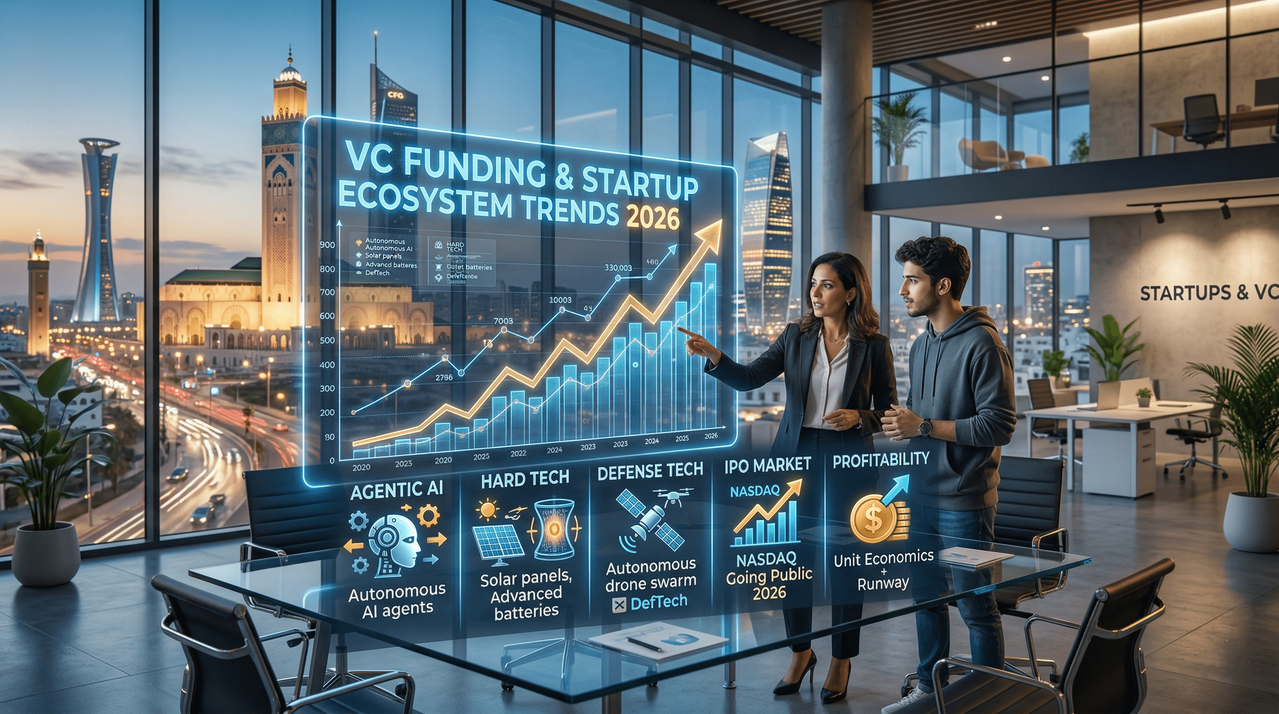
The Future of Funding: 5 Venture Capital & Startup Trends Dominating 2026
After the roller-coaster years of market corrections and soaring interest rates, the venture capital landscape has officially entered a new era in 2026. The days of "growth at all costs" have been replaced by a focus on sustainable unit economics, while groundbreaking technological leaps continue to unlock massive funding rounds.
If you are a founder looking to raise capital or an enthusiast tracking the next unicorn, understanding the current pulse of the VC world is crucial. Here are the top five venture capital and startup trends shaping the ecosystem in 2026.
1. The Pivot from Generative AI to "Agentic" & Vertical AI
In 2023 and 2024, VCs threw billions at foundational Large Language Models (LLMs). In 2026, the hype has matured. Investors are no longer looking for generic chatbots; they are pouring money into Agentic AI—systems capable of autonomous decision-making and executing multi-step workflows without human intervention.
Furthermore, Vertical AI is having its massive breakout moment. Startups that apply AI to deeply specific, highly regulated industries—such as legal-tech, biotech, advanced manufacturing, and logistics—are seeing rapid term sheet offers.
- Takeaway for Founders: Don't just pitch an "AI wrapper." Show investors how your AI solves a complex, deeply entrenched industry problem autonomously.
2. Climate Tech Evolves into "Hard Tech"
Climate tech has consistently defied broader VC downturns, but the focus has shifted. Software solutions for carbon accounting are giving way to investments in physical infrastructure, often referred to as "Hard Tech."
Venture capitalists are increasingly raising dedicated deep-tech funds to back capital-intensive projects. The biggest funding rounds are going to startups working on:
- Next-generation battery storage and solid-state tech.
- Green steel and sustainable cement manufacturing.
- Grid optimization and nuclear fusion advancements.
- Takeaway for Founders: If you are building in the climate space, VCs are currently willing to accept higher upfront CapEx risk if the total addressable market (TAM) guarantees a global-scale impact.
3. Defense Tech and "Dual-Use" Startups Surge
Driven by ongoing geopolitical shifts and the modernization of global militaries, Defense Tech (or "DefTech") has officially shed its taboo status in Silicon Valley.
Top-tier VC firms are actively hunting for startups building dual-use technologies—products that have immediate commercial applications but can also be utilized by defense departments. Sectors like autonomous drone swarms, cybersecurity, satellite infrastructure, and advanced materials are experiencing a funding renaissance.
4. The Reopening of the IPO Window and M&A Liquidity
For a few years, the exit market was frozen, leaving VCs unable to return capital to their Limited Partners (LPs). In 2026, the IPO window is back open, fueled by stabilized macroeconomic conditions and adjusted valuations.
We are seeing a steady stream of mature, late-stage tech companies successfully going public. This resurgence in liquidity is creating a "trickle-down" effect. Because VCs are finally seeing returns, they are actively reinvesting that capital back into Seed and Series A startups.
5. Profitability is the New "Growth Hacking"
While the VC purse strings have loosened, the investment philosophy has permanently changed. The "growth at all costs" mindset is a relic of the past. Today's venture capitalists are heavily scrutinizing gross margins, customer acquisition costs (CAC), and runway.
Startups raising Series A or B rounds in 2026 are expected to demonstrate a clear, realistic path to profitability. Bootstrapping in the early days to prove product-market fit before taking institutional money has become the ultimate badge of honor.
- Takeaway for Founders: Build lean. Show investors that their money will be used to scale a proven, profitable engine, not to figure out your business model.
The Bottom Line
The 2026 startup and VC ecosystem is defined by a healthy balance of extraordinary technological ambition and strict financial discipline. Whether you are building autonomous AI agents, revolutionizing defense infrastructure, or decarbonizing the planet, venture capital is abundant—but only for those who can prove tangible value.
What startup sector do you think will produce the most unicorns in 2026? Let us know in the comments below!




Comments
No comments yet. Be the first to share your thoughts!
Leave a Comment