

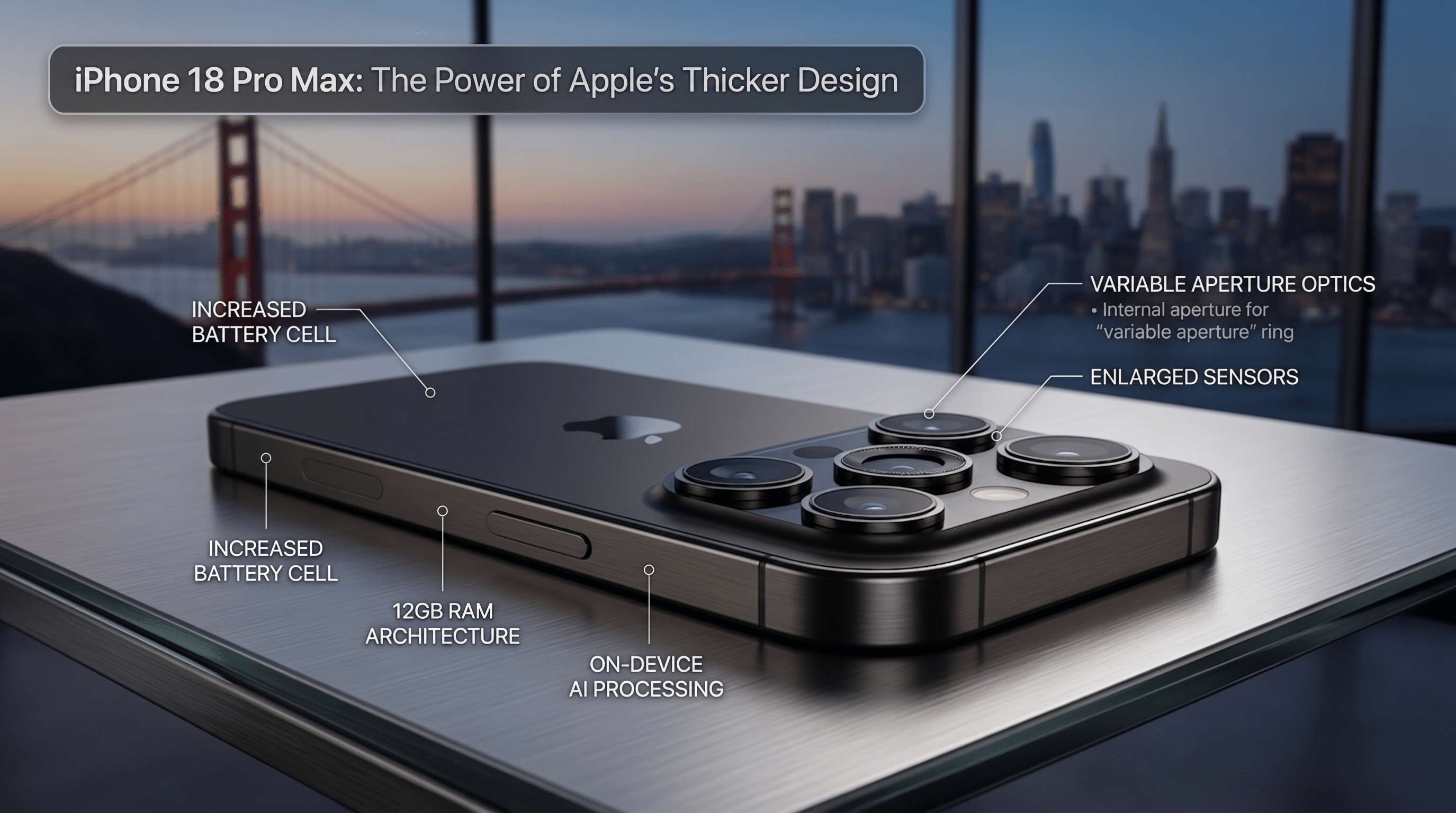
The iPhone 18 Pro Max: Why Apple’s Shift to Thicker Designs is Exactly What American Power Users Need
For over a decade, the American smartphone market was dominated by a single, unwavering design philosophy: thinner is always better. From the iconic moment Steve Jobs pulled the original MacBook Air out of a manila envelope, the Cupertino-based tech giant has historically treated device thickness as the ultimate enemy of aesthetic perfection. However, times are changing, and so are consumer priorities. The era of compromising battery life and thermal management for the sake of a razor-thin chassis was finally put to rest when Apple introduced the iPhone 17 Pro Max, its thickest flagship to date.
Now, as we look toward the horizon, the upcoming iPhone 18 Pro Max is absolute proof that Apple no longer believes thicker devices are aesthetically unattractive—as long as they deliver undeniable, real-world benefits. Based on recent supply chain reports and dummy unit comparisons, thicker devices are officially back in fashion. For power users stretching from Silicon Valley to Wall Street, this is the design revolution we have been waiting for.
The Death of the Thinness Obsession
While some purists might conclude that Apple has lost its design "mojo" with these recent, bulkier releases, the reality is far more practical. Today's smartphone user demands more. Whether you are taking a cross-country flight from New York to Los Angeles or relying on your device for heavy mobile video editing, battery anxiety is a very real issue.
The iPhone 17 Pro Max proved that consumers will happily accept a slightly thicker footprint if it means securing the largest battery ever placed in an Apple release. Now, the iPhone 18 Pro Max is said to take this philosophy up a notch in both physical dimensions and internal specifications. Apple has recognized that an ultra-thin phone that dies by 3:00 PM is useless, but a slightly thicker powerhouse that lasts through a full day of heavy GPS navigation, 5G streaming, and 4K video recording is a true flagship.
A Tale of the Tape: iPhone 18 Pro Max vs. iPhone 17 Pro Max
Recent insights from the popular YouTube channel Max Tech have given us our best look yet at what to expect. By comparing a detailed iPhone 18 Pro Max dummy unit against the current iPhone 17 Pro Max, we can see exactly where Apple is allocating its physical footprint.
Interestingly, the base thickness of the phone remains completely unchanged. Despite strong rumors claiming that the iPhone 18 Pro Max will feature an even larger battery capacity than its immediate predecessor, the core chassis without the camera plateau measures the exact same 8.75mm as the iPhone 17 Pro Max.
This lack of change in the base frame is a massive engineering triumph. It indicates that Apple’s internal design team has somehow managed to rework the logic board and internal components to increase the battery cell size without making the device feel "inflated" in your hand or pocket. However, when we flip the phone over, the similarities end.
To accommodate a massive leap in photographic capabilities, the camera module is growing significantly. When factoring in the camera plateau and the individual lens bumps, the iPhone 18 Pro Max is nearly 5 percent thicker.
Detailed Dimension Comparison Breakdown:
| Measurement Type | iPhone 18 Pro Max | iPhone 17 Pro Max | Percentage Difference |
| Base Thickness (No Bump) | 8.75mm | 8.75mm | 0% |
| With Camera Plateau Only | 11.54mm | 11.23mm | +2.76% thicker |
| With Full Camera Bump | 13.78mm | 13.13mm | +4.95% thicker |
Why the Camera Bump is Growing: The Variable Aperture Era
If you are going to add almost 5 percent more bulk to a smartphone's camera module, there needs to be a stellar justification. These dimension changes indicate that Apple is not just using larger, more light-sensitive camera sensors, but they are completely revamping the optical hardware.
The increased space is heavily rumored to accommodate a brand-new variable aperture unit. Expected to arrive on both the iPhone 18 Pro and the iPhone 18 Pro Max later this year, variable aperture is a game-changer for mobile photography. Similar to traditional DSLR cameras, this mechanical feature will allow the iPhone's lens to physically open and close, adjusting the amount of light that hits the sensor while giving users true, optical depth-of-field control.
For the American creator economy—vloggers, influencers, and independent filmmakers—this means unprecedented performance in low-light environments and natural, creamy bokeh for portrait shots that computational photography simply cannot perfectly replicate.
What Lies Under the Hood: More RAM and a Refined Display
While the external dimension changes are largely focused on the rear camera array, the front of the device is getting a welcome refinement. Users should expect a noticeably miniaturized Dynamic Island, freeing up more screen real estate for media consumption, gaming, and multitasking.
However, the majority of the major upgrades are happening on the inside. From the outside, apart from the beefier camera lenses, there is not a whole lot Apple appears to have changed. But that matters very little when you look at the spec sheet. The iPhone 18 Pro Max is said to be treated to an incredible specifications bump that includes a 12GB RAM upgrade across the entire Pro lineup.
In the modern landscape of on-device AI and Apple Intelligence, 12GB of RAM is not just a luxury; it is a necessity. This massive memory boost will ensure that complex machine learning tasks, real-time language translation, and heavy localized data processing happen instantly, without relying on cloud servers. It is the ultimate future-proofing move for users who plan to keep their devices for three to four years.
The Verdict: Embracing the Bulk
The smartphone industry is maturing, and the obsession with paper-thin hardware is finally behind us. Apple's willingness to embrace a 13.78mm thickness at the camera bump proves that function is finally taking precedence over form. By utilizing this extra space to house a variable aperture lens, a massive battery, and superior internal cooling for its new 12GB RAM architecture, Apple is building a device truly worthy of the "Pro" moniker.
With the official launch slated to happen later this year, excitement in the US market is already building. If you are itching to daily-drive this new, uncompromising flagship, keep your eyes glued to the rumor mill, as this is shaping up to be one of the most significant architectural leaps in iPhone history. Sometimes, bigger truly is better.



Comments
No comments yet. Be the first to share your thoughts!
Leave a Comment