

Firmus Hits $5.5 Billion Valuation: How an Australian AI Data Center Builder Became One of the Hottest Infrastructure Plays in the World
The artificial intelligence infrastructure race is no longer confined to Silicon Valley or Northern Virginia. A rapidly scaling company called Firmus Technologies has just closed a $505 million equity raise led by Coatue Management at a $5.5 billion post-money valuation, firmly establishing Australia as a serious contender in the global AI compute landscape211. The round marks a staggering acceleration for a company that, not long ago, was building cooling systems for cryptocurrency miners.
This article breaks down what Firmus is building, why investors are pouring billions into its vision, and what the company's rise means for the future of AI infrastructure in the Asia-Pacific region.
A Capital Raise That Signals Serious Momentum
Firmus's latest fundraise is not an isolated event. It represents the third equity round the company has completed in just six months, bringing total equity raised in that window to approximately $1.35 billion211. Previous rounds included an AU$330 million raise (roughly $215 million) at an AU$1.85 billion valuation, with participation from Nvidia itself — one of the most consequential strategic backers any AI infrastructure company can secure11.
The new round was led by Coatue Management, a global investment firm with deep roots in technology and infrastructure investing, with continued participation from Nvidia2. With this valuation and trajectory, Firmus is now targeting a $2 billion initial public offering on the Australian Securities Exchange (ASX), expected as early as June or July 20262. If it proceeds, the listing would position Firmus as one of the most valuable technology companies ever to debut on the Australian market.
Project Southgate: A National AI Factory Network
At the heart of Firmus's growth story is Project Southgate, an ambitious, multi-site AI data center program spanning the Australian continent. The project is designed not as a conventional colocation expansion but as a network of purpose-built AI Factories — modular, vertically integrated systems that tightly couple compute, cooling, and power infrastructure from the ground up134.
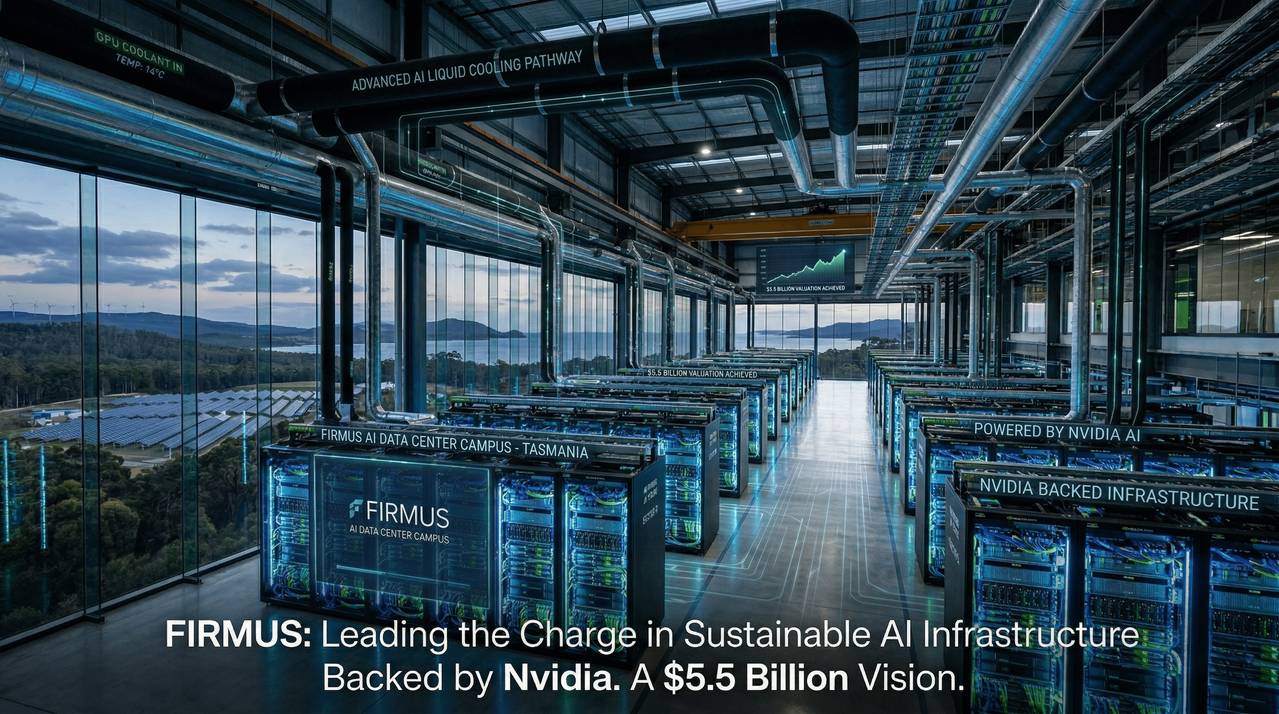
The flagship campus is located in Launceston, Tasmania, chosen for its access to abundant renewable energy, favorable climate, and strategic positioning for energy-efficient operations2. This facility is expected to house approximately 36,800 Nvidia GB300 GPUs when completed in late 2026, setting a new benchmark for sustainable AI compute14.
Beyond Tasmania, Firmus has already secured a multi-billion-dollar contract for a Melbourne facility, covering approximately 18,400 Nvidia GB300 GPUs for a leading global technology company14. This contract represents the second large-scale customer signed under the Southgate umbrella and marks what the company calls the arrival of hyperscale AI factories in Australia for the first time1.
The broader vision for Project Southgate extends to five Australian locations — Melbourne, Sydney, Canberra, Perth, and Tasmania — targeting a combined capacity of 1.6 gigawatts by 2028247. The total projected build cost for the full national rollout is an extraordinary $73.3 billion, a figure that underscores both the capital intensity and the scale of ambition behind the program2.
Backed by Blackstone: One of Australia's Largest Private Debt Deals
Fueling this expansion is a US$10 billion debt financing facility secured in February 2026, led by Blackstone Tactical Opportunities and Blackstone Credit & Insurance, with additional support from Coatue710. The transaction ranks among the largest private credit deals in Australian corporate history and was structured as long-dated infrastructure debt — a format signaling institutional confidence in the bankability of contracted AI data center assets27.
John Watson, a Senior Managing Director in Blackstone's Tactical Opportunities Group, described AI infrastructure as "one of our highest conviction investment themes," reflecting the broader trend of institutional capital flooding into the physical layer of the AI economy7.
The Technology: Liquid Cooling and Nvidia's Latest Architectures
Firmus's competitive edge is rooted in its proprietary liquid-cooling technology, which the company claims reduces energy consumption by up to 60% compared with conventional air-cooled facilities and cuts construction costs by roughly half2. These are not trivial claims in an industry where power consumption and thermal management are among the most significant operational challenges.
The company's AI Factory platform is built on Nvidia's DSX reference architecture, currently deploying Grace-Blackwell GPU clusters and designed to accommodate Nvidia's next-generation Vera Rubin platform, expected to ship in the second half of 2026711. This forward-compatibility is a critical strategic advantage, as it allows Firmus to upgrade its compute capabilities within the same installed infrastructure base without costly redesigns14.
Firmus has also invested more than AUD $300 million in building a domestic Australian supply chain, including partnerships with manufacturing groups Benmax and Maas Group, which are already producing AI Factory components at industrial scale14. This sovereign supply chain supports the delivery of up to 1.5 gigawatts of AI facility capacity per year and is projected to create up to 400 skilled advanced manufacturing jobs across Australia4.
From Bitcoin Cooling to AI Powerhouse
Perhaps one of the most compelling elements of the Firmus story is its origin. The company began roughly seven years ago as a provider of cooling solutions for Bitcoin mining operations, where the extreme energy demands of proof-of-work computing exposed the need for radically more efficient thermal management258.
That expertise in immersion cooling technology became the foundation for a pivot into AI infrastructure, where the same thermal challenges exist at even greater scale. Deploying high-density GPU clusters for AI training and inference generates enormous heat loads, and Firmus's experience in managing those loads at the hardware level has become a genuine differentiator in a market crowded with conventional data center operators814.
As the AI infrastructure cycle has accelerated, investors have shown a strong appetite for companies with real engineering capabilities rather than just real estate. Firmus fits that profile, combining deep thermal engineering expertise with a vertically integrated approach that encompasses power systems, cooling, compute, and supply chain management314.
What This Means for the Global AI Infrastructure Landscape
Firmus's rapid rise reflects several broader trends reshaping the AI infrastructure market. First, geographic diversification of AI compute is accelerating, as hyperscale customers seek capacity outside traditional hubs in the United States and Europe. Australia's competitive energy profile, skilled workforce, and political stability make it an increasingly attractive destination for large-scale deployments710.
Second, the sheer volume of capital flowing into AI infrastructure — from Blackstone's $10 billion debt facility to Coatue's repeated equity commitments — signals that institutional investors view physical AI compute capacity as a generational investment theme, comparable to earlier infrastructure cycles in telecommunications and cloud computing27.
Third, the convergence of sustainability and performance is becoming a real competitive axis. Firmus's ability to deliver lower power usage, reduced water consumption, and smaller physical footprints while running cutting-edge GPU clusters positions it well in a market where energy constraints are increasingly the binding limit on AI scaling238.
Looking Ahead
With a potential ASX IPO on the horizon, a $10 billion debt war chest, and contracted hyperscale customers already in place, Firmus is no longer an emerging startup — it is a scaled infrastructure platform executing against one of the most capital-intensive build programs in Australian industrial history. Whether it can deliver on the full 1.6-gigawatt vision by 2028 remains to be seen, but the capital, the partnerships, and the engineering foundation are now firmly in place.




Comments
No comments yet. Be the first to share your thoughts!
Leave a Comment