

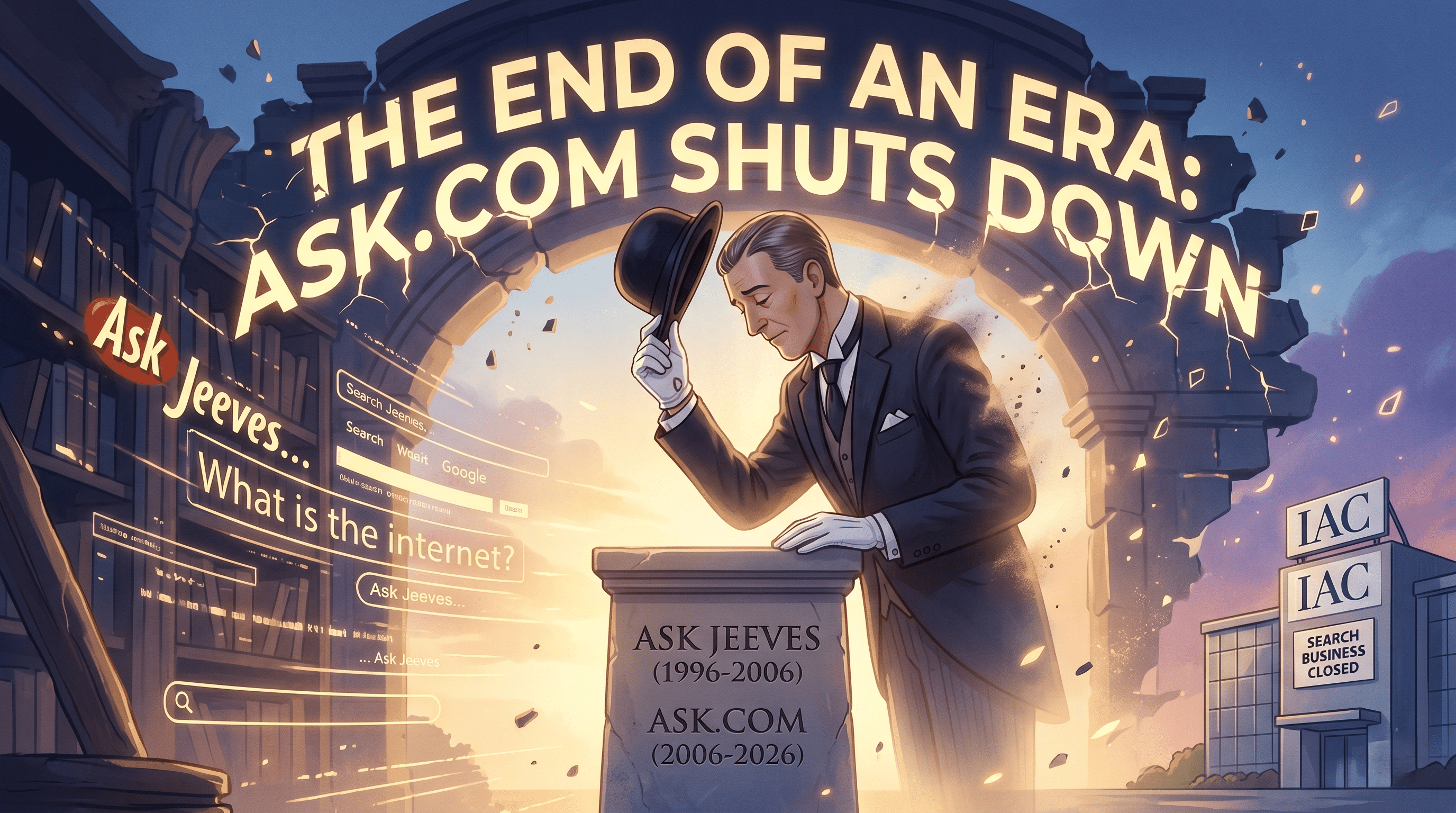
The End of an Era: Ask.com Shuts Down, Laying the Ghost of Jeeves to Rest
For nearly three decades, a quiet but enduring piece of internet history lingered in the background of the World Wide Web. Today, that chapter officially closes. Ask.com has officially shut down after nearly 30 years of operation, ending a fascinating saga in early search engine history that many modern web users have either long forgotten or never even knew existed.
The parent company, IAC (InterActiveCorp), confirmed the decisive move in a poignant message posted directly on the platform's homepage. This closure marks the definitive end of a service that, during the internet's formative years, competed directly with the biggest names in the search industry.
As we bid farewell to the platform, it is crucial to examine the rise, the pivot, and the slow fade of Ask.com—a journey that perfectly encapsulates the rapid evolution of search engine optimization (SEO), user behavior, and global digital geography.
The Golden Age of Ask Jeeves
To understand the magnitude of this shutdown, one must travel back to 1996. The internet was a vastly different landscape—a wild frontier where search engines were still desperately trying to figure out how to interpret human queries. Enter Ask Jeeves.
Before the dominance of algorithm-driven indexing, finding information online often required complex Boolean operators and rigid keyword combinations. Ask Jeeves revolutionized this by introducing a simple, yet groundbreaking concept: Natural Language Processing (NLP). Long before modern AI assistants and voice search normalized talking to computers, Ask Jeeves allowed users to type full, conversational questions.
Guiding this experience was the iconic mascot, Jeeves, a meticulously illustrated English valet who acted as the internet's personal butler. The branding was genius. It provided a friendly, recognizable face to the intimidating expanse of the early web.
Why Ask Jeeves Mattered
- Pioneering Natural Language: It trained a generation of early internet adopters to ask questions rather than type fragmented keywords.
- Curated Answers: In its early days, human editors helped curate the best answers for popular questions, ensuring a high degree of relevance before algorithms could do the heavy lifting.
- Global Recognition: The brand expanded internationally, creating localized domains and establishing a global geo-footprint that made the polite butler a household name across North America, Europe, and beyond.
The Algorithmic Shift and the Rebrand to Ask.com
Despite its early success and highly recognizable brand, the tech landscape began to shift dramatically at the turn of the millennium. The move towards more advanced, automated indexing and ranking systems—spearheaded by fierce competitors like Google—gradually pushed Ask out of the primary spotlight.
Google’s PageRank algorithm proved that speed, massive scalability, and algorithmic accuracy were what users truly valued. In a bid to compete in this new, faster-paced environment, the company made a controversial strategic pivot. In the mid-2000s, it officially rebranded to Ask.com and unceremoniously retired the beloved Jeeves character.
From an SEO and branding perspective, this was a massive gamble. By dropping the butler, Ask.com removed its most recognizable Unique Selling Proposition (USP). While the site aimed to present a cleaner, more modern interface to compete with Google and Yahoo, it lost the charm and distinct identity that had built its initial user base. Traffic began a slow, steady decline as users migrated to faster and more accurate alternatives.
Looking back, the overriding memory for many early web users is that Ask.com simply wasn't as precise as Google. However, it still provided a useful alternative ecosystem, occasionally surfacing search results and niche content that might have been buried deep on other search engines.
The Long Twilight of a Search Pioneer
Perhaps the most surprising aspect of the Ask.com story is not that it shut down, but that it survived until 2026. For years, the platform existed in a state of digital twilight. It no longer played a major role in how the global population searched the web, yet it stubbornly held onto life.
IAC kept the search business afloat by narrowing its focus, heavily utilizing search toolbars bundled with software downloads, and pivoting towards a Q&A format. However, as the digital landscape shifted toward mobile-first indexing and AI-driven conversational search, the legacy infrastructure of Ask.com struggled to maintain relevance.
Younger internet users—digital natives who grew up in an ecosystem dominated by massive tech conglomerates—are highly unlikely to even recognize the name. Ask.com hasn’t been part of the core search conversation for over a decade. For Gen Z and Gen Alpha, this closure won't mark the emotional end of a familiar tool, but rather the silent disappearance of an artifact they likely never encountered.
The Final Farewell: IAC's Official Statement
The announcement from IAC explicitly stated that the corporation is narrowing its operational focus and sunsetting its search business entirely. The official goodbye message left on the website serves as a touching digital epitaph to the platform, the developers, and the loyal users who stuck around.
The statement reads:
"To the millions who asked... We are deeply grateful to the brilliant engineers, designers, and teams who built and supported Ask over the decades. And to you -- the millions of users who turned to us for answers in a rapidly changing world -- thank you for your endless curiosity, your loyalty, and your trust. Jeeves’ spirit endures."
That final line—"Jeeves’ spirit endures"—is a poignant nod to the service’s original 1996 identity. It acknowledges that while the brand may have lost the search engine wars, its core philosophy won out. The idea of interacting with a computer using natural, conversational language is now the foundational principle of modern artificial intelligence and large language models.
Conclusion: A Legacy Written in the Algorithms
The service lasted far longer than its cultural relevance, a fact that speaks volumes about both the relentless pace of change in the search industry and the enduring power of early internet brand equity. Ask.com didn’t disappear overnight; it simply, and slowly, stopped being part of the everyday digital routine.
As we analyze the SEO and digital marketing implications of today's landscape, it is worth pausing to tip our hats to the pioneers. Ask Jeeves taught the internet how to ask questions. Today, as we query advanced AI and complex algorithms for our daily needs, we are still, in a way, leaning on the foundation laid by a polite digital butler nearly thirty years ago.




Comments
No comments yet. Be the first to share your thoughts!
Leave a Comment