

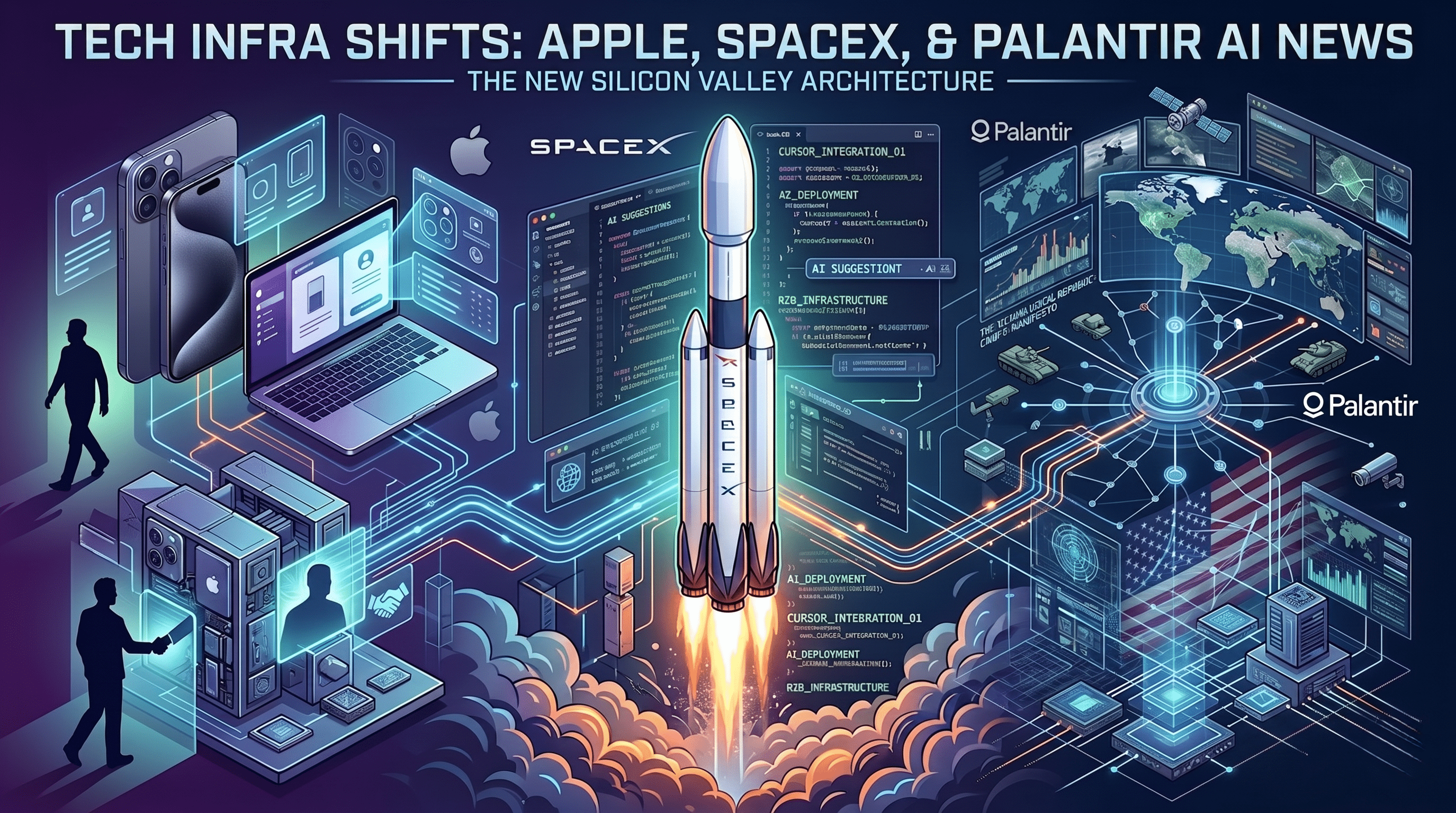
The Silicon Valley Shakeup: Apple’s Hardware Future, SpaceX’s Enterprise AI Play, and the Defense Tech Divide
The technology sector is currently experiencing a period of profound architectural and ideological realignment. From seismic shifts in legacy leadership to multi-billion-dollar plays in artificial intelligence infrastructure, the landscape for developers and venture capitalists is transforming rapidly. This week, three major developments dominated the strategic conversation: Apple’s impending CEO transition, a staggering proposed acquisition in the AI coding space by SpaceX, and a controversial ideological line drawn in the sand by defense-tech giant Palantir.
Coupled with an increasingly volatile macroeconomic and political environment, these moves highlight a broader industry trend: the relentless prioritization of robust technical infrastructure and enterprise utility over consumer-facing novelty.
Apple Post-Cook: A Hardware-Centric Approach to the AI Era
The era of Tim Cook is officially drawing to a close. With Cook stepping down to transition into an executive chairman role focused on global diplomacy, Apple has announced that long-time hardware engineering executive John Ternus will take the helm as CEO on September 1.
Cook’s legacy is undeniable. He transformed Apple into a multi-trillion-dollar behemoth, not necessarily through rapid-fire innovation, but through unparalleled mastery of operational infrastructure, supply chain logistics, and the creation of a high-margin services ecosystem (App Store, iCloud, Apple Pay).
However, Ternus inherits the company at a critical juncture: the generative AI race. Apple has notably abstained from incinerating hundreds of billions of dollars on proprietary foundation models. Instead, Ternus’s appointment signals a doubling down on what Apple does best: consumer hardware and ecosystem retention.
Key Takeaways for the Tech Ecosystem:
- The Vessel Strategy: Rather than building a foundational search engine or an underlying Large Language Model (LLM) from scratch, Apple is positioning the iPhone and Mac as the ultimate deployment vessels. By integrating Google Gemini and forging partnerships with entities like OpenAI, Apple retains its ecosystem dominance without bearing the massive compute costs of model training.
- Hardware Defense: As competitors rush to develop standalone "AI hardware" (such as AI pins or pendants), Apple is betting that the smartphone will remain the primary computing paradigm for the foreseeable future. If voice-agent hardware fails to displace screens, Apple’s defensive moat remains impenetrable.
The $60 Billion Question: Why SpaceX Wants Cursor
In what is perhaps the most staggering infrastructure play of the year, SpaceX has announced a potential $60 billion acquisition of Cursor, the hyper-popular AI-assisted coding platform. Should the deal fail to materialize ahead of SpaceX's rumored IPO, an unprecedented $10 billion fee will be paid for joint work completed.
On the surface, a rocket manufacturer purchasing a code editor seems disjointed. However, viewing this through the lens of enterprise technical infrastructure reveals a shrewd, albeit aggressive, strategy. SpaceX operates closely with xAI, which has historically focused heavily on consumer-facing grok models and generated media. Yet, the real, scalable revenue in artificial intelligence currently lies in enterprise code generation.
The Strategic Logic:
- Enterprise Code is King: While consumer AI captures headlines, enterprise coding models drive immense, recurring B2B value. Startups focused strictly on enterprise coding and infrastructural optimization are currently yielding the most tangible ROI in the venture capital space.
- Compute Synergy: Cursor gains access to xAI’s massive, highly optimized compute clusters, allowing them to compete aggressively with major frontier AI labs.
- IPO Positioning: SpaceX’s hesitation to finalize the deal immediately points to complex pre-IPO financial structuring. Consolidating the ultimate AI developer tool under the broader corporate umbrella could significantly bolster a public offering narrative centered on total technological vertical integration.
Palantir’s Manifesto and the Ideological Split in GovTech
As the technical infrastructure of the internet evolves, so too does its relationship with the state. This week, Palantir amplified its stance by publishing a 22-point summary of CEO Alex Karp’s book, The Technological Republic, unprompted on social media.
The manifesto outlines a stark vision where the engineering elite of Silicon Valley have an "affirmative obligation" to participate in national defense. It dismisses the pervasive neutrality often championed by tech companies, positioning Palantir as an unapologetic, extended arm of US government infrastructure.
Industry Implications:
- The Government Contract Moat: Palantir’s uncompromising stance is highly lucrative. As companies like Anthropic push back against certain military applications of their models, Palantir is aggressively securing its position as the vendor of choice for defense and intelligence agencies.
- Global Sales Friction: Internally, this ideology is not without cost. Employees have raised practical concerns that such aggressively nationalist positioning complicates the deployment and sale of Palantir’s enterprise software to international markets. It presents a fascinating case study in balancing domestic government revenue against global commercial scalability.
Macro Volatility and the Economics of Synthetic Media
Beyond the boardrooms of Apple and SpaceX, the broader socio-political environment is creating bizarre new micro-economies, heavily influenced by generative engine optimization and synthetic data.
A fascinating case study emerged this week highlighting the commercialization of polarized content. An international medical student successfully generated an entirely synthetic "MAGA-influencer" named Emily Hart. Recognizing that generic AI imagery failed to gain traction, the creator utilized advanced image generation tools—leveraging Google's state-of-the-art Gemini 3 Flash Image architecture (an evolution of the Nano Banana 2 models)—to tailor the synthetic avatar toward highly specific, politically polarized aesthetics.
The result was immediate: a massive influx of engagement, followers, and subsequent monetization via subscription platforms. Interestingly, attempts to replicate this success with a left-leaning synthetic counterpart failed completely.
This underscores a critical reality for developers and content strategists: in the current algorithm-driven web, neutral content starves. Engagement infrastructure heavily rewards hyper-specific, polarized targeting, a mechanic that bad actors and opportunistic creators will increasingly exploit as synthetic media generation becomes cheaper and more accessible.
Looking Ahead
As we move toward the midterms and upcoming tech IPOs, the division between consumer novelty and hardcore technical infrastructure is widening. The companies poised to win are those securing the base layers—whether that is Apple controlling the mobile vessel, Cursor streamlining the developer experience, or Palantir locking down federal data contracts. For the development and venture capital communities, the directive is clear: look past the consumer hype and focus on the architecture running beneath it.




Comments
No comments yet. Be the first to share your thoughts!
Leave a Comment