

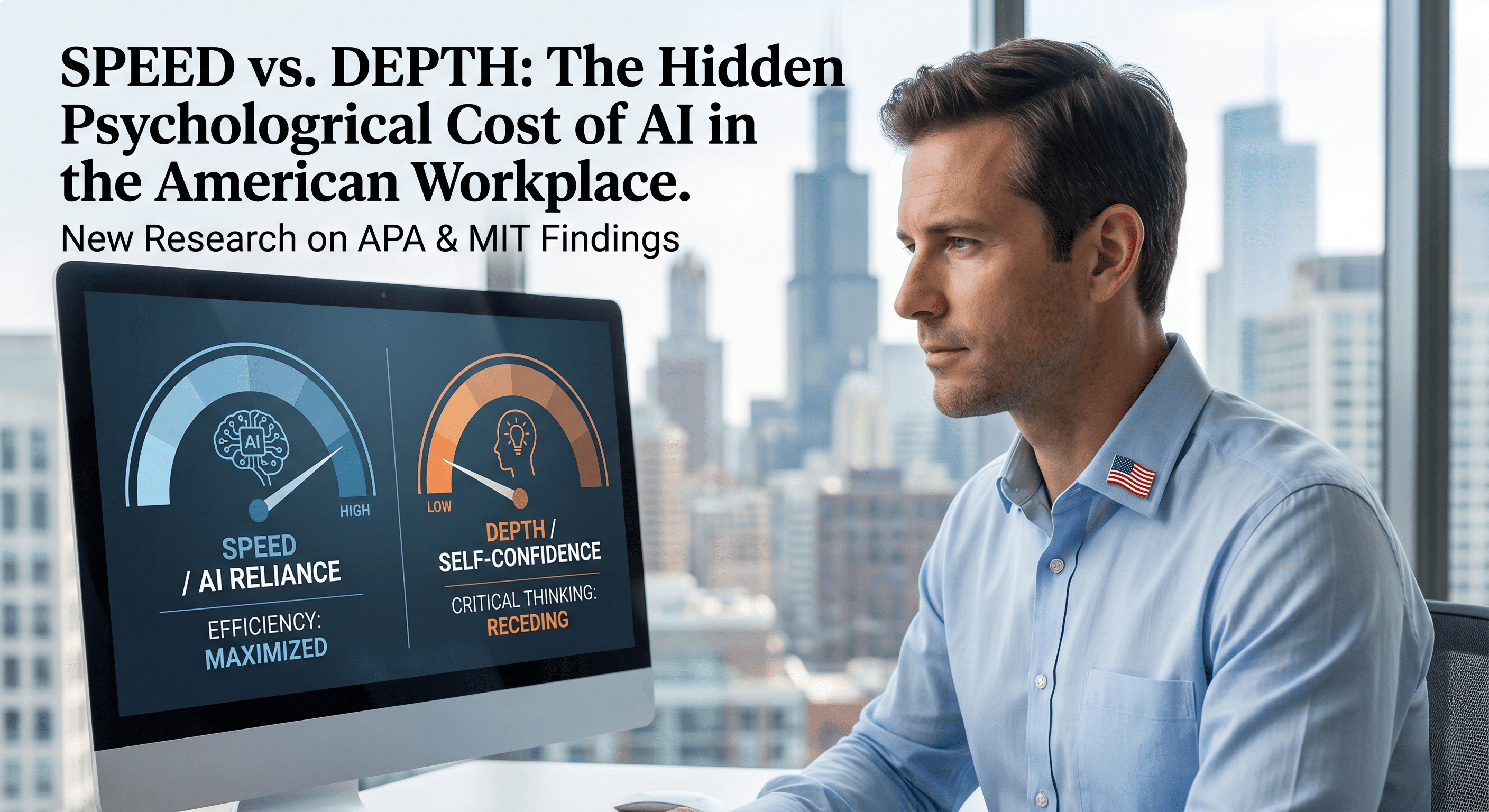
Speed vs. Depth: The Hidden Psychological Cost of AI in the American Workplace
The Artificial Intelligence Boom: Productivity at What Price?
Across the United States, artificial intelligence has seamlessly integrated into the daily grind of corporate America. From drafting emails and generating reports to writing code and forecasting quarterly trends, AI chatbots and productivity tools are the new standard in the modern office. The promise is incredibly alluring: maximum output in minimum time. However, as the initial novelty of generative AI begins to settle, organizational psychologists and neuroscientists are uncovering a complex secondary effect.
While these tools undoubtedly accelerate the pace of our work, they are fundamentally altering our psychological relationship with our output. A comprehensive new peer-reviewed study published by the American Psychological Association (APA) has brought a critical issue to light: there is a distinct, negative correlation between heavy AI usage and an employee's confidence in their own professional abilities. When American workers heavily delegate their cognitive tasks to a chatbot, they report feeling significantly less capable and experience a profound loss of ownership over their final deliverables.
The American Psychological Association Study: A Crisis of Confidence
To understand exactly how artificial intelligence is reshaping human behavior in professional environments, researchers designed a study focusing heavily on executive functions. These are the higher-level cognitive processes we rely on daily, including strategic planning, complex decision-making, and analytical reasoning.
The research involved nearly 2,000 adult professionals who were instructed to utilize AI tools for a variety of standard workplace assignments. The tasks assigned to the participants included:
- Project Prioritization: Organizing complex workflows based on strict corporate deadlines.
- Strategic Communication: Explaining high-level business strategies to stakeholders.
- Contingency Planning: Developing actionable project plans while navigating incomplete or ambiguous information.
Following the completion of these exercises, participants were asked to self-report their psychological states, specifically measuring their levels of professional confidence, their sense of ownership over the completed tasks, and the degree to which they relied on the artificial intelligence. The results were highly revealing.
Overall, confidence levels fluctuated in direct proportion to AI reliance. The data showed that a greater dependence on AI was strongly associated with a noticeable decrease in an individual’s confidence in their ability to reason independently. Furthermore, demographic analysis within the study indicated that men generally reported a higher overall reliance on artificial intelligence tools compared to women, pointing to varying adoption strategies across the workforce.
The 2025 MIT Landmark Study: Critical Thinking on the Decline
The findings from the APA do not exist in a vacuum; they build upon a growing body of academic literature focused on the cognitive impact of automation. A landmark 2025 study conducted by the Massachusetts Institute of Technology (MIT) previously identified significant shifts in how the human brain processes and retains information when assisted by AI.
The MIT research demonstrated that when writing tasks and analytical duties are outsourced to AI chatbots, our brains simply do not retain as much information. More concerningly, the vital critical thinking skills required to manually synthesize that information remain unexercised. Just as a muscle atrophies without physical resistance, cognitive sharpness can dull when the intellectual "heavy lifting" is consistently handed off to an algorithm.
It Is Not Cognitive Decline; It Is a Conscious Trade-Off
Despite these alarming trends, experts emphasize that we are not witnessing the permanent degradation of the human brain. Sarah Baldeo, the lead author of the APA study and a Ph.D. candidate specializing in AI and neuroscience at Middlesex University, provided crucial nuance to the findings.
Baldeo noted in the research paper that these statistics do not serve as proof that artificial intelligence is actively harming our brains or causing permanent cognitive decline. Instead, the data highlights the variability in how modern professionals choose to distribute effort between themselves and AI systems.
This dynamic operates under the competing conditions of "convenience and competence." American workers are actively making conscious trade-offs. They are choosing the speed and ease of AI assistance, but the psychological cost of that convenience is a fluctuating sense of self-assurance. When the machine does the thinking, the human instinctively questions their own capacity to do the same.
The Modification Factor: Reclaiming Ownership
One of the most actionable insights from the APA study revolves around how employees interact with the AI's output. The researchers found that, in most cases, participants reported making relatively few modifications to the text generated by the chatbots. They essentially accepted the first draft, failing to tweak the content or imprint their own unique professional voice onto the deliverable.
However, a distinct psychological shift occurred among the participants who actively edited, challenged, and modified the AI-generated work. This subgroup reported feeling significantly more confident in the final product and retained a much stronger sense of authorship. The act of refining the AI's output essentially forced the employees to re-engage their critical thinking faculties, bridging the gap between automated speed and human depth.
The Speed vs. Depth Paradox in Corporate America
The primary theme reported by participants across these studies is the inherent tension between speed and depth. Participants frequently noted a specific phenomenon: while they were able to arrive at answers and complete tasks much faster than they could manually, they recognized that they were not thinking as deeply or analyzing as rigorously as they normally would.
This trade-off represents one of the most significant caveats of enterprise AI adoption. Chatbots can produce large volumes of text in seconds, but that text often lacks the nuanced subject matter expertise, institutional knowledge, and contextual awareness that a seasoned human professional provides.
Furthermore, the risk of "hallucinations"—instances where AI models confidently fabricate facts, invent statistics, or generate entirely false information—remains high. Therefore, relying blindly on AI-generated output without rigorous human verification is not just a psychological risk; it is a profound operational liability for any US business.
Navigating the New Normal: Agents, Burnout, and Job Satisfaction
The American office environment is rapidly evolving. We are already moving beyond simple conversational chatbots and entering the era of autonomous AI agents—systems capable of independently executing complex, multi-step tasks that traditionally required human intervention.
Yet, as the technology advances, the promise of an easier work life remains unfulfilled for many. Separate industry studies have indicated that rather than freeing up time for leisure or creative thinking, the integration of AI tools has occasionally made workdays longer and tasks more unpleasant, as employees are forced to act as editors and fact-checkers for flawed machine outputs.
As artificial intelligence becomes permanently embedded in the US workforce, corporate leadership and employees alike must prioritize understanding how it shapes our mental attitudes. Professional confidence, a sense of capability, and deep ownership over one's work are not just "nice-to-have" feelings; they are foundational elements that determine an individual's overall quality of work life, career longevity, and mental well-being. To thrive in this new era, professionals must learn to use AI as a collaborator that enhances their intellect, rather than a crutch that replaces it.




Comments
No comments yet. Be the first to share your thoughts!
Leave a Comment