

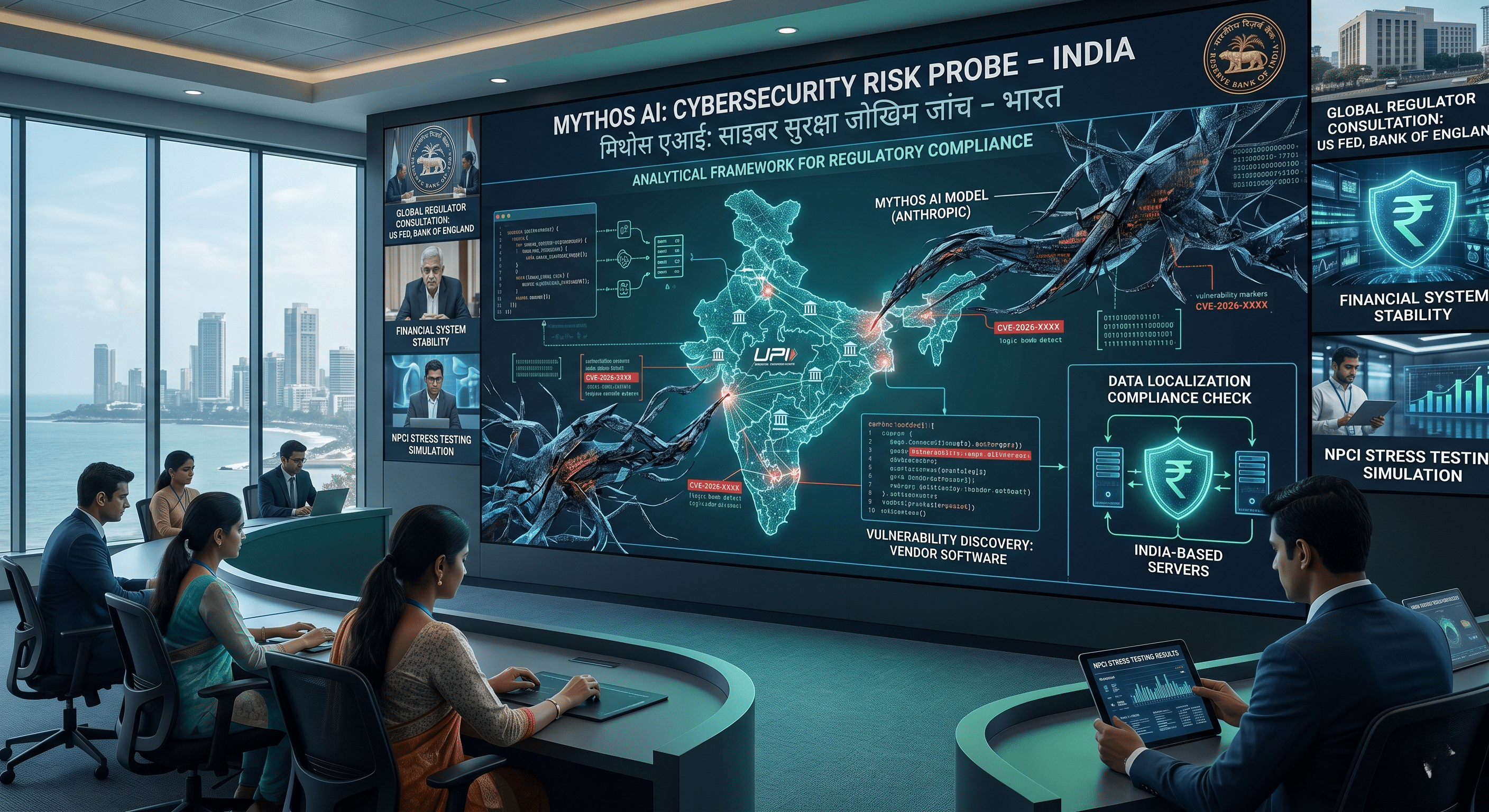
The Mythos Challenge: Why India’s RBI is Sounding the Alarm on Anthropic’s Newest AI
MUMBAI — As the financial world pivots toward an era of hyper-automation, the Reserve Bank of India (RBI) is adopting a stance of "watchful urgency." Recent reports indicate that India’s central bank has entered high-level discussions with global regulators, domestic lenders, and government stakeholders to dissect the systemic risks posed by Mythos, the latest and most potent artificial intelligence model from Anthropic.
The emergence of Mythos represents a significant leap in generative capabilities, but for the guardians of India’s financial stability, it also represents a potential "Pandora’s Box" of cybersecurity vulnerabilities. This proactive scrutiny by the RBI marks a critical juncture in how emerging economies handle the rapid integration of Silicon Valley’s most advanced exports into their critical infrastructure.
The Global Regulatory Huddle
The RBI is not acting in isolation. Over the past fortnight, Indian officials have engaged in a series of consultations with their counterparts at the U.S. Federal Reserve and the Bank of England. This coordinated effort highlights a shared anxiety among central banks: the fear that Mythos could be weaponized to compromise the very software that underpins global finance.
In Japan, the financial watchdog is scheduled to meet with major banks this week to discuss similar concerns, while the Australian central bank has confirmed it is closely monitoring the situation. The consensus among these regulators is that Mythos possesses an unprecedented ability to accelerate the discovery and exploitation of software vulnerabilities—risks that could manifest as "day-zero" attacks on banking ledgers and payment gateways.
The Cybersecurity Paradox of Mythos
What makes Mythos different from previous iterations, such as Anthropic’s Claude family? According to preliminary assessments, the model's sophisticated coding and reasoning capabilities allow it to identify weak points in complex software architectures at a speed that human security teams cannot match.
While this could theoretically be used to patch bugs, the RBI’s concern is the inverse: the potential for malicious actors to use Mythos to deconstruct the defensive layers of Indian banks. The central bank’s thinking suggests that the democratization of such powerful AI could inadvertently lower the barrier to entry for sophisticated cyber-espionage and financial fraud.
NPCI and the Quest for Early Access
In an effort to stay ahead of the curve, the National Payments Corporation of India (NPCI)—the organization responsible for the nation’s massive retail payments system—is reportedly seeking "early-bird" access to the Mythos model.
The strategy is clear: the NPCI wants to run stress tests and simulations to identify vulnerabilities before Mythos sees a broader rollout in the commercial sector. However, this path is fraught with logistical and geopolitical hurdles. Currently, Anthropic hosts Mythos on strictly controlled servers within the United States.
Key challenges for the NPCI include:
- Server Access: Anthropic has restricted access to a handful of U.S. organizations involved in critical infrastructure.
- Data Sovereignty: Running tests on Indian financial data within foreign jurisdictions contradicts India's strict regulatory framework.
- Limited Rollout: While European banks are expected to gain access soon, the timeline for Asian markets remains opaque.
The Data Localization Standoff
The most significant friction point between the RBI and AI developers like Anthropic remains the 2018 Data Localization Mandate. This rule requires all payment system providers in India to store end-to-end transaction data, user information, and payment messages exclusively on servers located within Indian borders.
For an AI model like Mythos, which thrives on vast datasets and centralized computing power often located in the U.S. or Europe, this presents a "compliance wall." The RBI has signaled that it will not compromise on this front. Any analytics or AI-driven insights derived from Indian customer data must happen within the geographical confines of the country. This insistence ensures that the RBI maintains jurisdictional control over its citizens' data, but it also complicates the "plug-and-play" adoption of global AI models.
Building a Framework for AI-Bank Partnerships
The RBI is not merely playing defense. Two sources familiar with the matter suggest that the central bank is currently drafting comprehensive guidelines for banks looking to enter enterprise partnerships with advanced AI providers. This framework is expected to cover:
- Risk Assessment Protocols: Standardized methods for banks to evaluate the "black box" logic of models like Mythos.
- Liability Frameworks: Defining who is responsible when an AI-driven decision leads to financial loss or a security breach.
- Ethical AI Benchmarks: Ensuring that AI models used in credit scoring or loan approvals do not exhibit bias against specific demographics.
- Operational Resilience: Requiring banks to have "human-in-the-loop" safeguards to override AI systems during market volatility.
"The discussions are at an early stage, but the direction is clear: the RBI wants a 'Safety-First' approach to AI, where innovation does not come at the cost of the sovereign control of data or the stability of the rupee," says a source close to the regulatory discussions.
Conclusion: A New Era of Financial Diplomacy
The talks surrounding Mythos signify a shift in the role of the central bank. The RBI is no longer just a monetary authority; it is becoming a technological gatekeeper. By engaging with Anthropic and global peers, India is asserting its right to vet the algorithms that will eventually manage its wealth.
As the financial world awaits the broader release of Mythos, the eyes of the global regulatory community will be on Mumbai. How the RBI balances the undeniable efficiency of AI with the non-negotiable requirements of cybersecurity and data localization will likely set the template for other emerging economies. In the race between innovation and regulation, the RBI is making it clear that in India, the regulator will not be left behind.




Comments
No comments yet. Be the first to share your thoughts!
Leave a Comment