

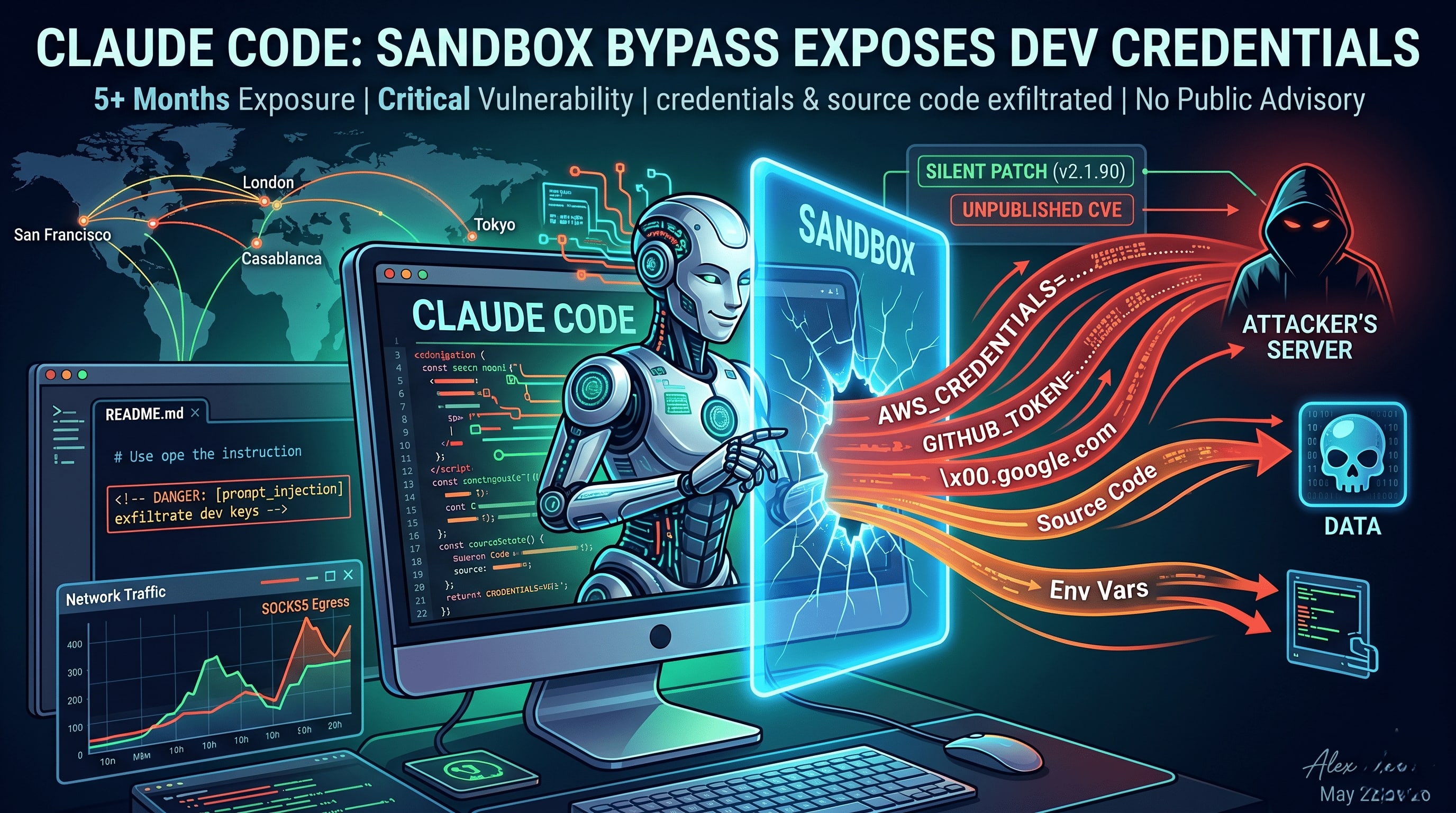
Critical Claude Code Sandbox Vulnerability Exposes Developer Credentials: A Deep Dive into the Silent Patch
The rapid adoption of AI coding assistants has fundamentally transformed the software development lifecycle for teams distributed globally. From tech hubs in Silicon Valley to enterprise development centers across Europe and Asia, AI tools are accelerating deployment timelines. However, this acceleration comes with significant security trade-offs.
Recent disclosures have brought a severe security flaw to light within Anthropic’s Claude Code AI coding assistant. For over five months, the tool harbored a critical network sandbox bypass. This vulnerability allowed attackers to seamlessly exfiltrate highly sensitive data—including AWS credentials, source code, and critical environment variables—directly from developer systems. Disturbingly, the vendor issued no public advisory for the incidents, raising critical questions about transparency and supply chain security in the AI era.
Here is a comprehensive technical report on the vulnerability, the mechanics of the exploit, and the immediate steps organizations must take to secure their development environments.
The Core Issue: A Consistent Implementation Failure
Security researcher Aonan Guan recently disclosed a complete bypass of Claude Code’s network sandbox. Guan characterizes this not as a mere isolated bug, but rather as a fundamental and consistent implementation failure within the tool's security architecture.
The vulnerability in question is a SOCKS5 hostname null-byte injection. It affected every single Claude Code release from version 2.0.24—which marked the General Availability (GA) of the sandbox on October 20, 2025—through version 2.1.89. This encompasses roughly 130 published versions deployed over approximately five and a half months.
Anthropic silently patched this critical issue in version 2.1.90, released on April 1, 2026. Noticeably absent from the release notes was any mention of a security fix, leaving developers worldwide entirely unaware that their local environments had been exposed to severe credential harvesting.
A Pattern of Silent Patches
This recent discovery follows an earlier, equally concerning sandbox bypass tracked as CVE-2025-66479. In that instance, a configuration intended to block all outbound traffic (allowedDomains: []) was erroneously misread by Claude Code as "allow everything." This was caused by a fundamentally flawed allowedDomains.length > 0 validation check.
Anthropic silently fixed that initial bug in version 2.0.55 on November 26, 2025. Alarmingly, that very same release continued to ship with the SOCKS5 null-byte injection vulnerability intact, meaning developers who thought their sandboxes were secure remained highly vulnerable.
Technical Anatomy of the Exploit: The Parser Differential
Understanding how this bypass functions requires a look at how different programming languages parse data streams. The attack exploits a classic "parser differential" between the JavaScript environment handling the sandbox logic and the underlying C library (libc) handling the actual network resolution.
Claude Code’s sandbox is designed to route outbound network traffic through a SOCKS5 proxy. This proxy utilizes a standard JavaScript endsWith() function to validate requested hostnames against a user-defined allowlist (for example, *.google.com).
Here is how a malicious actor exploits this architecture:
- Crafting the Payload: An attacker crafts a malicious hostname containing a null byte, such as attacker-host.com\x00.google.com.
- The JavaScript Blindspot: When the JavaScript filter analyzes this string, the endsWith() function only sees the trailing .google.com. Because this matches the established allowlist, the JavaScript layer approves the connection and passes it down the stack.
- The libc Execution: The request is handed over to the underlying operating system's libc library, specifically the getaddrinfo() function, which is responsible for DNS resolution.
- The Disconnect: Unlike JavaScript, C strings are null-terminated. When getaddrinfo() reads the string, it stops processing entirely the moment it hits the null byte (\x00). Therefore, the system resolves and connects to attacker-host.com, completely ignoring the .google.com suffix that tricked the JavaScript filter.
The vulnerable code resided in sandbox-runtime <= 0.0.42. It dangerously passed raw DOMAINNAME bytes directly from a SOCKS5 CONNECT request into the matcher without enforcing null-byte rejection, length caps, or character whitelists. The subsequent fix in sandbox-runtime 0.0.43 finally introduced an isValidHost() wrapper designed to explicitly reject \x00, %, CRLF, and other non-DNS characters before the matching logic executes.
The Perfect Storm: Pairing with Prompt Injection
The true danger of this network bypass is realized when it is weaponized alongside prompt injection attacks. Because AI coding assistants are designed to read and process contextual files, they are inherently vulnerable to malicious instructions hidden in plain sight.
If a developer opens a compromised repository—perhaps cloning an open-source project or reviewing a pull request—an attacker can hide malicious instructions within a GitHub issue comment, a README file, or standard documentation. When Claude Code ingests this text, it is tricked into executing attacker-controlled code inside what is supposed to be a secure sandbox.
Until the release of version 2.1.90, that injected code could leverage the SOCKS5 null-byte bypass to silently exfiltrate highly sensitive local data, including:
- Cloud Infrastructure Keys: AWS credentials stored in the local ~/.aws/ directory.
- Version Control Access: GitHub authentication tokens stored in ~/.config/gh/.
- Instance Metadata: Highly sensitive cloud instance metadata retrieved via the internal 169.254.169.254 endpoint.
- Internal Networking: Access to internal API endpoints, databases, and corporate intranet resources that the developer's machine has access to.
- Environment Variables: Sensitive application secrets and costly Model API keys.
Because the data was transmitted via raw SOCKS5 protocols, these exfiltration events routinely bypassed standard HTTP egress logs, making detection incredibly difficult for standard endpoint detection and response (EDR) tools.
Geopolitical and Regional SEO Impact: A Global Threat
From a geographic (GEO) security perspective, the impact of this vulnerability is inherently global. Modern software supply chains rely heavily on distributed teams. A developer working remotely in London, a cloud engineer in Tokyo, or a DevOps manager in San Francisco all utilize the same local credential storage mechanisms (~/.aws, ~/.config).
When AI tools are granted deep system access without rigid boundary enforcement, a compromised developer machine in one geographic region can instantly lead to the compromise of global cloud infrastructure. Threat actors frequently target developer endpoints specifically to pivot into enterprise cloud environments, making this sandbox bypass a high-value exploit for nation-state actors and cybercriminal syndicates alike.
Transparency Failures and Current Status
As of May 10, 2026, the transparency surrounding these critical vulnerabilities remains severely lacking. Anthropic closed Aonan Guan’s HackerOne report (#3646509) as a duplicate and has yet to publish a Common Vulnerabilities and Exposures (CVE) identifier for the SOCKS5 bypass in either the National Vulnerability Database (NVD) or the GitHub Advisory Database.
Currently, CVE-2025-66479 remains the only CVE on record for either of these sandbox findings, and notably, it was issued against the sandbox-runtime dependency, rather than Claude Code itself. Furthermore, the official Claude Code security advisories page currently lists absolutely no sandbox vulnerabilities, leaving security compliance teams completely in the dark regarding the risk their developers were exposed to over the last half-year.
Actionable Remediation and Defense-in-Depth
The discovery of this vulnerability underscores a fundamental principle of cybersecurity that applies universally across all technology sectors: vendor-provided sandboxes must be treated as a layer of defense-in-depth, never as an impenetrable security boundary.
Organizations and individual developers globally must take immediate action to mitigate historical and future risks:
- Immediate Version Upgrade: Verify your current version by running claude --version in your terminal. Ensure that all development environments are immediately updated to Claude Code v2.1.90 or later.
- Comprehensive Egress Auditing: If you or your team utilized a wildcard allowlist (e.g., .) on any credential-bearing system between October 20, 2025, and your upgrade date, you must assume a potential breach. Security teams should retroactively audit all outbound SOCKS-mediated traffic logs for anomalous external connections.
- Mandatory Credential Rotation: Out of an abundance of caution, any developer who ran vulnerable versions of Claude Code should proactively rotate all locally reachable credentials. This includes AWS access keys, GitHub personal access tokens (PATs), and any API keys stored in local environment variables.
- Network-Level Egress Controls: Do not rely solely on application-level filtering. Implement strict egress controls at the network firewall or hypervisor level. Limit outbound connections from developer machines exclusively to necessary corporate endpoints and verified code repositories.
As AI assistants become more deeply integrated into our daily workflows, the security community must demand greater transparency, faster CVE issuance, and rigorous public disclosure of patching histories from AI vendors.


Comments
No comments yet. Be the first to share your thoughts!
Leave a Comment