

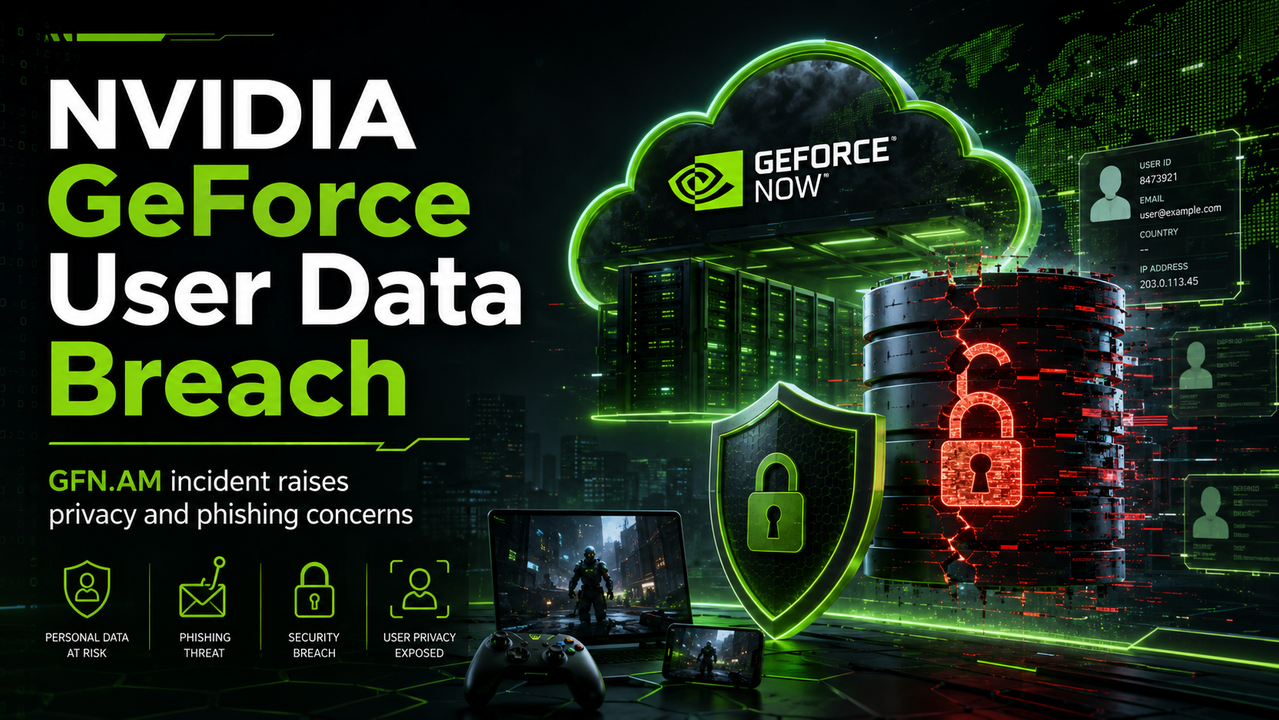
NVIDIA GeForce NOW Provider Reports User Data Exposure After Backend Database Breach
A data breach involving GFN.AM, an authorized NVIDIA GeForce NOW cloud gaming service provider operating under “GFN CLOUD INTERNET SERVICES” LLC, has reportedly exposed personal information belonging to registered users. The incident highlights the growing cybersecurity risks facing cloud gaming platforms, third-party service providers, and users who rely on digital entertainment services connected to personal accounts.
According to the company’s disclosure dated May 5, 2026, unauthorized access to its backend database may have occurred as early as March 9, 2026. The breach was reportedly discovered on May 2, 2026, meaning threat actors may have had access to user records for approximately 54 days before the incident was detected.
GFN.AM confirmed that the unauthorized party accessed its backend database, where sensitive user information could have been viewed or exfiltrated. While the breach does not appear to involve passwords, the exposed data still creates serious privacy and security risks for affected users.
The incident affects only users who registered on or before March 9, 2026. Accounts created after that date were not impacted, according to the company’s statement.
What Personal Information Was Exposed?
Based on the official disclosure, several categories of personal information may have been compromised. The affected data reportedly includes email addresses, phone numbers for users who registered through a mobile operator, dates of birth, GFN.AM platform usernames, and full names for users who authenticated through Google Sign-In.
This type of information may seem less dangerous than leaked passwords or payment card details, but it can still be highly valuable to cybercriminals. Email addresses, phone numbers, names, and dates of birth are often used in phishing attacks, identity profiling, account recovery abuse, and social engineering campaigns.
The company emphasized that account passwords were not compromised. This reduces the immediate risk of direct account takeover on the GFN.AM platform. However, users should not treat the incident as harmless. Attackers do not always need passwords to cause damage. Personal data can be used to craft convincing scams that pressure victims into revealing login credentials, verification codes, or financial information.
For users who registered through Google Sign-In, the exposure of full names may increase the risk of targeted phishing. A scam message that includes a real name, gaming platform username, or reference to GeForce NOW can appear more trustworthy than a generic phishing attempt.
Why This Breach Matters for Cloud Gaming Users
Cloud gaming services have become increasingly popular because they allow users to stream high-performance games without owning expensive hardware. Platforms such as NVIDIA GeForce NOW depend on a network of service providers, regional operators, authentication systems, and account management tools. This ecosystem creates convenience, but it also expands the number of systems that must be secured.
The GFN.AM breach is a reminder that a security incident does not always occur directly inside a major technology company. Authorized providers and regional platforms may also hold sensitive user information. When those systems are compromised, users can still face privacy risks, even if the core service provider’s infrastructure is not directly breached.
For consumers, this distinction can be confusing. Many users may associate the service with NVIDIA GeForce NOW, even though the breach reportedly occurred at GFN.AM, a separate authorized provider. From a user’s perspective, however, the impact is practical: personal data linked to a gaming account may now be in the hands of unauthorized third parties.
Possible Risks for Affected Users
Although no passwords were reportedly exposed, users should be alert to several possible risks.
The first major risk is phishing. Attackers may send emails pretending to be from GFN.AM, NVIDIA, Google, or a related gaming service. These messages may ask users to “verify” their account, reset their password, confirm payment information, or click a fake security link.
The second risk is SMS-based fraud. Users whose phone numbers were exposed may receive suspicious text messages claiming there is a problem with their account. These messages may include malicious links or attempt to steal one-time passcodes.
The third risk is SIM swapping. If a phone number, name, and other personal details are exposed, criminals may try to convince a mobile operator to transfer a victim’s phone number to another SIM card. This can allow attackers to intercept SMS verification codes.
The fourth risk is social engineering. A scammer may contact users while referencing real details such as their name, username, or cloud gaming account. This can make the scam feel legitimate and increase the chance that users respond.
The fifth risk is credential stuffing. Even though GFN.AM passwords were reportedly not compromised, attackers may use exposed email addresses to test leaked passwords from other breaches. Users who reuse passwords across multiple platforms are especially vulnerable.
What GFN.AM Says It Has Done
GFN.AM stated that after detecting the breach, it took immediate steps to eliminate the root cause of the unauthorized access. The company also said it implemented additional organizational and technical controls to strengthen its information systems and reduce the likelihood of a similar incident.
However, the public notice did not provide detailed technical information about how the breach happened. It remains unclear whether the unauthorized access involved a compromised credential, an unpatched vulnerability, weak access controls, or a misconfigured database.
This lack of detail is not unusual in early breach disclosures, especially when investigations are ongoing. Still, users and security professionals often look for more specific information to understand the level of risk and whether the incident could have affected other connected systems.
GFN.AM has not publicly indicated whether all affected users will receive individual notifications. It has also not clearly stated whether data protection regulators have been informed. In many jurisdictions, companies are required to notify authorities and affected individuals when personal information is exposed, depending on the type of data and applicable privacy laws.
What Affected Users Should Do Now
Users who registered with GFN.AM on or before March 9, 2026, should take precautionary steps even if they have not received a personal notification.
First, users should monitor their email accounts for suspicious login attempts, password reset messages, or unexpected security alerts. Any message that asks for credentials or verification codes should be treated with caution.
Second, users should be careful with unsolicited SMS messages or phone calls mentioning GFN.AM, NVIDIA GeForce NOW, Google Sign-In, account verification, or payment problems. Scammers often use real breach information to make fraudulent messages more believable.
Third, users should enable multi-factor authentication on their email accounts, Google accounts, gaming accounts, and any other services linked to the same email address. Authentication apps or hardware security keys are generally safer than SMS-based codes.
Fourth, users who reused the same password across multiple services should change those passwords immediately. Even though GFN.AM says passwords were not compromised, exposed email addresses can still be used in credential-stuffing attacks.
Fifth, users should review Google account activity if they used Google Sign-In. They should check recent logins, connected apps, recovery phone numbers, and recovery email addresses.
Sixth, users should be cautious about sharing personal information with anyone claiming to represent customer support. Official support teams should not ask for passwords, full verification codes, or sensitive financial information through email or chat.
Finally, users who suspect additional personal information may have been exposed should consider contacting their mobile operator and relevant financial institutions. In higher-risk cases, placing fraud alerts or adding extra verification steps to mobile accounts may help reduce the risk of SIM swapping.
A Broader Lesson for Gaming and AI Infrastructure
The GFN.AM incident is part of a larger cybersecurity pattern affecting digital platforms that collect user identity data. Gaming services, AI platforms, streaming tools, and cloud providers increasingly rely on account-based ecosystems. These ecosystems often include usernames, email addresses, mobile numbers, OAuth login providers, and behavioral data.
Even when companies avoid storing passwords in plain text or prevent payment data exposure, personal identifiers remain attractive targets. Attackers can combine data from multiple breaches to build detailed profiles of victims. A single breach may not provide everything needed for identity theft, but it can become one piece of a much larger fraud operation.
For cloud gaming users, the lesson is clear: account security should not depend only on the platform provider. Users should practice strong password hygiene, enable multi-factor authentication, avoid password reuse, and remain skeptical of urgent messages that request action.
For companies, the incident reinforces the need for continuous monitoring, database access controls, least-privilege permissions, encryption, breach detection systems, and transparent communication with affected users. A 54-day detection window shows why proactive security monitoring is essential. The longer attackers remain undetected, the greater the potential damage.
Final Thoughts
The reported GFN.AM data breach did not expose user passwords, according to the company, but the compromised personal information still presents real security risks. Email addresses, phone numbers, birth dates, usernames, and full names can be weaponized in phishing campaigns, SIM-swapping attempts, and targeted social engineering.
Affected users should not panic, but they should act carefully and quickly. Monitoring accounts, enabling multi-factor authentication, reviewing Google activity, and staying alert for suspicious messages are practical steps that can reduce risk.
As cloud gaming continues to grow, incidents like this show why cybersecurity must be treated as a core part of the user experience. Trust is not built only on performance, graphics quality, or low-latency streaming. It also depends on how well service providers protect the personal information behind every account.


Comments
No comments yet. Be the first to share your thoughts!
Leave a Comment