

Zero Trust Architecture: Building Resilient Strategies Against 2026 Supply Chain Attacks
In 2026, supply chain attacks have surged, with IBM X-Force reporting a 44% year-over-year increase in exploitation of public-facing applications tied to third-party vulnerabilities. Kaspersky's global study names them the most common cyberthreat over the past year, affecting businesses worldwide. From Q4 2025's systemic failures in developer tools to AI-driven threats topping SecurityScorecard's 2026 Supply Chain Cybersecurity Trends Report, the risks are escalating.
Enter Zero Trust Architecture (ZTA): a "never trust, always verify" model that's no longer optional. This article dives into building ZTA strategies tailored for 2026 supply chain resilience, with SEO-optimized insights for global audiences. Whether you're in the US facing CISA mandates, EU under NIS2, or Asia's manufacturing hubs, learn actionable steps to minimize risks.
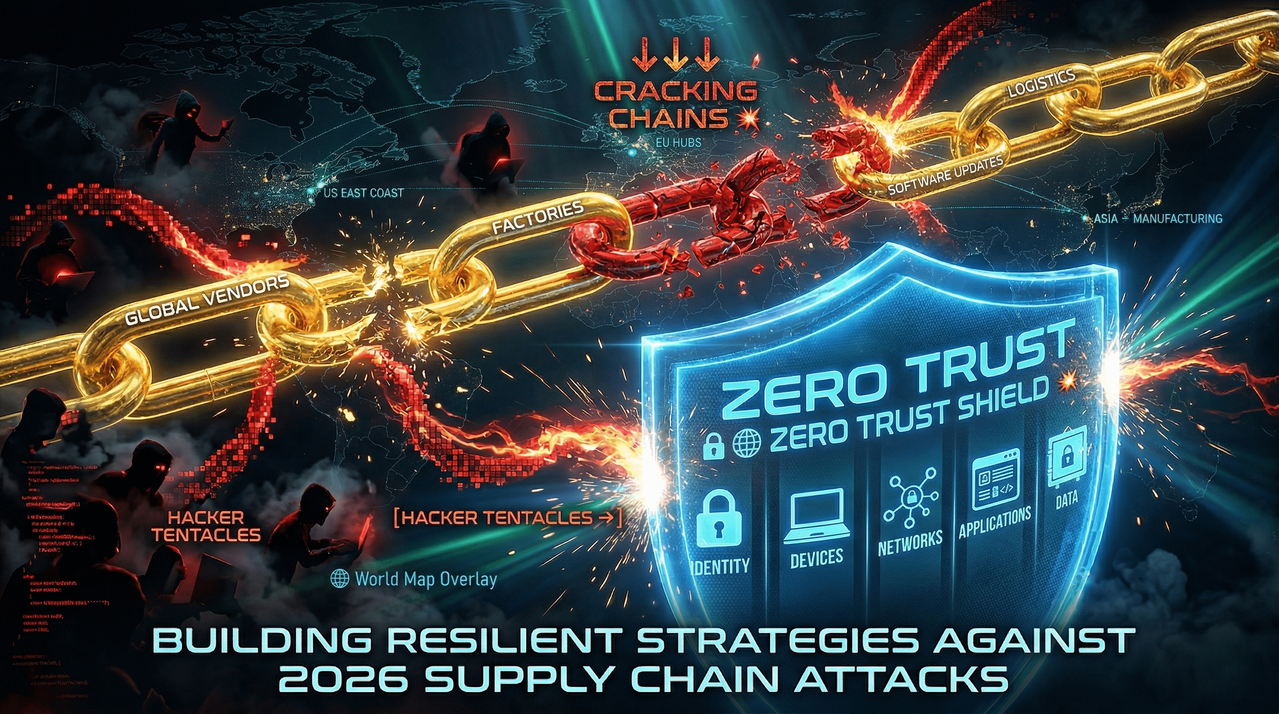
Image Alt: Infographic showing Zero Trust pillars blocking supply chain attack vectors like SolarWinds-style breaches.
What is Zero Trust Architecture?
Zero Trust flips traditional perimeter security on its head. Coined by Forrester in 2010, it's now a cornerstone of 2026 cybersecurity, as per Gartner's top trends. Core principles:
- Verify Explicitly: Authenticate and authorize every access request based on user, device, location, and context.
- Least Privilege: Grant minimal access, just-in-time and just-enough.
- Assume Breach: Design for constant monitoring and micro-segmentation.
NSA's 2026 Zero Trust Implementation Guideline Primer outlines pillars like identity, devices, networks, applications, and data—essential for supply chains where third-party code introduces blind spots.
Table 1: Zero Trust vs. Traditional Security
| Aspect Traditional Perimeter Zero Trust Architecture | ||
| Trust Model | Trust inside network | Never trust, always verify |
| Access Control | Network-based | Identity & context-based |
| Breach Assumption | Perimeter stops all | Assume breach everywhere |
| Supply Chain Fit | Vulnerable to insiders/third-parties | Micro-segments vendors |
Supply Chain Attacks in 2026: The Growing Threat
Supply chains are the weak link: 90% of leaders are confident in resilience, yet AI-driven threats rank #1, per SecurityScorecard. Predictions for 2026 include:
- Rise of AI-Orchestrated Attacks: Autonomous agents exploiting open-source libraries or SaaS vendors.
- Geopolitical Vectors: Hybrid warfare disrupting Asia-Pacific manufacturing.
- Stats: Group-IB warns of six key attack groups targeting MSPs and open-source in 2026.
Recent examples: 2025's developer tool compromises evolved into multi-stage extortion, up 63%.
Why Zero Trust is Essential for 2026 Supply Chains
ZTA reduces lateral movement post-breach, critical for supply chains. Exabeam notes it minimizes attack surfaces via segmentation. Benefits:
- Vendor Risk Mitigation: Continuous verification of third-party APIs and code.
- SBOM Integration: Use Software Bill of Materials with ZTA for real-time scanning.
- AI Agent Security: As Cisco's new ZTA for AI agents shows, runtime monitoring is key. (From X discussions)
X experts echo: "Implement supply chain zero trust: Scan builds, secure sources, plan upgrades."
Step-by-Step Guide to Implementing Zero Trust for Supply Chains
Follow NSA's phased guidelines and CISA's Maturity Model for a roadmap.
Phase 1: Assess & Plan (1-3 Months)
- Inventory assets: Map suppliers, SBOMs.
- Gap analysis: Use CISA's model (Traditional → Initial → Advanced → Optimal).
Phase 2: Identity & Access (3-6 Months)
- Deploy IAM + MFA for all vendors.
- Implement ZTNA (Zero Trust Network Access).
Phase 3: Micro-Segmentation & Monitoring (6-12 Months)
- Network segmentation; tools like Illumio.
- AI-driven anomaly detection.
Phase 4: Automate & Scale
- Integrate with CI/CD for code signing.
- Continuous testing via red-team exercises.
IBM's Workflow:
- Identify exposures.
- Eliminate implicit trust.
- Monitor continuously.
Pro Tip: Start small—pilot with high-risk suppliers.
Geo-Specific Zero Trust Strategies for Global Compliance
Tailor ZTA for local regs to boost geo-SEO (e.g., "Zero Trust supply chain US CISA").
United States: Align with CISA & NSA
CISA's Zero Trust Maturity Model mandates federal adoption by 2026; extend to private supply chains. Focus: Public-facing app protections amid 44% exploit rise.
European Union: NIS2 Directive Essentials
NIS2 (effective 2024, enforced 2026) requires zero-trust for critical sectors like energy/manufacturing. Use data pillars for compliance: Verify all supply chain data flows.
Asia-Pacific: Manufacturing & Geopolitics
India/China hubs face hybrid threats; integrate ZTA with local standards (e.g., Singapore's Cybersecurity Act). Prioritize vendor micro-segmentation for electronics supply chains.
Hreflang Tip: Use hreflang="en-us", en-gb for multi-region targeting.
Real-World Case Studies
- Post-2025 Recovery: A firm using ZTA blocked lateral movement after a vendor breach, per Practical DevSecOps.
- Manufacturing Win: EU plant under NIS2 segmented OT/IT, thwarting ransomware.
Common Challenges & Best Practices
- Challenge: Over-tooling (LinkedIn: 2026 failure reason #1).
- Fixes: Phased rollout, executive buy-in, training.
Best Practices:
- Automate SBOM verification.
- Quarterly supplier audits.
- Leverage open-source like DECAF for decentralized trust.
2026 Predictions & Future-Proofing
Gartner foresees quantum threats amplifying supply chains; pair ZTA with PQC. By 2027, 80% of enterprises will mandate ZTA for vendors.
Conclusion: Secure Your Supply Chain Today
Zero Trust isn't a product—it's a strategy for 2026's attack landscape. Implement now to cut breach costs by 50% (IBM est.).
CTA: Download our free ZTA Checklist. Subscribe for "Cybersecurity Trends 2026" updates. Share your ZTA journey in comments!
Related: Agentic AI Threats | PQC Migration Guide


Comments
No comments yet. Be the first to share your thoughts!
Leave a Comment