

Apple’s Siri Revamp Puts Privacy at the Center of AI
Apple is preparing for one of the most important Siri updates in the assistant’s history. After years of criticism that Siri has fallen behind more advanced artificial intelligence tools, the company is reportedly planning a major relaunch that could turn Siri into a more capable, privacy-focused AI assistant. The update is expected to be a central theme at Apple’s Worldwide Developers Conference in June, where the company will try to convince developers, consumers, and investors that it still has a strong role to play in the fast-moving AI market.
According to reporting from Bloomberg’s Mark Gurman, privacy will be one of Apple’s biggest messages when it introduces the new version of Siri. That strategy is not surprising. Apple has spent years building its brand around user privacy, especially in contrast to companies whose business models rely heavily on advertising, data collection, or cloud-based user profiling. But in the current AI race, privacy is no longer just a marketing point. It has become one of the biggest concerns surrounding chatbots, digital assistants, and generative AI platforms.
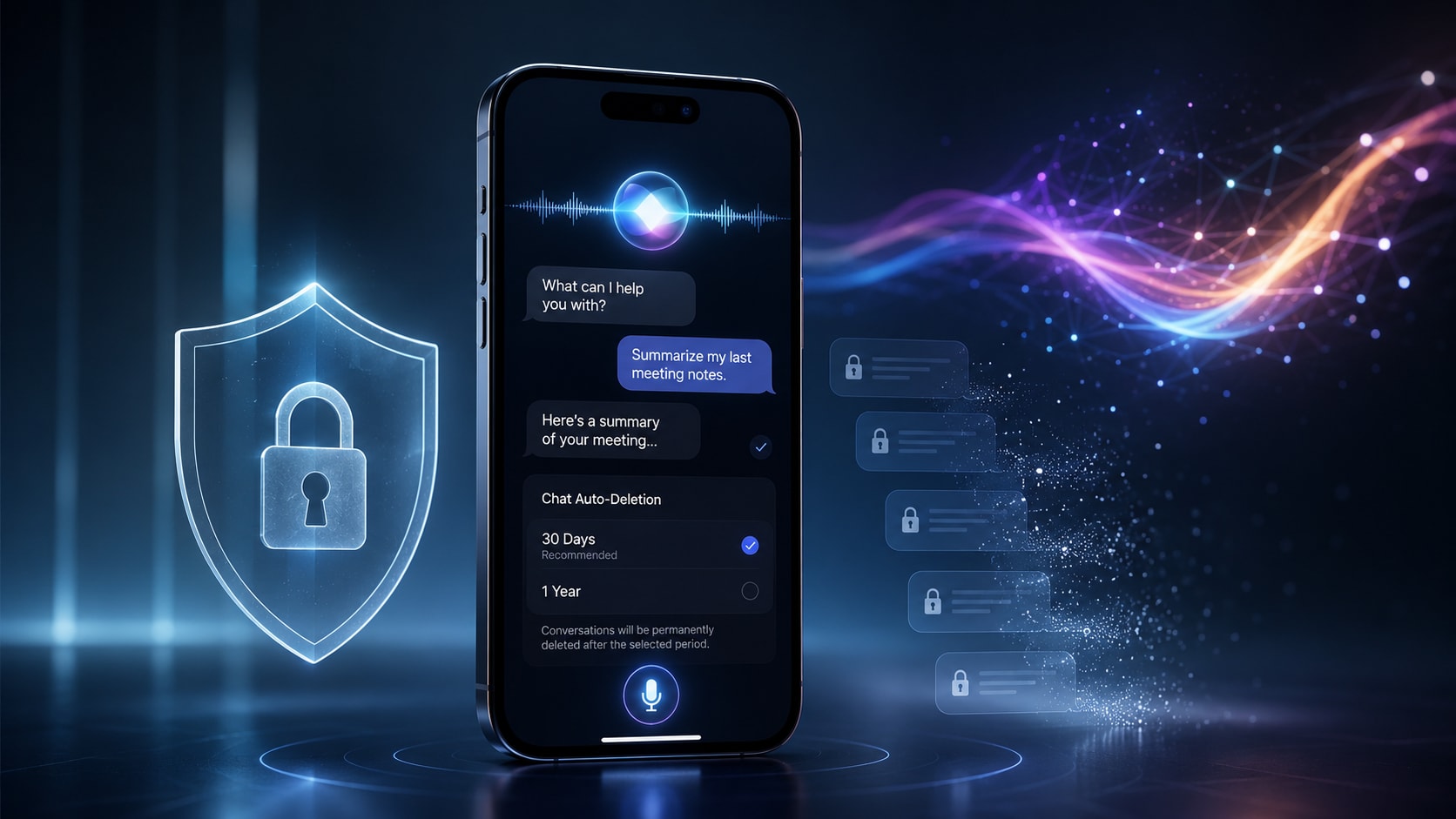
The reported Siri revamp could include a standalone Siri app, a chatbot-style experience, and a new approach to how conversations are stored. One of the most notable possible features is automatic chat deletion. Similar to Apple’s Messages app, users may be able to choose whether Siri conversations disappear after 30 days, after one year, or remain saved indefinitely. This would give users more direct control over their AI history at a time when many people are becoming more aware of how much personal information they share with digital assistants.
This feature could become a major differentiator for Apple. Many AI chatbots depend on long-term conversation history to improve personalization, maintain context, and provide better responses over time. That can be useful, but it also raises questions about data retention, user consent, security, and whether private conversations may be reviewed or used to improve models. By giving users clearer deletion options, Apple may try to position Siri as the AI assistant for people who want convenience without feeling like every interaction is permanently stored somewhere in the cloud.
The timing is critical. Apple has been under pressure to show that it can compete in artificial intelligence. While OpenAI, Google, Microsoft, Anthropic, and Meta have moved quickly with new AI models and chatbot products, Apple has taken a slower and more cautious approach. That caution may fit Apple’s brand, but it has also created the perception that Siri is outdated compared with tools like ChatGPT, Gemini, and Claude. A redesigned Siri is therefore more than a product update. It is a statement about Apple’s future in AI.
Reports suggest that the new Siri experience may be powered in part by Google Gemini. This would be a major development because it would mean Apple is relying on one of its biggest technology rivals to help power its AI assistant. For users, the result could be a Siri experience that feels more like a modern chatbot, capable of answering broader questions, understanding more complex requests, and possibly handling tasks across apps with more intelligence than before.
However, this partnership also creates a complicated privacy message. Apple can argue that it is building a more privacy-friendly AI experience, but if Google technology is involved, users may naturally ask how much of their data is processed by Apple, how much is handled by Google, and what safeguards exist between the two companies. Apple will need to explain this clearly. In the AI era, vague privacy promises are not enough. Users increasingly want to know where their information goes, who processes it, how long it is stored, and whether it is used for model training.
The possible auto-delete feature could help Apple answer some of those concerns. If users can decide how long Siri conversations remain available, Apple can present the assistant as more transparent and user-controlled than many competing platforms. This would fit Apple’s broader privacy philosophy, where the company often emphasizes on-device processing, limited data collection, and user choice. Even if some AI requests must be processed in the cloud, Apple may try to reduce the amount of retained personal information.
Still, privacy may not solve all of Siri’s problems. One important criticism raised in Gurman’s reporting is that Apple may use privacy as a way to explain why Siri remains less powerful than competing products. This is a real risk. A privacy-first assistant is valuable only if it is also useful. If Siri offers stronger privacy but weaker performance, users may still turn to ChatGPT, Gemini, Claude, or other AI tools for serious work, research, writing, coding, and planning.
Apple must therefore balance two goals. First, it needs to make Siri smarter, more flexible, and more reliable. Second, it needs to do that without weakening its long-standing privacy position. That balance is difficult because the most powerful AI systems often rely on large-scale cloud infrastructure, massive datasets, and continuous personalization. Apple’s challenge is to prove that a consumer AI assistant can be both useful and restrained in how it handles personal data.
For everyday users, the new Siri could change how AI fits into the Apple ecosystem. A standalone Siri app would make the assistant feel less like a background voice command tool and more like a direct competitor to chatbot apps. Instead of only asking Siri to set timers, send messages, or check the weather, users may be able to use it for brainstorming, summarizing, writing, scheduling, and answering more complex questions. If Apple connects this assistant deeply with iPhone, iPad, Mac, Apple Watch, and Apple services, Siri could become more practical than a general chatbot because it would understand the user’s device context.
That is where Apple has a potential advantage. The company controls the hardware, software, operating systems, and app ecosystem around hundreds of millions of users. If Siri becomes deeply integrated into iOS, macOS, and Apple apps, it could offer a smoother experience than third-party AI tools. A user might ask Siri to summarize a message thread, find a file, draft an email, organize reminders, or compare calendar availability without switching between apps. If Apple can do this securely and privately, Siri could regain relevance.
But execution will matter more than branding. Apple has promised Siri improvements before, and many users remain skeptical. Siri’s reputation has been damaged by years of limited understanding, inconsistent answers, and weaker conversational ability than modern AI assistants. A true relaunch must go beyond a refreshed interface or privacy settings. It must deliver meaningful improvements in accuracy, speed, context awareness, and task completion.
The reported use of Google Gemini could help Apple close the performance gap faster. Instead of building every AI capability from scratch, Apple may be using external model power while focusing on product design, privacy controls, and system integration. This approach could be practical, but it also means Apple will need to carefully manage how it presents the product. Users may not care which model powers Siri if the assistant works well. But privacy-conscious users will care about how their information is handled behind the scenes.
From an E-E-A-T perspective, this development matters because it sits at the intersection of consumer technology, privacy policy, AI infrastructure, and platform strategy. Apple is not simply updating a voice assistant. It is trying to define what a mainstream AI assistant should look like inside a privacy-focused ecosystem. The company’s choices could influence how other consumer technology firms design AI data retention controls, transparency settings, and chatbot memory features.
For the broader AI industry, Apple’s move may increase pressure on competitors to offer clearer data retention options. If Siri allows users to automatically delete conversations after 30 days or one year, other chatbot providers may face more questions about why their own data controls are not equally simple. Privacy features often become more powerful when they are easy to understand. A user should not need to read a long policy document to know whether their AI conversations are stored forever.
At the same time, Apple must avoid overpromising. If the new Siri depends on Google Gemini for certain features, Apple should be transparent about the division of responsibility. Consumers deserve clear explanations of when data stays on device, when it goes to Apple servers, when it may be processed by a partner, and what happens after the request is completed. In AI, trust is not built only through privacy slogans. It is built through clear design, consistent behavior, and honest communication.
The Siri relaunch could become one of Apple’s most important AI moments. If successful, it may reposition Siri as a serious assistant for the modern chatbot era. If disappointing, it could reinforce the belief that Apple is still behind in generative AI despite its strong hardware ecosystem and privacy reputation.
For now, the most interesting part of the reported update is not only that Siri may become smarter. It is that Apple appears ready to make data deletion, retention limits, and privacy controls part of the core AI experience. In a market where many users are excited about AI but worried about what happens to their information, that may be exactly the message Apple wants to deliver.

Comments
No comments yet. Be the first to share your thoughts!
Leave a Comment