

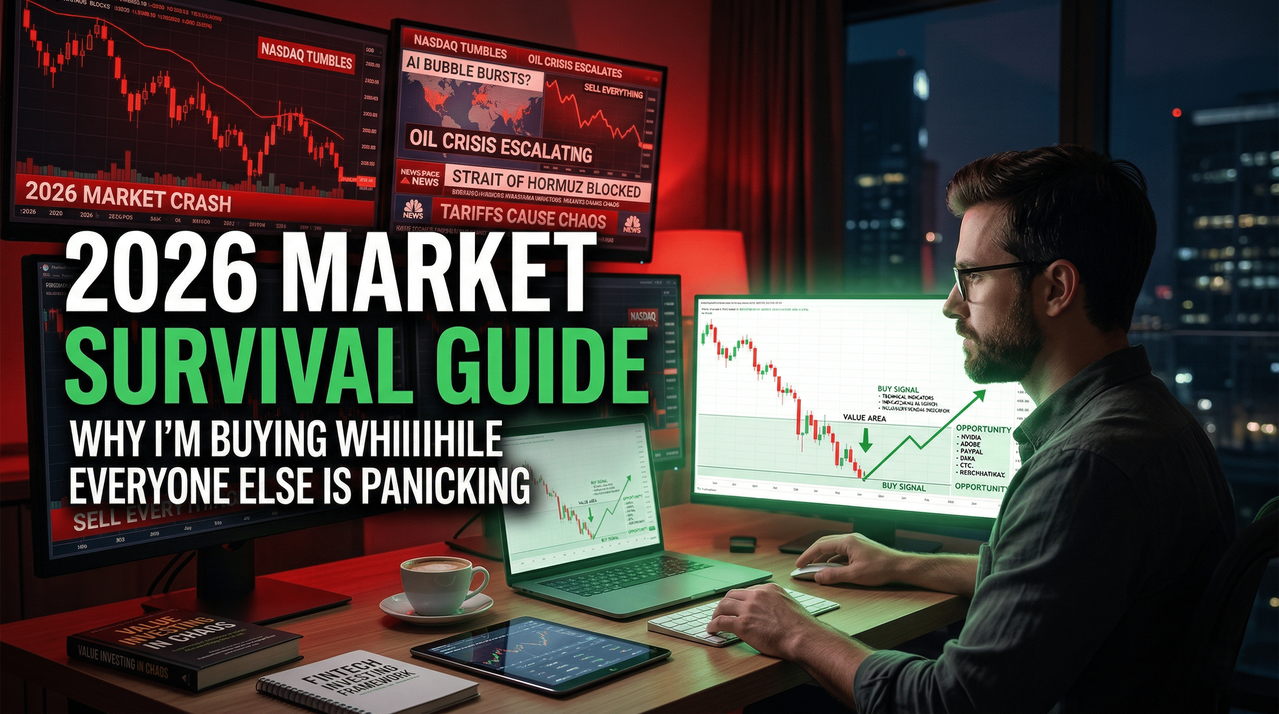
The 2026 Market Survival Guide: Why Volatility is Your Greatest Opportunity
If you’ve been watching the markets in 2026, you already know the feeling. It’s heavy. It’s the kind of weight that sits in your chest every time a new notification pops up on your phone. Every week seems to bring a headline that makes you wonder if you should just liquidate everything and hide under a rock.
From the escalating conflict in the Middle East to the sudden surge in oil prices, and the NASDAQ posting some of its most brutal days in a decade—I get it. Your portfolio is likely down. Mine is too. But here is the difference: I’m not checking mine. In this article, I want to move past the panic. I want to give you a framework—a way of thinking that completely shifts how you experience moments like this. We aren't going to pretend uncertainty isn't real; we are going to use it to our advantage.
The Anatomy of the 2026 "Gut Punch"
Fear is almost always fueled by the unknown. To stop being controlled by the market, we have to deconstruct what actually happened this year. Three specific "shocks" delivered a gut punch to investor confidence:
1. The Deepseek AI Shock (Late January)
As someone deeply embedded in the tech and AI space, this one was fascinating. For years, the "AI trade" was built on the assumption that world-class AI required billions of dollars in hardware—specifically from Nvidia. Then, a Chinese lab called Deepseek released a model that matched top-tier performance at a fraction of the cost.
The market panicked. Nvidia lost nearly 10% of its value in days, and the NASDAQ dropped over 3% in a single session. $500 billion in market cap vanished. People asked: Is the AI thesis dead?
2. The Tariff Ambiguity
Then came the "Tariff Rollercoaster." It wasn't just the 10% or 15% hikes; it was the permanent state of ambiguity. When businesses don't know what their supply chain will cost next week, they stop hiring and start raising prices. This psychological exhaustion is often worse for the market than a defined crisis.
3. The Energy Crisis & the Strait of Hormuz
Finally, the escalation in the Middle East put the Strait of Hormuz under threat. Since 20% of the world’s oil flows through this narrow passageway, prices skyrocketed. It wasn't just about the gas tank; it was about fertilizer, shipping, and everything we consume.
Lessons from History: What Graham Stephan Got Wrong
I recently watched a video by Graham Stephan discussing the history of the stock market. While he’s a great creator, I think it’s important to correct the record on a few points to truly understand market mechanics.
Graham mentioned that the 1929 Great Depression crash happened because people sold at the "slightest glimpse of a crack." That’s not quite right. It was actually forced selling.
In the 1920s, people borrowed massive amounts of money from banks to buy stocks. When prices dipped, banks made "margin calls." They told investors: "Your collateral has fallen; give us more money or we sell your shares for you." This created a massive tidal wave of selling that no one could stop.
The Professional’s Rule: When you are forced to sell, you are never going to get a good price.
The lesson? If you aren't investing on margin (borrowed money), you aren't forced to sell. And if you aren't forced to sell, you are in a position of power.
The Math of Opportunity: Valuation vs. Price
As a math enthusiast, I always look at the numbers. Price is what you pay; value is what you get.
Most people treat the stock market like a lottery ticket. When the price goes down, they feel they are losing. But think about it this way: if you bought a high-end laptop for $2,000 and saw it on sale for $1,200 a week later, you wouldn't run into the store and demand they take your laptop back for $1,200. You’d probably wish you’d waited so you could buy a second one!
Why I Get Excited When Futures are Red
I don’t lose sleep when the NASDAQ is down 700 points. I get excited. My investment strategy is built on Principal Driven Investing. Before I buy a company—whether it’s Adobe, PayPal, or a tech giant—I ask:
- Did the fundamental business change?
- Did they lose their customers?
- Is their revenue stream collapsing?
Almost always, the answer is no. The business is the same; only the mood of the market has changed. When the price of a great business drops, my "Margin of Safety" actually increases.
$$\text{Margin of Safety} = \text{Intrinsic Value} - \text{Market Price}$$
When the market price falls, your potential for future returns goes up. It’s simple math, yet it’s the hardest thing for the emotional brain to accept.
The 20-Year Horizon: Personal Finance is Personal
We often hear that "the market always recovers." While true, that’s cold comfort if you’re retiring next year. This is where Personal Finance becomes more personal than finance.
If you are 15, 20, or 30 years away from retirement, a market crash in 2026 is the best thing that could happen to you. You are in the "accumulation phase." Through Dollar Cost Averaging (DCA), you are buying more shares when they are cheap.
When the next bull market inevitably arrives, you won't just have recovered—your "spring of value" will explode.
The "Smart Move" Strategy for the Rest of 2026
So, what should you actually do? Not emotionally, but strategically?
- Stop "Guessing": Don't buy a stock because a guy on YouTube or TV said it’s "going to the moon." Invest because you understand the business.
- Anchor to Value: Use tools—like a stock analyzer or a retirement calculator—to find the real worth of what you own.
- Check Your Ego, Not Your App: If you find yourself checking your portfolio every hour, you haven't built a portfolio; you've built an anxiety machine. Close the app.
- Prepare for High Valuations: We are still in a high-valuation environment. This means you must be picky. Look for quality companies with strong cash flow that can survive high interest rates and energy shocks.
Conclusion: Changing Your Narrative
The fear you’re feeling right now is an evolutionary response to danger. But the stock market is one of the few places where our instincts are almost always wrong.
2026 has been a difficult year. The headlines are real, the wars are real, and the volatility is real. But if you have a framework—a set of principles to anchor to—the next down day won't feel like an emergency. It will feel like information.
Stay level-headed. Know what you own. And remember: the best time to build wealth is when everyone else is too afraid to try.
What do you think? Are you adjusting your strategy for the 2026 energy crisis, or are you staying the course with a long-term view? Let’s discuss in the comments below.



Comments
No comments yet. Be the first to share your thoughts!
Leave a Comment