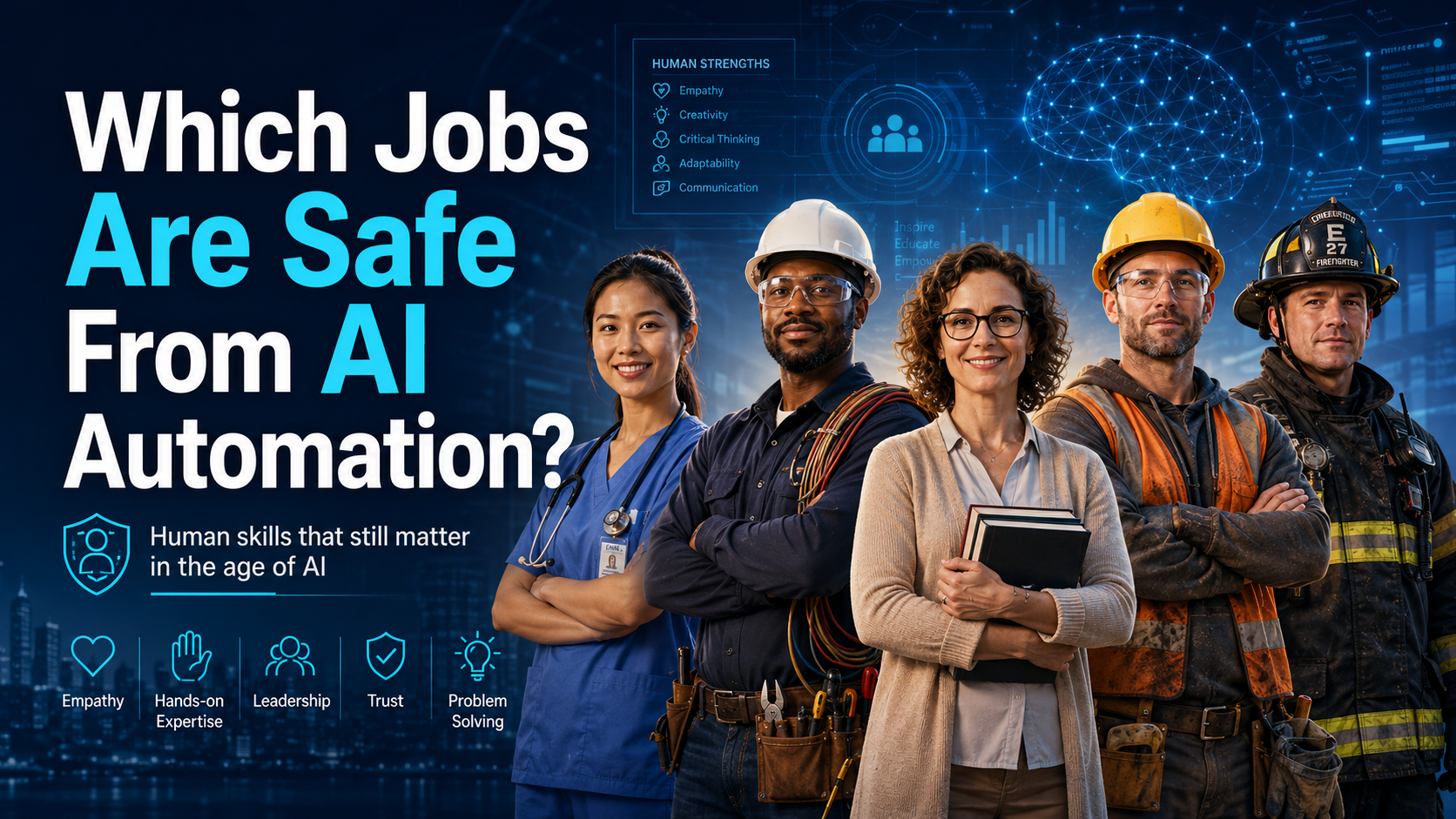
Which Jobs Are Safe From AI Automation?
Artificial intelligence is changing the labor market faster than many workers expected. From customer service chatbots to AI coding assistants, automated research tools, content generators, and workplace agents, many tasks that once required human effort can now be completed by software in seconds. This raises one of the most important career questions of the decade: which jobs are safe from AI automation?
The honest answer is that no job is completely untouched by AI. However, some careers are much more resistant to automation because they depend on physical presence, human judgment, emotional intelligence, creativity, trust, leadership, unpredictable problem-solving, or complex real-world environments. AI may assist these jobs, but it is unlikely to fully replace them in the near future.
According to the World Economic Forum’s Future of Jobs Report 2025, AI and other major economic shifts are expected to displace 92 million jobs by 2030 while creating 170 million new roles, resulting in a net gain of 78 million jobs globally. The key challenge is not simply job loss, but job transformation. Workers who understand where human value remains strongest will be better prepared for the future.
Why Some Jobs Are Safer From AI Than Others
AI is especially strong at processing data, summarizing information, generating text, recognizing patterns, writing code, translating language, and automating repetitive digital tasks. That means jobs built mainly around routine screen-based work are more exposed.
Goldman Sachs Research has estimated that around 300 million jobs globally are exposed to some level of AI automation, with the strongest effects already appearing in technology, knowledge work, and creative sectors. Exposure does not always mean replacement, but it does mean that tasks within those jobs may be automated or redesigned.
The safest jobs usually have one or more of these characteristics: they require hands-on physical work, they take place in unpredictable environments, they involve deep human trust, they demand ethical judgment, or they depend on interpersonal relationships. In other words, AI can write a report, but it cannot repair a power line during a storm, comfort a patient during a crisis, manage a chaotic classroom, or lead a team through uncertainty with human empathy.
1. Skilled Trades and Hands-On Technical Jobs
Skilled trades are among the most AI-resistant career paths. Electricians, plumbers, HVAC technicians, welders, mechanics, construction workers, carpenters, and power-line installers work in physical environments where every job site is different. These roles require manual dexterity, safety awareness, spatial judgment, and real-time adaptation.
A recent analysis based on research from OpenAI, OpenResearch, and the University of Pennsylvania highlighted occupations such as power-line installers, repairers, athletes, and equipment operators as among the least likely to be automated because they depend on physical presence and unpredictable environments.
AI may improve these jobs through diagnostics, scheduling, predictive maintenance, or training tools, but the actual work still needs skilled humans. A robot may eventually assist on construction sites, but replacing millions of local tradespeople across homes, roads, factories, and emergency repair settings remains extremely difficult.
2. Healthcare and Caregiving Roles
Healthcare jobs are also relatively safe, especially those requiring direct patient care. Nurses, doctors, physical therapists, occupational therapists, mental health counselors, paramedics, home health aides, and caregivers rely on empathy, trust, observation, and ethical responsibility.
AI can help analyze scans, summarize medical notes, support diagnosis, and improve hospital operations. But patients still need human professionals who can listen, explain, comfort, and make decisions in sensitive situations. A patient does not only need information; they need care.
The aging population in many countries also increases demand for healthcare and caregiving workers. AI may reduce administrative burden, but it is unlikely to replace the human bond between caregiver and patient. In fact, healthcare workers who learn to use AI tools may become more productive and more valuable.
3. Education, Training, and Human Development
Teachers, trainers, coaches, tutors, school counselors, and education leaders are not immune to AI disruption, but their core role remains deeply human. AI can generate lesson plans, grade simple assignments, create quizzes, and offer personalized learning support. However, education is more than content delivery.
Good teachers motivate students, manage classrooms, understand emotional needs, adapt to different learning styles, and build confidence. They notice when a student is struggling socially, emotionally, or intellectually. These human abilities are difficult to automate.
As AI enters classrooms, the safest education professionals will be those who combine subject knowledge with mentorship, communication, creativity, and digital fluency. The teacher of the future may use AI as an assistant, but the human teacher remains central to learning.
4. Leadership, Management, and Strategy Roles
AI can provide analysis, dashboards, forecasts, and recommendations, but leadership is not just about data. Managers, executives, founders, project leaders, and team supervisors must make decisions under uncertainty, resolve conflicts, inspire people, negotiate priorities, and take responsibility for outcomes.
These roles are safer when they involve judgment, accountability, and human trust. AI can suggest a business strategy, but it cannot fully understand company culture, employee morale, customer relationships, or the political complexity of decision-making.
The best leaders will not ignore AI. They will use it to make faster and better decisions while focusing their human energy on vision, communication, ethics, and team development.
5. Creative Direction and Original Human Storytelling
Some creative tasks are highly exposed to AI. Basic copywriting, simple image generation, stock content, generic marketing text, and routine design work can already be automated. However, high-level creative direction remains safer.
Creative directors, brand strategists, filmmakers, investigative journalists, authors, artists, product designers, and content strategists who bring original ideas, cultural insight, emotional depth, and audience understanding still have strong value.
AI can generate content, but it does not truly live human experience. It does not understand a brand’s reputation, a community’s emotions, or the meaning behind a cultural moment in the same way a person does. The safest creative professionals will be those who move beyond generic production and focus on taste, strategy, storytelling, and originality.
6. Jobs Based on Human Trust and Relationships
Many careers are protected by the importance of trust. Lawyers, financial advisors, therapists, social workers, consultants, real estate agents, HR professionals, community organizers, and client relationship managers all depend on credibility and personal connection.
AI can assist with research, document preparation, financial modeling, and workflow automation. But when people face major decisions involving money, law, family, health, business, or personal risk, they often want a trusted human expert.
This does not mean every role in these fields is safe. Routine paperwork and junior-level research may be automated. The safer positions are those involving judgment, negotiation, ethics, persuasion, and relationship management.
7. Emergency, Public Safety, and Field Response Jobs
Firefighters, police officers, emergency medical technicians, disaster response workers, rescue teams, and military field personnel operate in high-pressure, unpredictable environments. These roles require physical action, moral judgment, teamwork, and rapid decision-making.
AI can improve emergency response through mapping, predictive alerts, communication systems, and risk analysis. But in a crisis, humans are still needed to act, coordinate, rescue, protect, and make judgment calls where lives are at stake.
These jobs are not easy, and some carry significant risk, but they remain among the hardest to fully automate.
8. AI-Adjacent and Technology Governance Jobs
Ironically, AI is also creating safer career paths for people who can build, manage, audit, secure, and govern AI systems. AI engineers, machine learning specialists, cybersecurity analysts, data engineers, AI product managers, AI compliance officers, model auditors, and automation consultants are likely to remain in demand.
The World Economic Forum has identified AI specialists, big data specialists, and fintech engineers among the fastest-growing roles linked to technological change.
However, technical workers must continue learning. AI is already automating some coding, testing, and analysis tasks. The safest technology professionals will be those who understand systems, architecture, security, business needs, and responsible AI deployment.
Jobs Most Exposed to AI Automation
To understand safe jobs, it is also important to understand risky ones. Roles with repetitive, predictable, and digital tasks are more exposed. These include data entry clerks, basic customer support agents, telemarketers, routine content writers, administrative assistants, transcriptionists, simple bookkeeping roles, and some junior analyst positions.
The IMF has warned that employment levels in AI-vulnerable occupations can decline in regions with high AI-skill demand, and entry-level jobs may face higher exposure because many junior tasks are easier to automate.
This does not mean these workers have no future. It means they need to move toward higher-value skills: problem-solving, communication, AI tool usage, customer understanding, compliance, quality control, and decision support.
How to Future-Proof Your Career
The safest career strategy is not to avoid AI, but to become harder to replace. Workers should focus on skills that complement automation rather than compete with it.
The most valuable future skills include critical thinking, emotional intelligence, leadership, communication, creativity, technical literacy, adaptability, and ethical judgment. The World Economic Forum has emphasized that nearly six in ten workers will need some form of training by 2030, making continuous learning essential.
A worker who only performs routine tasks is vulnerable. A worker who uses AI to improve productivity, solve complex problems, and deliver human-centered value is much safer.
Final Answer: Which Jobs Are Safe From AI Automation?
The safest jobs from AI automation are not always the highest-paying or most digital roles. They are jobs that require human presence, emotional intelligence, physical skill, trust, leadership, creativity, responsibility, and real-world judgment.
Skilled trades, healthcare, education, emergency response, leadership, relationship-based professions, advanced creative roles, and AI-related governance jobs are among the strongest career paths in an automated world.
AI will not simply destroy work. It will divide work into tasks that machines can do and tasks where humans still matter most. The future belongs to people who learn how to work with AI while strengthening the qualities that technology cannot easily copy.

Comments
No comments yet. Be the first to share your thoughts!
Leave a Comment