

Google’s Latest AI Search Update: Integrating Reddit, Forums, and the Complex Future of Digital Discovery
Google is officially updating its search engine to refine its Artificial Intelligence (AI) experience by incorporating more contextual links, excerpts from web forums like Reddit, blog perspectives, and highlighted links from users’ personal news subscriptions. While this integration of human-centric discussion boards aims to answer niche queries more effectively, it raises critical questions about AI hallucinations, source reliability, and the fundamental purpose of a search engine. This report explores the mechanics of the new update, the ongoing battle with AI inaccuracies, and what this means for the future of Generative Engine Optimization (GEO) and traditional SEO.
The Evolution of Google’s AI Overviews
Two years ago, Google fundamentally overhauled its search experience to place artificial intelligence front and center. The introduction of the "AI Overview" fundamentally changed the user interface of the world's most popular website. When users search for a query today, Google frequently summons an AI-generated summary at the very top of the results page, designed to provide an immediate, synthesized answer without requiring the user to click through to multiple websites.
However, this ambitious technological leap has spurred a deeply mixed reception from the global user base. Almost immediately after its widespread rollout, internet users and digital analysts pointed out how easily the AI feature could be exploited or confused. The underlying Large Language Models (LLMs) struggled significantly with contextual nuances, frequently failing to recognize obvious sarcasm, satire, or information originating from highly dubious, unverified sources.
The Hallucination Problem: Rocks, Pizza Glue, and Accuracy Ratings
The early days of Google's AI Overviews were marked by highly publicized, sometimes comical, but fundamentally concerning errors—widely referred to in the tech industry as "hallucinations." In one infamous instance, the AI cited the satirical news outlet The Onion as a factual source, officially advising a user to eat "one small rock per day" for their health. In another widely shared failure, the AI ingested a sarcastic comment from a years-old Reddit thread and subsequently advised a user to put non-toxic glue on their homemade pizza to help the cheese stick better.
Though Google’s engineering teams have worked tirelessly to patch these vulnerabilities, AI Overviews have improved significantly but remain inherently prone to hallucination. This is the foundational flaw of anything powered by predictive text algorithms. A recent, comprehensive analysis conducted by The New York Times found that Google's AI Overviews were factually correct about nine times out of ten. In a vacuum, a 90% success rate might sound impressive. However, for a monopolistic search engine that processes trillions of individual queries every single year, that 10% failure rate translates to hundreds of thousands of searches returning wildly inaccurate, potentially harmful results every single minute of the day.
The Rise of Human-Centric Queries and Forum Integration
Despite the push for automated, machine-generated answers, human behavior has actively pushed back. Over the last few years, search data has revealed a massive trend: people are increasingly appending the word "Reddit" to the end of their Google searches. Not every search has a clean, objective, yes-or-no answer. When looking for product reviews, travel advice, or troubleshooting highly specific technical issues, users inherently trust the lived experiences of other human beings over a sanitized corporate article.
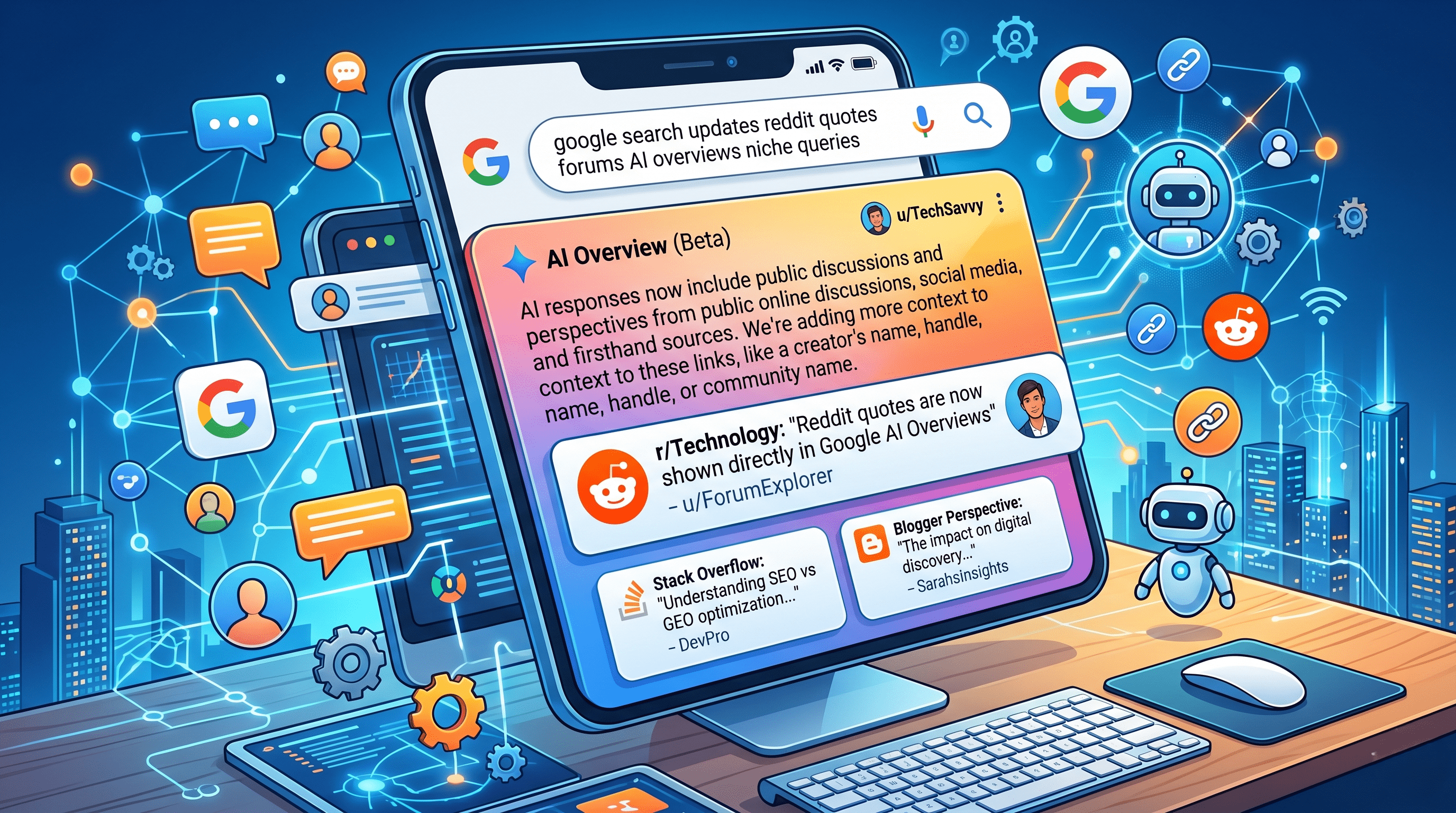
Google has recognized this behavioral shift and is updating its AI accordingly. "For many searches, people are increasingly seeking out advice from others," Google explained in a recent statement regarding the update. "To help you find the most helpful insights to explore further, AI responses will now include a preview of perspectives from public online discussions, social media, and other firsthand sources."
To facilitate this, Google is adding robust context to the links within its AI Overviews. Moving forward, users will see a creator’s specific name, their social handle, or the specific community name (such as a Reddit sub-forum) directly within the AI response. This design choice is intended to help users decide at a glance which digital discussions they might want to read in full or actively participate in. Furthermore, the update brings a personalized touch by highlighting links drawn directly from a user’s paid or tracked news subscriptions, aiming to elevate premium, trusted journalism that the user already values.
The Philosophical Dilemma: Search Engine or Content Aggregator?
While these updates provide much-needed transparency, they are also complicating the fundamental role of Google's AI Overviews. The industry must now ask a pressing question: Is the AI Overview supposed to definitively answer a user's question, or is it merely supposed to serve the user a categorized variety of sources that might contain the information they are looking for?
If the AI's primary function is shifting toward summarizing forum posts and providing a list of relevant links with context attached, critics argue that this is essentially just a traditional Google search, albeit wrapped in a more resource-intensive, AI-generated user interface. The line between a "search engine" and an "AI answering engine" is becoming increasingly blurred.
Implications for SEO and GEO (Generative Engine Optimization)
For digital marketers, publishers, and content creators, this update signals a massive shift in how visibility is achieved online. Traditional Search Engine Optimization (SEO) focused heavily on backlinks and keyword density. Today, Generative Engine Optimization (GEO) requires a totally different approach.
Because Google is now actively pulling quotes and perspectives from forums, blogs, and social media directly into the AI Overview, establishing high-quality, authoritative conversational content is more critical than ever. Brands and publishers must focus on generating first-hand, experiential content. Furthermore, because Google is highlighting user news subscriptions, building a loyal, subscribed audience base will directly impact a publisher's visibility within the AI Overview space. GEO strategies must now prioritize formatting content in a way that LLMs can easily parse, cite, and attribute to specific authors or verified community handles.
Conclusion: Trust, but Verify
Ultimately, Google is taking a step in the right direction by adding more context regarding where its AI Overview commentary originates. By clearly displaying community names, creator handles, and trusted subscription sources, users are empowered to decipher whether they are receiving information from a genuinely trustworthy source. This mirrors the current strategies employed by competing AI platforms like ChatGPT or Anthropic's Claude, which increasingly rely on providing inline citations to back up their algorithmic claims.
However, the core technology remains imperfect. While the integration of human voices and forum discussions adds valuable nuance to search results, it also introduces the chaos of unmoderated public opinion into the search engine's most prominent feature. As this update rolls out globally, the ultimate recommendation for users remains unchanged: utilize the AI Overviews for quick summaries and diverse perspectives, but always double-check the source links to ensure the artificial intelligence is not hallucinating the validity—or the safety—of its citations.


Comments
No comments yet. Be the first to share your thoughts!
Leave a Comment