

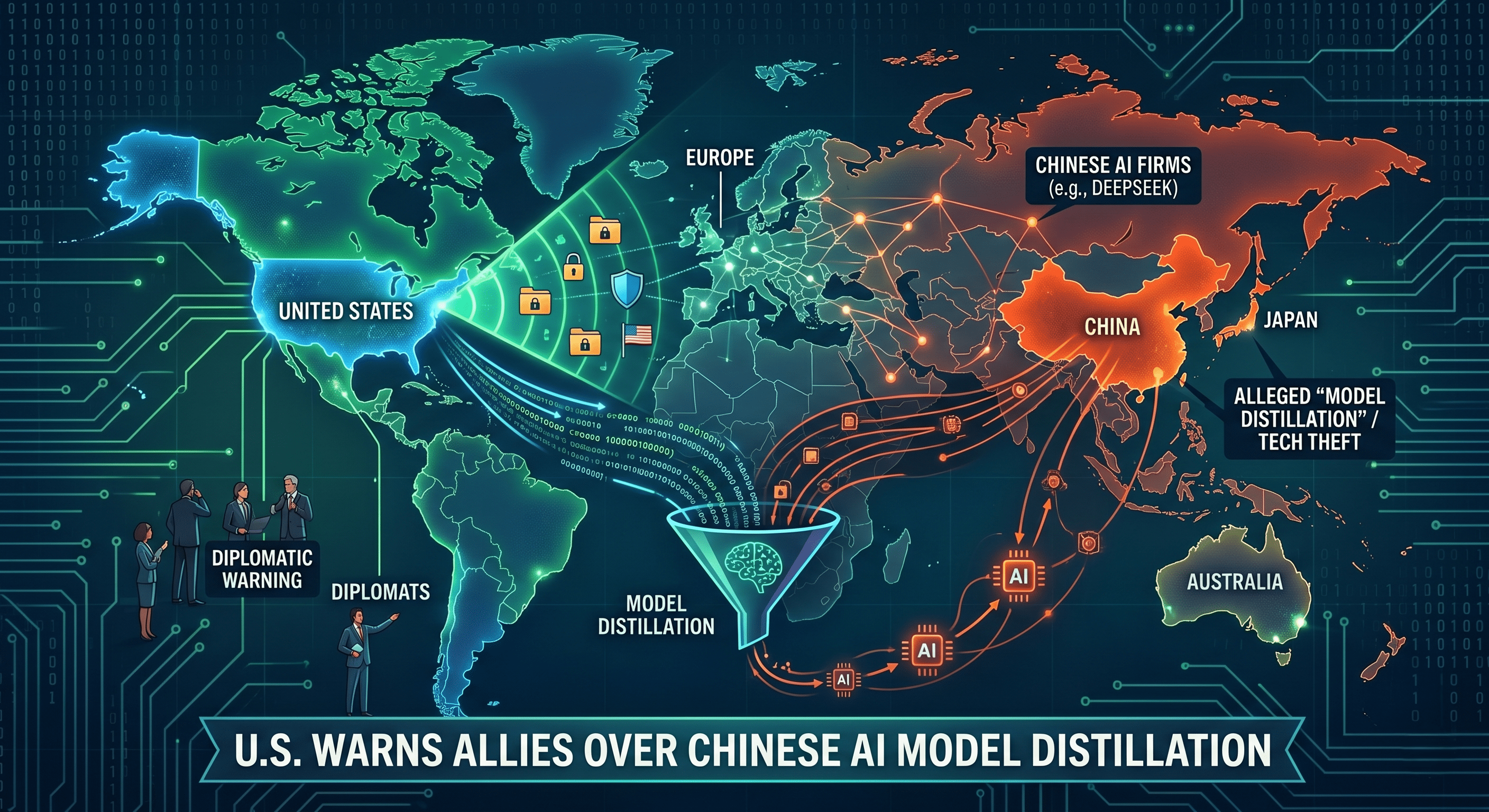
🇺🇸 The New Tech Frontier: Why the U.S. is Sounding the Alarm on Chinese AI "Model Distillation"
Artificial Intelligence is the defining technological frontier of the 21st century, and the United States has historically led the charge. From the bustling startup hubs of Silicon Valley to the massive tech conglomerates operating out of Seattle and Austin, American innovation has set the benchmark for global technological progress. However, an invisible, high-stakes battle is currently raging over who actually controls, owns, and profits from this groundbreaking intellectual property.
On April 24, 2026, the U.S. State Department took a decisive and unprecedented step. Washington issued a global directive, actively warning our international allies about a highly controversial practice known as "AI model distillation." This practice is allegedly being heavily utilized by Chinese tech firms, including companies like DeepSeek, to quietly replicate complex American AI systems.
This is no longer just a matter of domestic policy enforcement or corporate squabbling; it is a full-scale international diplomatic campaign. The directive marks a significant pivot in how the United States handles international tech competition. It sends a clear, undeniable signal that the U.S. government views the unauthorized replication of proprietary artificial intelligence not just as corporate espionage, but as a direct, existential threat to American economic dominance and national security.
The Heart of the Controversy: What Exactly is "Model Distillation"?
To understand why Washington is raising such severe red flags, we have to look under the hood of how modern AI is actually built. Developing a "frontier" AI model—the kind of advanced system capable of writing complex code, generating photorealistic video, or analyzing massive troves of medical data—is an astronomically expensive and resource-heavy endeavor. American companies spend hundreds of millions, and sometimes billions, of dollars on research, development, data acquisition, and massive arrays of specialized semiconductors to train these models from scratch.
"Model distillation" is a technique that essentially shortcuts this entire grueling process.
In simple terms, developers can take a smaller, much cheaper AI model and train it almost entirely using the highly sophisticated outputs of an advanced, expensive model. Imagine spending a decade researching and writing a masterful encyclopedia, only for a competitor to use an automated scanner to read your book, rephrase it slightly, and quickly publish a cheaper, condensed version.
The Technical Reality: It is important to note that distillation is a standard, widely accepted optimization method within the global AI research community. When used internally, it helps companies make their own AI faster, cheaper, and less resource-intensive for consumer devices like smartphones.
The Core Problem: U.S. officials argue that foreign entities are weaponizing this technique across borders. By systematically querying advanced American models and feeding those high-quality responses into their own systems, foreign developers can effectively "clone" the behavior and reasoning capabilities of cutting-edge U.S. tools. All of this is accomplished without ever needing access to the original, proprietary source code or making the massive initial financial investment.
DeepSeek and the Escalating U.S.-China Tech Rivalry
The State Department’s warning explicitly targets Chinese AI firms, bringing companies like DeepSeek to the forefront of this geopolitical conversation. The primary concern among U.S. policymakers is that model distillation allows these companies to rapidly close the technological gap with leading American firms.
If a foreign competitor can achieve 90% to 95% of the performance of a U.S.-built AI for a mere fraction of the cost, the economic implications for the American tech sector are catastrophic. Training a top-tier model costs a fortune, but cloning its capabilities through distillation is comparatively dirt cheap.
Beijing, predictably, has vehemently denied these accusations. Chinese officials have aggressively pushed back on the global stage, labeling the U.S. claims as entirely baseless. They characterize the State Department's warning as a politically motivated smear campaign designed specifically to throttle China's legitimate technological rise. According to officials in Beijing, their domestic companies are simply innovating rapidly, and Washington is weaponizing intellectual property claims to maintain an unfair global monopoly over the AI industry.
"The boundaries between reliable, open-source research and intellectual property infringement remain dangerously blurred in the AI space. Because AI models are trained on vast datasets and interactive responses, determining exactly where 'inspiration' ends and 'imitation' begins is an incredibly difficult technical challenge."
The Geopolitical Chessboard: Why Washington is Pressuring Allies
This recent diplomatic push by the State Department does not exist in a vacuum. It is the latest, escalated maneuver in a broader, multi-year strategy by the United States to restrict China's access to foundational future technologies. Readers will likely recall the strict export controls placed on advanced American-designed semiconductors and the heavy restrictions on high-performance computing equipment that Washington rolled out over the past few years.
By escalating the issue of model distillation through international diplomatic channels, the U.S. is drawing a firm line in the sand for its allies. Washington wants European, Asian, and developing nations to align strictly with the American framework for AI safety, governance, and intellectual property protection.
This places many allied nations in an incredibly difficult and delicate position:
The Appeal of Cost: Chinese AI companies are currently offering highly competitive, highly affordable AI solutions. For developing markets looking to modernize their infrastructure and economies, these cheap alternatives are immensely attractive.
The Security Risk: Integrating foreign-cloned AI models deeply into national infrastructure raises profound security vulnerabilities, data privacy concerns, and reliance on hostile foreign supply chains.
The Diplomatic Pressure: Cozying up to Chinese AI providers risks severely alienating the United States, potentially jeopardizing critical trade agreements, intelligence sharing, and defense partnerships.
What This Means for the American Economy and Everyday Citizens
For the everyday American and the U.S. economy at large, the stakes of this invisible tech war are incredibly high. The artificial intelligence sector is universally projected to add trillions of dollars to the global economy over the next decade. If American intellectual property is continually siphoned off through technical loopholes like model distillation, the U.S. risks losing its primary competitive advantage on the world stage.
This isn't just about protecting the massive profit margins of Big Tech executives. It is fundamentally about protecting millions of American jobs in software engineering, data science, hardware manufacturing, semiconductor design, and the myriad of downstream industries that rely on a robust, domestically controlled tech ecosystem. The U.S. government's aggressive new stance is a calculated attempt to ensure that the massive investments made by American researchers—often subsidized by U.S. taxpayer-funded grants and infrastructure—yield economic dividends for the United States, rather than subsidizing the growth of foreign adversaries.
The Road Ahead: Uncharted Territory
As we look toward the remainder of the decade, the controversy surrounding AI model distillation serves as a massive, urgent wake-up call. The technology is evolving far faster than international law, copyright frameworks, or global trade agreements can possibly manage. Without clear international standards, this debate risks becoming permanently bogged down in political posturing rather than technical resolution.
Whether this global directive from the State Department will successfully curb the replication of American AI systems, or merely drive a deeper, permanent wedge between global tech ecosystems, remains to be seen. What is absolutely obvious, however, is that artificial intelligence is no longer just a commercial software product. It is a critical, foundational component of national defense, economic resilience, and global geopolitical power. The battle for the future of AI has officially moved from the server rooms of Silicon Valley to the international diplomatic stage.
Comments
No comments yet. Be the first to share your thoughts!
Leave a Comment