
TikTok’s Hidden AI Meme Remixer: Why Creators Are Sounding the Alarm and How You Can Opt Out
The landscape of social media is evolving at a breakneck pace, and artificial intelligence is at the steering wheel. In recent months, users have witnessed platforms rushing to integrate generative AI into every corner of their apps. The latest development comes from TikTok, which is currently testing an experimental AI-generated "meme remixer." While the concept might sound like a fun, interactive tool for fans, it has quietly introduced a new setting that automatically grants other users permission to remix your content using AI.
For the global creator community, this quiet rollout is setting off major alarm bells. What was originally intended as a playful feature to enhance comment sections has quickly sparked widespread concerns over data privacy, consent, and the alarming potential for digital identity theft. Here is a comprehensive report on what this new AI remix setting entails, why creators are fiercely pushing back, and exactly how you can protect your content.
Understanding TikTok’s Experimental AI Meme Remixer
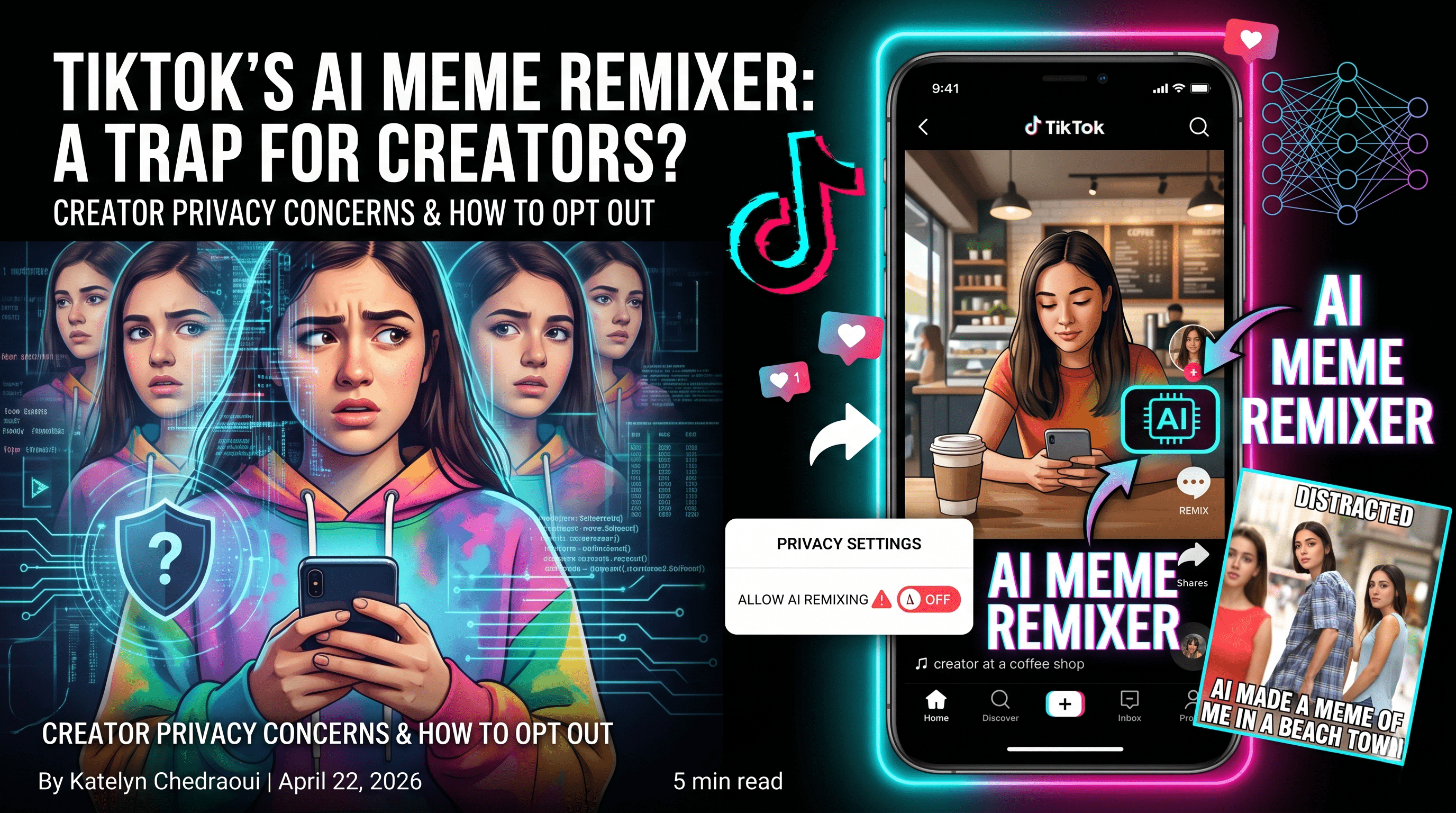
At its core, the AI meme remixer is designed to let anyone who views your TikTok video generate a customized, AI-altered image based on your original content. This goes far beyond the traditional "Duet" or "Stitch" features that TikTok popularized. With this new tool, a user can fundamentally alter the face, voice, or background of the original video subject.
Consider a hypothetical, everyday scenario: You post a harmless vlog of yourself enjoying a latte at a newly opened local coffee shop. Under this new AI framework, a commenter could use the meme remixer to type in a custom text prompt and generate a highly realistic AI image of your exact likeness placed in a completely different scenario—perhaps on a tropical beach, or worse, in a compromising or offensive situation. These newly generated images are then shared directly within the comments section of your original video for all your followers to see.
From TikTok’s corporate perspective, this is simply the next logical step in expanding user engagement. It is viewed as an innovative way to elevate the ability to post images in comments. However, for the individuals actually producing the content, this feature feels like a direct invasion of privacy and yet another stealthy attempt by tech giants to alter and monetize original, human-made content.
The Privacy Backlash: Why Creators Are Deeply Concerned
The primary point of contention is not necessarily the technology itself, but how it is being deployed. The AI remix setting is enabled by default. Unless a creator explicitly notices the hidden toggle and switches it off, their likeness is automatically up for grabs.
Many high-profile TikTokers and everyday users alike feel this crosses a massive ethical line. Creator Sean Szolek-Van Valkenburgh recently voiced a sentiment shared by thousands, stating that it shouldn't be overly complicated to allow users to opt out via a single, universal account setting. While it is true that creators knowingly surrender certain rights to their content when agreeing to a platform's Terms of Service, there is a growing consensus that there must be strict, easily accessible limits on how much of a person's digital identity can be exploited by generative AI.
Furthermore, creators are terrified of the potential for malicious misuse. Georgie, a popular creator known online as soupytime, accurately pointed out that it is already incredibly easy for bad actors to steal and repost viral videos. By integrating a native AI manipulation tool directly into the app, TikTok could inadvertently streamline the creation of deepfakes. Without stringent safeguards, malicious users could take innocent videos and easily twist them into abusive, misleading, or even illegal content—a dangerous phenomenon we have already witnessed with other unmoderated AI tools like Grok on X (formerly Twitter).
TikTok’s Defense: Policies vs. Enforcement
In response to the mounting backlash, TikTok has attempted to reassure its user base. The company officially stated that if you allow your videos to be remixed with AI, that specific content will not be used to train their overarching AI models. However, given the inherently opaque, "black box" nature of how massive tech conglomerates develop and train their algorithms, individual creators have absolutely no way to verify this promise.
TikTok also emphasizes its general AI policy, which mandates that any content edited or entirely created by AI must strictly adhere to its established community guidelines. The platform’s rules explicitly outlaw edited media that intentionally misleads users into believing a fabricated event is real. This includes strict prohibitions against faking authoritative sources, depicting public figures in false contexts, and generating child sexual abuse material.
To aid in transparency, AI-edited content shared on the platform is supposedly embedded with an invisible watermark that complies with the C2PA (Coalition for Content Provenance and Authenticity) standard. Unfortunately, as AI image and video models become exponentially more powerful, invisible watermarks do little to help the average scroller distinguish between reality and an AI-generated fabrication in real-time. Policies may look airtight on paper, but in the fast-paced ecosystem of a short-form video app, enforcement is incredibly difficult to scale.
The Broader Industry Trend: Drowning in "AI Slop"
TikTok’s meme remixer is just one piece of a much larger puzzle. The platform has been aggressively introducing AI features for years, such as "Tako," the AI assistant symbolized by a translucent icon hovering above profile pictures.
This trend is industry-wide. Meta (owning Instagram and Facebook) and Snapchat are all charging headfirst into the artificial intelligence arms race. The result is a phenomenon users have dubbed "AI slop"—a flood of low-effort, machine-generated content that actively drowns out original, human-made art and entertainment. The push for AI integration brings with it a host of environmental, legal, and ethical concerns, but the potential for increased engagement and ad revenue seems to outweigh creator safety in the eyes of major tech executives.
How to Protect Your Content: A Step-by-Step Guide to Opting Out
Currently, TikTok’s meme remixer is still in its experimental phase and has not been rolled out globally. The company has noted that the tool could undergo significant changes before a general release. However, if you have the feature on your account, it is crucial to know how to protect your digital footprint.
The most frustrating aspect of this new feature is the lack of a global opt-out switch. There is currently no way to disable AI remixing at an account level. You must manually turn off this setting for every single video you upload.
Here is how you can disable the AI remixer on your posts:
- Navigate to the specific video you want to protect.
- Tap the three horizontal dots located in the bottom right corner of the screen.
- Scroll through the menu options and tap on Privacy Settings.
- Locate the toggle labeled "Allow AI to remix content" and tap to turn it Off.
For influencers and daily vloggers who post multiple times a week, this per-video requirement is an immense, tedious burden.
Final Thoughts
As social media platforms continue to prioritize AI innovation over user consent, the burden of protection is unfairly shifting onto the creators. While generative AI holds incredible potential for digital art and entertainment, it must not come at the cost of personal privacy and digital autonomy. Until platforms implement sensible, account-wide opt-out features, creators must remain vigilant and proactively guard their content against non-consensual remixing.
Comments
No comments yet. Be the first to share your thoughts!
Leave a Comment