

Beyond Shadow AI: How KiloClaw is Standardizing the Enterprise Agentic Workforce
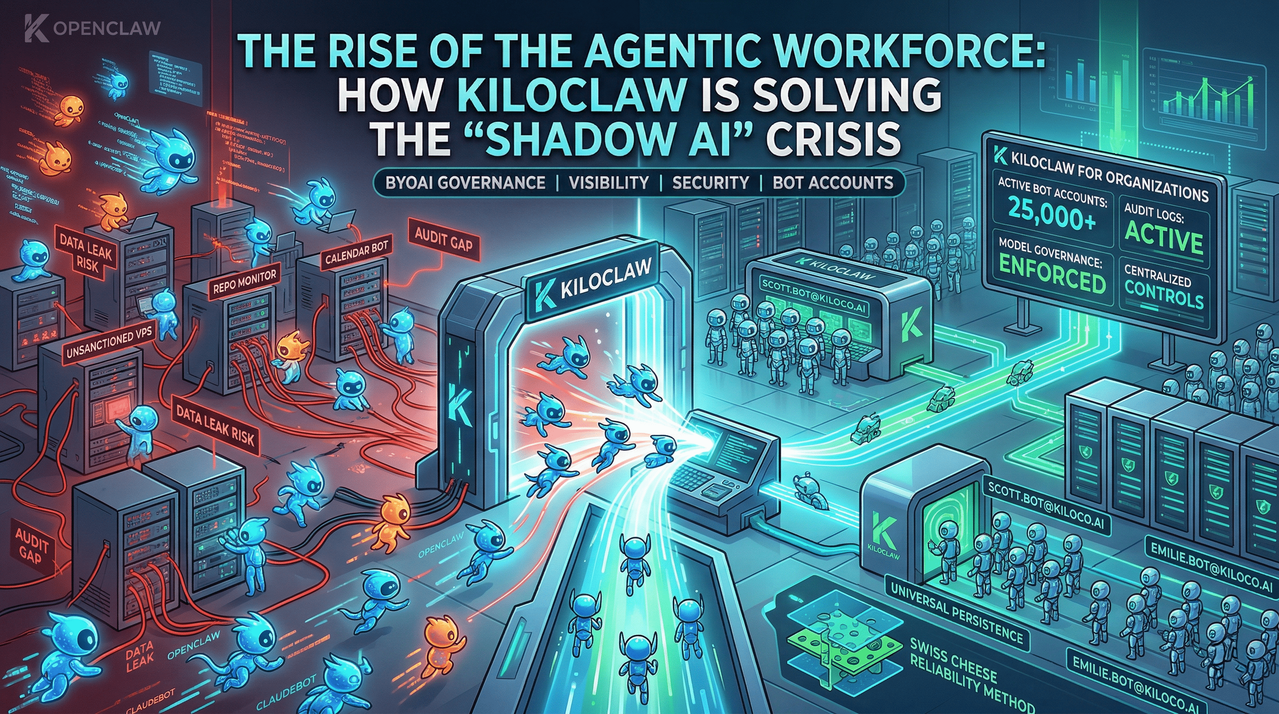
The evolution of generative AI has moved with a speed that has left many corporate IT departments breathless. What began as a novelty in late 2022 has, by 2026, matured into a fundamental workplace staple. However, this rapid adoption has birthed a new friction point for the modern enterprise: the "Shadow AI" crisis, often referred to as Bring Your Own AI (BYOAI).
Much like the "Bring Your Own Device" (BYOD) era of a decade ago, developers and knowledge workers are no longer waiting for corporate approval. Instead, they are increasingly deploying autonomous agents on personal infrastructure to manage professional workflows, monitor repositories, and handle scheduling. Today, Kilo is moving to bring these "shadow" operations into the light with the launch of KiloClaw for Organizations and KiloClaw Chat.
The Growth of the "Shadow AI" Layer
The impetus for Kilo’s new enterprise suite stems from a massive visibility gap. While organizations might have official policies on ChatGPT or Claude, the use of open-source agentic frameworks like OpenClaw has surged under the radar.
According to Kilo co-founder Scott Breitenother, the journey has always been about making AI more accessible. Since making their securely hosted, one-click OpenClaw product—KiloClaw—available last month, the platform has seen over 25,000 users integrate AI agents into their daily professional lives. This momentum was further validated during the 2026 Nvidia GTC conference, where CEO Jensen Huang referenced Kilo’s proprietary agent benchmark, PinchBench, which has now logged over 250,000 interactions.
However, for IT directors, this "bottom-up" adoption is a nightmare. In recent discussions with government contractors and tech firms, Kilo leadership discovered that developers were running agents on random VPS (Virtual Private Server) instances. The result? A total lack of audit logs, zero credential management, and no visibility into what sensitive data was being sent to various APIs.
KiloClaw for Organizations: From Blanket Bans to Managed Access
The lack of oversight has historically led many firms to issue blanket bans on autonomous agents. Anand Kashyap, CEO of Fortanix, notes that while OpenClaw has "taken the technology world by storm," enterprise adoption has remained low due to these inherent security concerns. While industry giants like Cisco and Crowdstrike have announced "Claw" variants with traditional perimeter security, they often fail to address the fundamental problem: reducing the attack surface of a non-deterministic actor.
KiloClaw for Organizations changes the narrative by allowing security teams to say "yes." By purchasing organization-level packages, companies can transition agents from fragmented, developer-managed infrastructure into a controlled, managed environment.
Key Governance Features include:
- Identity Management: Full integration with SSO/OIDC and SCIM provisioning for automated user lifecycles.
- Centralized Billing: Transparent visibility into compute and inference costs across the entire workforce.
- Admin Controls: The ability to set org-wide policies on which LLM models can be used and the duration of agent sessions.
- Secrets Configuration: Utilizing 1Password integrations to ensure agents never handle raw credentials, preventing accidental leaks in code or logs.
Solving the Reliability Gap: The "Swiss Cheese" Method
One of the primary technical hurdles in the agent landscape is the fragmentation of sessions. Emilie Schario, Kilo’s head of product and engineering, points out that even advanced tools often struggle with "canonical sessions," leading to dropped messages or sync failures across devices.
To combat the inherent unreliability of autonomous agents—where a missed cron job or a failed execution can derail a workflow—Kilo employs the "Swiss cheese method." This approach layers deterministic guardrails on top of the base OpenClaw architecture. By stacking these protective layers, Kilo ensures that critical tasks, such as generating a daily executive summary, are completed even if the underlying AI logic momentarily falters.
This reliability isn't just about productivity; it’s about risk mitigation. In an enterprise setting, an agent that fails improperly could accidentally leak data by commenting on the wrong GitHub issue or emailing sensitive information to the wrong recipient. Managed infrastructure provides the "safety net" necessary for these agents to operate autonomously.
KiloClaw Chat: Bridging the UX Divide
While the backend infrastructure handles security, KiloClaw Chat addresses the user experience. Historically, interacting with an OpenClaw agent required a high degree of technical literacy, often involving third-party messaging services like Telegram or Discord and the configuration of "BotFather" tokens.
"If you don't know what's going on, it's overwhelming," Schario observed regarding the technical barriers. KiloClaw Chat removes this friction by offering a native web and mobile UI. This is vital for corporate compliance; enterprises rarely want employees using personal messaging accounts to communicate with work-related bots. When an employee leaves a company, the organization must have the power to instantly revoke access to the bot and its history—a feat impossible with personal Telegram accounts.
The "Bot Account" Model: A New Identity Paradigm
Perhaps the most forward-thinking aspect of Kilo’s announcement is the shift toward employee "bot accounts." As AI agents gain shell access and browser control, they cease to be simple chatbots and become "non-deterministic actors."
Ev Kontsevoy, CEO of Teleport, warns that agents without cryptographic identities or real-time audit trails represent a significant security hole. Kilo’s solution is to give every employee a twin identity: a standard human account and a corresponding bot account (e.g., [email protected]).
These bot identities operate under a "least privilege" model:
- Scoped Access: Bots are granted read-only permissions to logs or specific repositories.
- Verifiable Identity: Every action taken by the bot is tied to a verifiable actor.
- Data Privacy: Because Kilo’s code is source available, organizations can audit the security of the platform. Furthermore, Kilo does not train its models on user data, ensuring that proprietary corporate intelligence remains within the organization’s "walled garden."
Availability and Pricing
KiloClaw for Organizations is available as of April 1, 2026. The company is adopting a usage-based pricing model, allowing firms to pay only for the compute and inference they consume. For those who prefer to maintain their own LLM relationships, a "Bring Your Own Key" (BYOK) approach is supported, or they can utilize Kilo Gateway credits.
KiloClaw Chat is currently in beta, supporting web, desktop, and iOS. To encourage exploration, new users can access a free tier that includes seven days of compute.
As the workplace shifts from "one-off" AI experiments to a scalable, agentic workforce, Kilo is positioning itself as the bridge between innovation and governance. By moving away from "Shadow AI" and toward a managed, transparent ecosystem, the enterprise can finally harness the full potential of autonomous agents without sacrificing security.

Comments
No comments yet. Be the first to share your thoughts!
Leave a Comment