

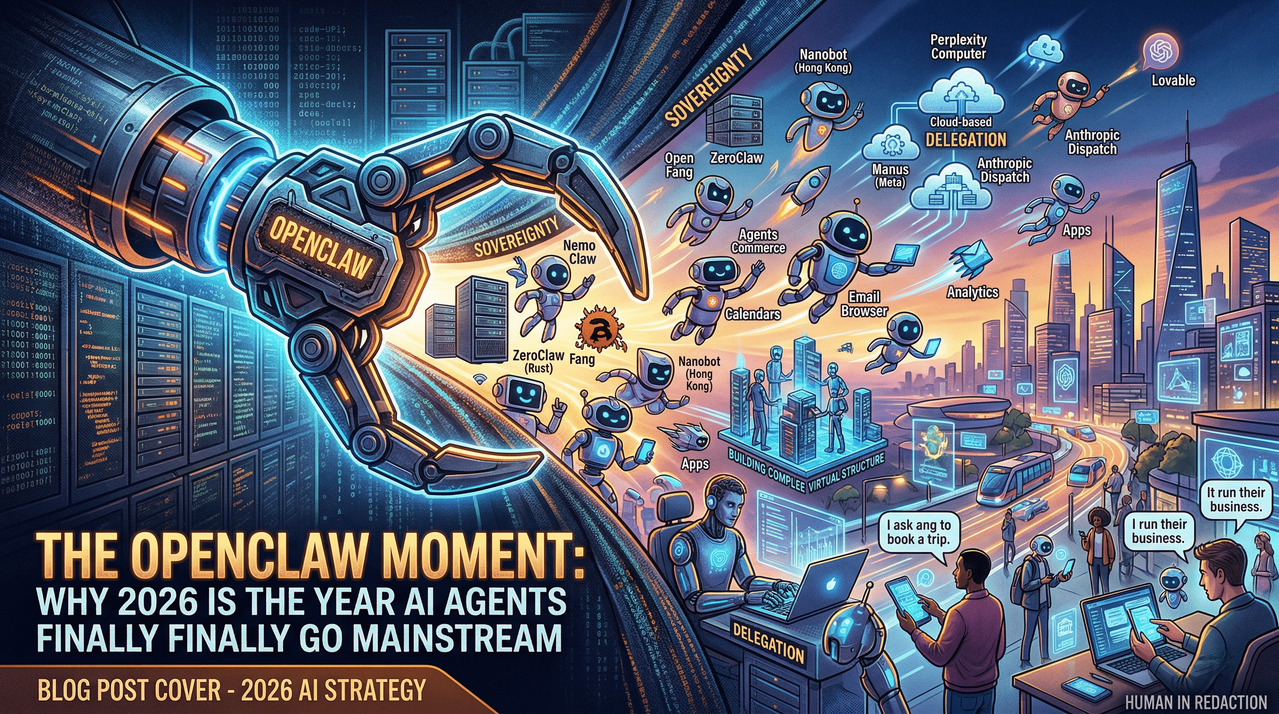
The OpenClaw Phenomenon: Why 2026 is the Year of the Agent
Forget the "AI horse race" headlines. Forget the sensationalist "security dumpster fire" takes. While those stories are real, they’re just the surface tension. Underneath the OpenClaw explosion lies the most significant shift in technology since the launch of ChatGPT.
If you want to understand where the world is headed, you have to look at the strategic bets being made by the giants on the board. We’re witnessing a massive consolidation—a "compression" of the interface layer—where every app, builder, and tool is collapsing into a single conversational agent.
The Framework: Three Axes to Rule Your Agents
To evaluate any new agent product, you don't need to be a developer. You just need to ask three questions. These are the axes that define the "agentic" landscape:
- Where does it run? (Local vs. Cloud vs. Hybrid)
- This determines your data sovereignty. If it's local (like OpenClaw), you own the keys. If it's cloud-based (like Perplexity), you're trading privacy for convenience.
- Who orchestrates the intelligence? (Single Model vs. Multi-Model Harness)
- Is it one model doing everything? Or is there a "harness" that picks the best tool for the job? This determines your cost and quality.
- What is the interface contract? (Messaging vs. Dedicated App)
- Do you talk to it on WhatsApp, Telegram, or a specialized terminal? This determines the user experience and how much you're willing to change your behavior.
The Players: Differing Bets on the Future
The market is currently an "avalanche" of OpenClaw competitors and forks. Here is how the major players are positioning themselves:
1. OpenClaw: The Sovereignty Play
OpenClaw is the "Linux moment" of AI. It's messy, powerful, and wildly adopted—boasting over 250,000 GitHub stars.
- The Pro: Maximum control. You bring your own LLMs, your own plugins, and your own infrastructure.
- The Con: High technical debt and security risks. Researchers have already documented 30,000 publicly exposed instances with missing authentication and over 800 compromised skills in supply chain attacks.
2. Perplexity Computer: The Delegation Play
Perplexity is betting that you’d rather pay $200 a month than manage your own server. It’s a cloud-first "virtual box" where you describe an outcome, and the system decomposes it into subtasks.
- The Bet: Professional-grade reliability over user control.
3. Meta’s Manis: The Distribution Play
After spending $2 billion on Manis, Mark Zuckerberg pivoted it straight into the OpenClaw lane.
- The Goal: Capturing eyeballs. With 3 billion users, Meta doesn't need to monetize right away. They just need to keep you in their ecosystem rather than wandering off to a standalone agent.
4. Anthropic’s Dispatch: The Safety Play
Anthropic is leaning into its brand as the "safe" option. Dispatch allows you to drive your computer via your phone through a secure, single-threaded terminal. It’s less flexible than a multi-model harness, but it’s built for the non-tech professional who wants to "just work."
5. Lovable: The Evolution Play
Lovable was the "vibe coding" darling of 2025, reaching $300 million in ARR. Now, they are pivoting from a human-mediated website builder to an agent-first execution tool. It’s a "go deep" play in a world that is rapidly going broad.
The Competitive Matrix: Complexity vs. Control
If we map these players out, OpenClaw sits in the "Top Right"—it offers maximum user control but requires maximum technical management. Perplexity sits in the "Lower Left"—trading control for ease of use.
The 2026 Thesis: Relentless Simplification
We are entering an era of Agent Commerce. In the next 5 to 10 years, how we do business will be defined by how we delegate trust to these agents.
The middle ground is a dangerous place to be right now. Tools that aren't "best-in-class" for a specific niche or "general enough" to be a default delegation layer will likely face product death.
The real question for you this year isn't "Which AI is faster?" but "How much control am I willing to trade for convenience?" Whether you're a developer building on ZeroClaw (the Rust rewrite) or a consumer using Meta's distribution, you are participating in a massive case study in business strategy.
Choose your agent wisely. Your data—and your time—depend on it.


Comments
No comments yet. Be the first to share your thoughts!
Leave a Comment