The Middleware Trap: Why Perplexity’s Best Product is Also its Biggest Risk
The launch of Perplexity Computer on February 25, 2026, was a masterclass in execution. It is a cloud-native, multi-model orchestration system that routes tasks across 19 frontier models, spawns sub-agents, and delivers finished artifacts while you sleep. It is, by almost any metric, the best agentic product of the year.
And yet, it serves as a cautionary tale. Perplexity’s brilliance highlights a structural fragility: the "Middleware Trap." When you build a world-class product on a stack you don't own, execution alone might not save you.
The Power of Perplexity Computer
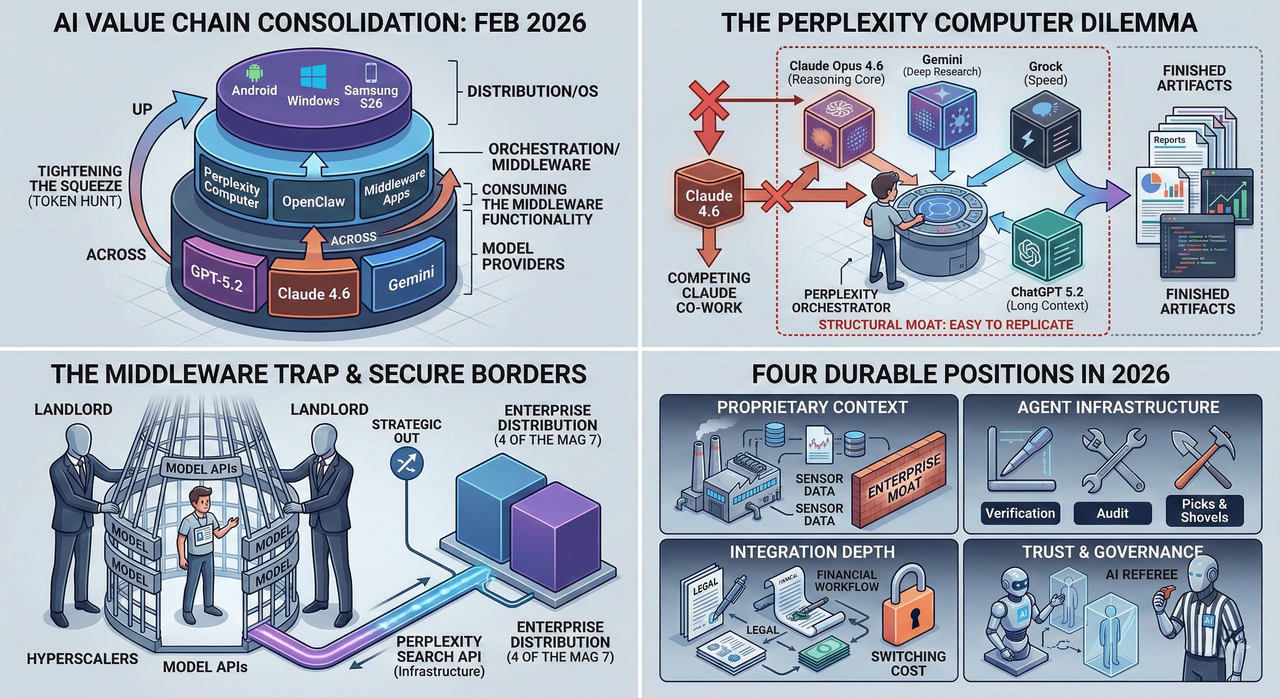
Perplexity Computer isn't hardware; it is a sophisticated Agentic System. For $200 a month, users get access to a "reasoning core" (Claude Opus 4.6) that delegates tasks to specialized models: Gemini for research, Grok for speed, and GPT-5.2 for long-context recall.
Key Capabilities:
- Parallel Execution: It can spawn multiple sub-agents to handle web research, document drafting, and coding simultaneously.
- Tool Integration: It connects to over 400 tools, including Slack, Gmail, Salesforce, and GitHub.
- Asynchronous Workflows: You can kick off a complex project and close your laptop; the agent persists for months if necessary to finish the deliverable.
- Persistent Memory: It accumulates context about your specific preferences over time, reducing the need for repetitive prompting.
The Middleware Trap: Borrowing Time
The fundamental problem for Perplexity—and almost every AI company that isn't Google, Microsoft, Meta, or OpenAI—is their position in the stack.
The industry has stratified into three layers:
- The Bottom (Model Providers): They own the weights and the compute.
- The Middle (Orchestration/Middleware): Companies like Perplexity that combine models into products.
- The Top (Distribution Owners): The OS or browser where the user actually lives (Android, Windows, iOS).
Perplexity sits in the middle—the most exposed layer. Every model provider they depend on is currently building a direct competitor. When Anthropic ships "Claude Co-work," they aren't just providing a model; they are providing an end-to-end agentic workflow. They own the model, which gives them better margins and deeper integration than any middleware wrapper can achieve.
The Hyperscaler Incentive: The Hunt for Tokens
Why are the giants squeezing the middle? Trillions of tokens. Cloud providers (AWS, Azure, Google Cloud) are spending roughly $690 billion a year on infrastructure. To justify this capital expenditure, they must fill that infrastructure with token traffic.
If a hyperscaler doesn't control a layer of the stack, someone else is capturing the value of the compute they subsidized. This is why we see "forward-deployed engineers" from OpenAI and Anthropic working directly with enterprises—they are locking in the relationship to ensure the token flow stays within their ecosystem.
Four Strategies for Durability in 2026
If you are building in the middleware layer, a "pretty UI" is no longer a moat. You must find a position where the giants' incentives align with your existence.
Gemini a dit
The launch of Perplexity Computer on February 25, 2026, was a masterclass in execution. It is a cloud-native, multi-model orchestration system that routes tasks across 19 frontier models, spawns sub-agents, and delivers finished artifacts while you sleep. It is, by almost any metric, the best agentic product of the year.
And yet, it serves as a cautionary tale. Perplexity’s brilliance highlights a structural fragility: the "Middleware Trap." When you build a world-class product on a stack you don't own, execution alone might not save you.
The Power of Perplexity Computer
Perplexity Computer isn't hardware; it is a sophisticated Agentic System. For $200 a month, users get access to a "reasoning core" (Claude Opus 4.6) that delegates tasks to specialized models: Gemini for research, Grok for speed, and GPT-5.2 for long-context recall.
Key Capabilities:
- Parallel Execution: It can spawn multiple sub-agents to handle web research, document drafting, and coding simultaneously.
- Tool Integration: It connects to over 400 tools, including Slack, Gmail, Salesforce, and GitHub.
- Asynchronous Workflows: You can kick off a complex project and close your laptop; the agent persists for months if necessary to finish the deliverable.
- Persistent Memory: It accumulates context about your specific preferences over time, reducing the need for repetitive prompting.
The Middleware Trap: Borrowing Time
The fundamental problem for Perplexity—and almost every AI company that isn't Google, Microsoft, Meta, or OpenAI—is their position in the stack.
The industry has stratified into three layers:
- The Bottom (Model Providers): They own the weights and the compute.
- The Middle (Orchestration/Middleware): Companies like Perplexity that combine models into products.
- The Top (Distribution Owners): The OS or browser where the user actually lives (Android, Windows, iOS).
Perplexity sits in the middle—the most exposed layer. Every model provider they depend on is currently building a direct competitor. When Anthropic ships "Claude Co-work," they aren't just providing a model; they are providing an end-to-end agentic workflow. They own the model, which gives them better margins and deeper integration than any middleware wrapper can achieve.
The Hyperscaler Incentive: The Hunt for Tokens
Why are the giants squeezing the middle? Trillions of tokens. Cloud providers (AWS, Azure, Google Cloud) are spending roughly $690 billion a year on infrastructure. To justify this capital expenditure, they must fill that infrastructure with token traffic.
If a hyperscaler doesn't control a layer of the stack, someone else is capturing the value of the compute they subsidized. This is why we see "forward-deployed engineers" from OpenAI and Anthropic working directly with enterprises—they are locking in the relationship to ensure the token flow stays within their ecosystem.
Four Strategies for Durability in 2026
If you are building in the middleware layer, a "pretty UI" is no longer a moat. You must find a position where the giants' incentives align with your existence.
| Position | Strategy | Why it Works |
| 1. Proprietary Context | Focus on data that is too sensitive or fast-moving for a general platform to ingest. | Enterprises won't hand their "secret sauce" to a model provider that might compete with them. |
| 2. Agent Infrastructure | Become the "pick and shovel" that agents call (e.g., Search APIs). | You become a partner to the winners rather than a competitor. |
| 3. Integration Depth | Own the institutional workflow so deeply that "ripping it out" would break the company. | High switching costs protect you from model commoditization. |
| 4. Trust & Verification | Build the audit and governance layer that model providers ignore. | As agents take autonomous action, someone must be the "referee" to ensure safety and policy compliance. |
The Verdict on Perplexity
Perplexity is actually smarter than the "Computer" launch suggests. While the media focused on the $200/month agent, their real "out" is their Search API. It is already running in production for four of the "Magnificent 7" tech giants. By becoming the infrastructure that other agents use to see the web, they are moving from a fragile middleware position to a durable infrastructure position.
For everyone else, the clock is ticking. The "landlords" of the AI era—the model and cloud providers—are getting hungrier. If your product is just a clever way to route someone else’s API, you aren't building a business; you’re just renting space in a market that is quickly being reclaimed.
Comments
No comments yet. Be the first to share your thoughts!
Leave a Comment