The Intelligence Revolution: 8 Defining AI Trends Shaping 2026
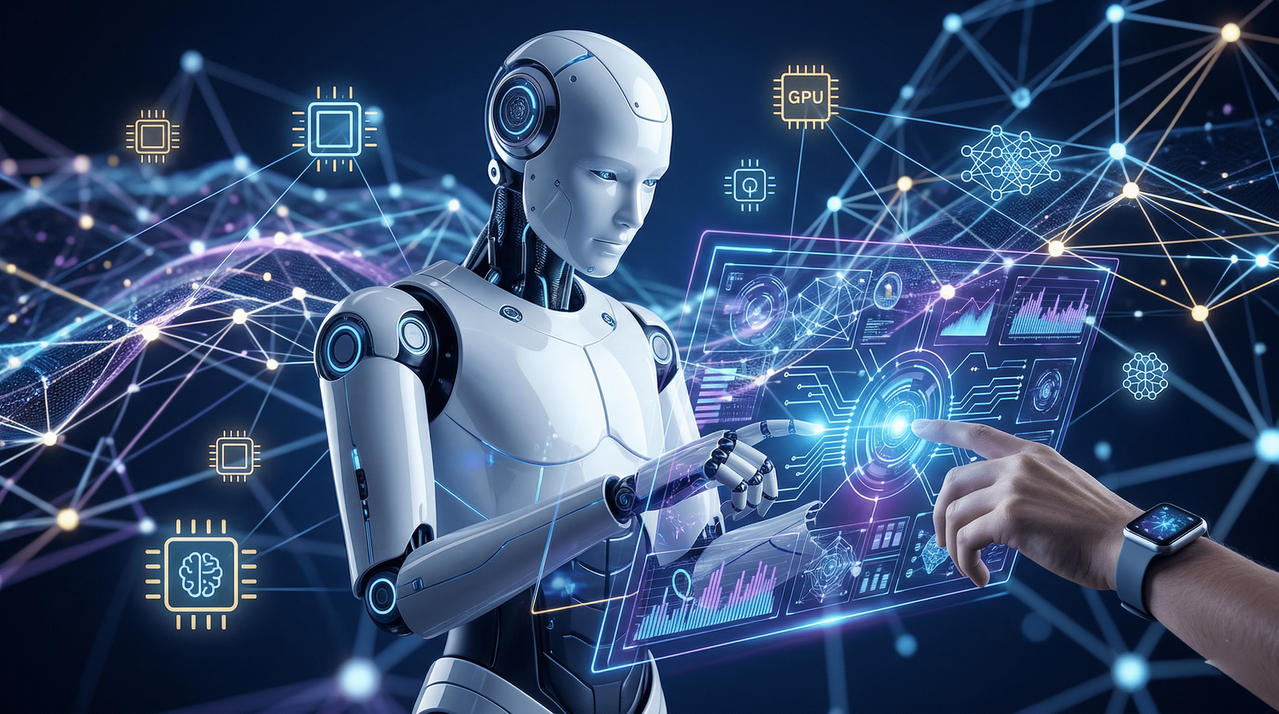
The landscape of artificial intelligence moves at a pace that often renders last month’s "breakthrough" today’s "standard feature." As we navigate through 2026, the industry has transitioned from the novelty of generative chat to a sophisticated, integrated, and physically embodied era of intelligence. While 2025 was widely recognized as the "Year of the Agent," 2026 is proving to be the year where those agents organize, reason, and step into the physical world.
The following report outlines the eight pivotal trends currently redefining the technological horizon, moving from the way software collaborates to the very hardware that powers our digital future.
1. Multi-Agent Orchestration: From Solos to Symphonies
In previous years, the industry sought a "God model"—a single, massive entity that could do everything from writing poetry to debugging complex C++ code. However, 2026 has brought a shift toward Multi-Agent Orchestration. We have realized that specialized agents, much like specialized human professionals, perform better when working in teams.
Current architectures now utilize a Coordinating Layer or an "Orchestrator." In this setup, a Planner Agent decomposes a high-level goal into discrete steps. These steps are then handed off to Worker Agents—some specialized in API calls, others in code generation. Crucially, a Critic Agent evaluates the output, flagging errors before they reach the user. This cross-checking mechanism significantly reduces hallucinations and allows for the verification of complex, multi-step tasks.
2. The Rise of the Digital Labor Workforce
We are moving beyond AI as a "tool" and toward AI as "labor." The Digital Labor Workforce consists of autonomous agents capable of parsing multimodal inputs—interpreting a mix of video, text, and data—to execute full workflows.
What makes 2026 different is the seamless integration of these workers into downstream enterprise systems. This isn't just about generating a report; it’s about an agent seeing a supply chain delay, reasoning through the alternatives, and executing the procurement order. To maintain safety and ethics, the Human-in-the-loop (HITL) model remains central, providing strategic guidance, oversight, and the "rails" that ensure autonomous systems remain aligned with human intent.
3. Physical AI and World Foundation Models
For years, AI lived behind a screen, manipulating pixels and text. In 2026, Physical AI has broken the digital barrier. While Large Language Models (LLMs) understand the syntax of language, World Foundation Models understand the syntax of reality.
These models are trained in high-fidelity simulations to understand 3D environments, gravity, and object permanence. Instead of humans coding explicit "if-then" rules for robots, these systems learn how to interact with the world through observation and trial. We are seeing humanoid robots move from research labs to commercial production lines, capable of performing tasks like "grasping a glass without crushing it" because they truly perceive the physics of the object.
4. Social Computing and the Shared AI Fabric
The interaction between humans and AI is no longer a series of isolated prompts. We are entering the era of Social Computing, where humans and agents operate within a Shared AI Fabric.
This fabric acts as a connective tissue, allowing for a continuous flow of information, context, and intent. When an agent understands a human’s emotional state or long-term goals through "affective computing," the collaboration becomes empathetic and emergent. This leads to Collective Intelligence—a real-world swarm where teams of humans and agents solve problems that neither could tackle alone.
5. Verifiable AI: The Regulatory Standard
As of mid-2026, the EU AI Act is fully applicable, serving as the "GDPR for Artificial Intelligence." This regulation has set a global template for AI governance, mandating that high-risk systems be auditable and traceable.
The trend toward Verifiable AI focuses on three pillars:
- Technical Documentation: Developers must demonstrate how models were tested and what risks were identified.
- Transparency: Users have a right to know when they are interacting with a machine; synthetic text and media must be clearly labeled.
- Data Lineage: Companies must summarize training data sources and prove they have respected copyright opt-outs.
This shift ensures that the "black box" nature of AI is replaced with a framework of accountability.
6. Quantum Utility Everywhere
2026 marks the point where quantum computing has moved from theoretical "supremacy" to practical Quantum Utility. We are now seeing hybrid quantum-classical systems that solve real-world problems faster and more efficiently than classical methods alone.
These systems are being woven into mainstream business operations, specifically in areas where classical computers struggle: Optimization, Simulation, and Complex Decision-Making. Whether it’s optimizing global logistics in real-time or simulating molecular interactions for drug discovery, quantum units are now working alongside traditional data center infrastructure to deliver tangible value.
7. Reasoning at the Edge
Last year’s focus was on "Small Language Models" (SLMs). This year, the focus is on Reasoning at the Edge. We have successfully distilled the "thinking" capabilities of massive frontier models into compact models with only a few billion parameters.
Through a process of distilling inference-time compute data—where large models are recorded "thinking out loud" through problems—smaller models have learned to replicate those reasoning steps. The result? Your phone or laptop can now perform complex reasoning offline. This is a massive win for:
- Privacy: Data never leaves the device.
- Latency: No round-trip to a data center.
- Mission-Critical Tasks: AI can function in remote areas without internet connectivity.
8. Amorphous Hybrid Computing
Finally, we are seeing a total transformation of our compute infrastructure into what is known as Amorphous Hybrid Computing. The rigid "transformer-only" era is evolving. New architectures are emerging that combine Transformers with State Space Models (SSMs) and other algorithmic innovations to create more fluid, efficient "backbones."
The hardware layer is equally diverse. A single AI task might be automatically mapped across a variety of optimal substrates:
- CPUs & GPUs: For general processing and parallel tasks.
- TPUs: For specialized tensor operations.
- QPUs: Quantum Processing Units for optimization.
- Neuromorphic Chips: Chips that emulate the human brain's architecture for ultra-low-power efficiency.
Looking further ahead, experiments in DNA Computing are already suggesting that the fluid nature of computing will only become more biological and "amorphous" as the decade progresses.
Final Thoughts
As we progress through 2026, the common thread across all these trends is integration. AI is no longer a standalone destination but a pervasive layer—physical, social, and regulatory—that is being woven into the fabric of daily life. From the robots on the factory floor to the reasoning models in our pockets, the intelligence revolution has moved from "predicting the future" to actively building it.
Comments
No comments yet. Be the first to share your thoughts!
Leave a Comment