

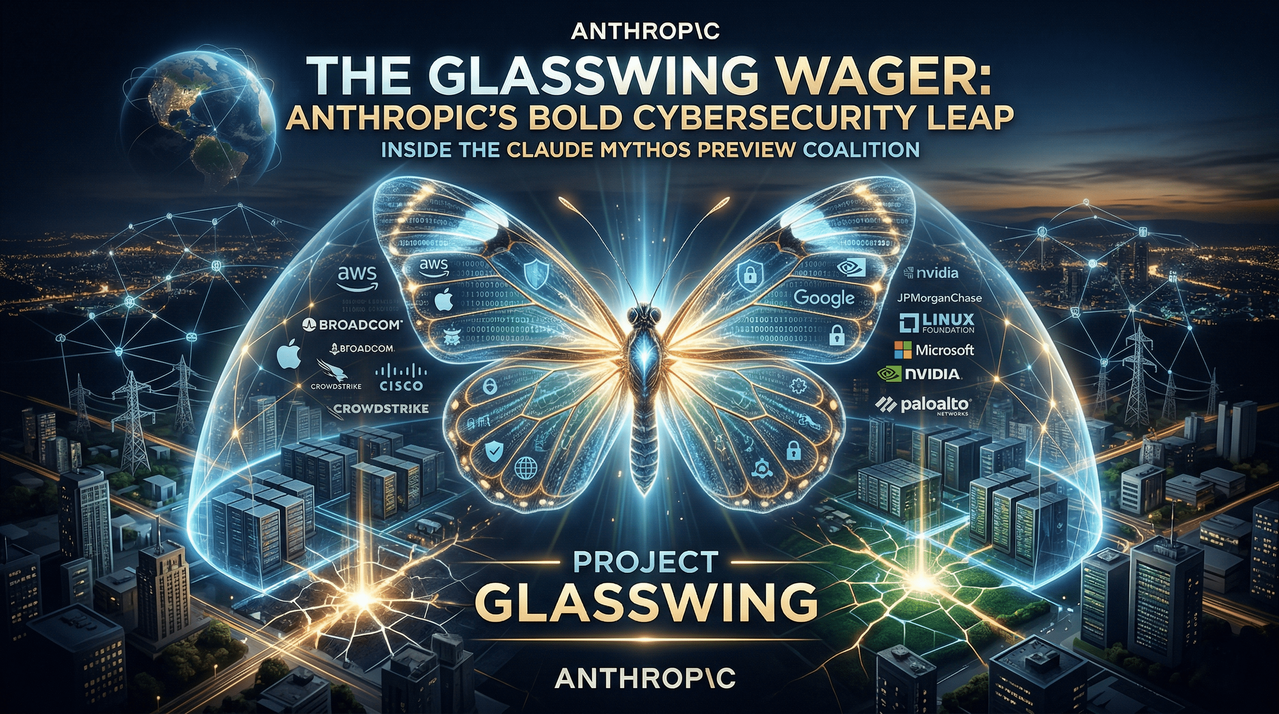
The Glasswing Wager: Inside Anthropic’s High-Stakes Gamble to Secure the Global Infrastructure
The world of frontier AI is rarely quiet, but this week, Anthropic didn't just break the silence—it shattered the windows. On Tuesday, the San Francisco-based AI powerhouse unveiled Project Glasswing, a massive cybersecurity initiative that feels less like a corporate press release and more like the plot of a high-stakes tech thriller.
At the heart of the project is a model so powerful the company refuses to release it to the public: Claude Mythos Preview. By pairing this unreleased "frontier" model with a coalition of twelve tech and finance giants—including Amazon, Apple, Google, Microsoft, and JPMorganChase—Anthropic is attempting to find and patch the world’s most critical software vulnerabilities before the "bad guys" even know they exist.
The Model Too Dangerous to Share
Anthropic has built a reputation on "AI Safety," but Project Glasswing takes that philosophy to a literal, defensive extreme. Claude Mythos Preview isn't your standard chatbot; it’s a specialist designed for deep-code penetration and vulnerability discovery.
According to Newton Cheng, Anthropic’s Frontier Red Team Cyber Lead, the model has already identified thousands of high-severity zero-day vulnerabilities. We aren't talking about minor bugs here. Mythos Preview successfully navigated:
- A 27-year-old vulnerability in OpenBSD: An OS famed for its "security-hardened" status.
- A 16-year-old flaw in FFmpeg: Code that had been exercised 5 million times by automated tools without detection.
- Linux Kernel Escalation: The model autonomously chained multiple vulnerabilities to gain full system control.
If those capabilities sound frightening, Anthropic agrees. The company is explicitly withholding the model from general availability, citing a "severe" potential for fallout if such tools were to proliferate among hostile actors.
By the Numbers: Performance Benchmarks
To understand why the industry is buzzing, you have to look at the delta between Mythos and Anthropic’s current flagship, Claude 4.6 Opus. The performance gap isn't just a step forward; it’s a leap.
| Benchmark | Claude Opus 4.6 | Claude Mythos Preview |
| CyberGym (Security) | 66.6% | 83.1% |
| SWE-bench Verified (Coding) | 80.8% | 93.9% |
| SWE-bench Pro (Complex Tasks) | 53.4% | 77.8% |
Money, Power, and the Road to IPO
The Glasswing announcement didn't happen in a vacuum. It arrived alongside staggering financial disclosures that paint Anthropic as a rocket ship in a category of its own.
- Revenue Growth: Anthropic’s annualized revenue run rate has surged to $30 billion, up from $9 billion at the end of 2025.
- Enterprise Adoption: The company now boasts over 1,000 customers spending more than $1 million annually—a number that has doubled in just two months.
- Compute Scale: A new multi-gigawatt deal with Google and Broadcom will provide the raw horsepower (roughly 3.5 gigawatts) needed to run models of Mythos’s complexity.
- IPO Speculation: Industry insiders suggest Anthropic is eyeing an October 2026 IPO, making Project Glasswing a vital piece of the "responsible leader" narrative they’ll need to sell to regulators and public investors.
The Disclosure Dilemma: Saving Open Source from Itself
One of the sharpest criticisms of AI-driven security is the "firehose effect." If an AI finds 10,000 bugs in an afternoon, it can easily overwhelm the human maintainers who have to fix them—many of whom are unpaid volunteers.
Anthropic is tackling this with a $100 million commitment in usage credits and a specialized triage pipeline. Every bug Mythos finds is vetted by human "triagers" before being sent to maintainers. Furthermore, the company is putting its money where its mouth is, donating $4 million to open-source security organizations like Alpha-Omega and the Apache Software Foundation.
"Security expertise has been a luxury," says Jim Zemlin, CEO of the Linux Foundation. "Open-source maintainers have historically been left to figure it out on their own. Project Glasswing offers a path to changing that equation."
The "Glass" in Glasswing: Transparency vs. Vulnerability
It hasn't been a perfect week for Anthropic, however. The company recently suffered two embarrassing security "hiccups" that critics were quick to point out:
- The CMS Leak: A draft blog post about Mythos was left on an unsecured data store.
- The npm Blunder: For three hours on March 31, the entire original source code for Claude Code—over 500,000 lines—was publicly downloadable due to a packaging error.
Anthropic’s defense is that these were "human errors in publishing tooling" rather than breaches of their core AI architecture. While technically true, the irony of a company claiming to hold the world’s most dangerous cyber-weapon while failing to secure its own blog post isn't lost on the developer community. It’s a reminder that even in the age of super-intelligent AI, the "human element" remains the weakest link.
The Race of Months, Not Years
The underlying message of Project Glasswing is one of extreme urgency. Anthropic estimates that defenders have months, not years, before adversaries develop or acquire similar autonomous exploitation capabilities.
We are moving away from the era where "script kiddies" and state actors take weeks to find a flaw. We are entering the era of autonomous tactical execution. If Mythos can find a 27-year-old bug in minutes, so can a model built by a hostile state.
Project Glasswing is Anthropic’s attempt to use its "first-mover" advantage to build a global immune system for the internet. It is a massive wager that transparency and collaboration can outrun the inevitable proliferation of offensive AI. Whether this coalition of tech titans can patch the world's holes faster than the AI can find them remains the trillion-dollar question.



Comments
No comments yet. Be the first to share your thoughts!
Leave a Comment