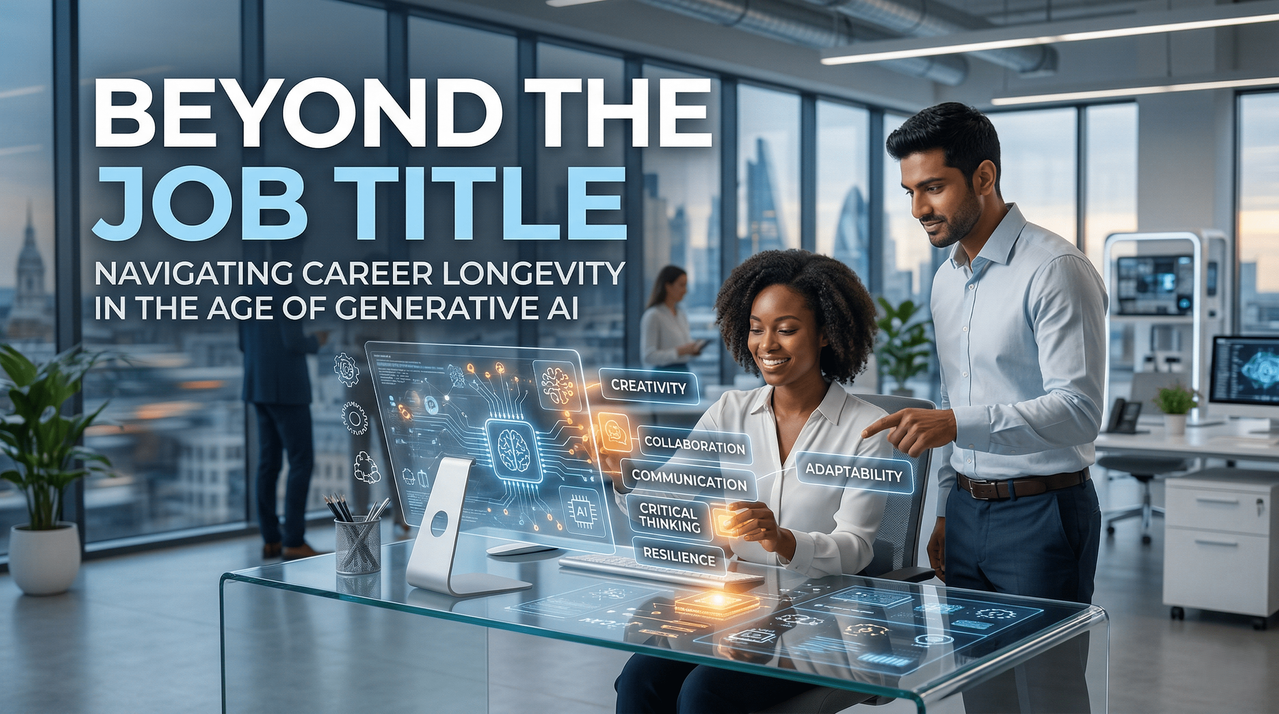
Beyond the Job Title: Navigating Career Longevity in the Age of Generative AI
The global workforce is currently standing at a precipice, staring into a future shaped by a technology that moves faster than any industrial revolution before it. Generative artificial intelligence (AI) is no longer a distant "what if"; it is a visceral reality that is rapidly claiming any role defined by process-driven tasks. From Silicon Valley to the financial hubs of London and the emerging tech scenes in Lagos or Bangalore, the anxiety is universal.
However, according to Anish Raman, LinkedIn’s Chief Economic Opportunity Officer and co-author of the bestseller Open to Work: How to Get Ahead in the Age of AI, the narrative of "job destruction" is missing a crucial nuance. The future isn't necessarily about the end of work, but rather the end of work as we have known it for the last century.
From Fatalism to Agency: Breaking the AI Anxiety
The current conversation surrounding AI and employment is often charged with a sense of "fatalism"—the belief that humans are merely along for the ride as technology dictates our professional destiny. This mindset suggests that the replacement of workers is inevitable and predetermined. Raman argues that this is the first hurdle every professional must clear.
The trajectory of our careers in the AI era depends on choices, beliefs, and proactive steps. Work is undergoing a fundamental transformation, not a terminal decline. The shift from "anxiety to agency" requires a realization that while we cannot control the pace of technological advancement, we have absolute control over our fluency with these tools and the tasks we choose to prioritize.
The Easiest Technology to Master
One of the most encouraging aspects of generative AI is its accessibility. Unlike the early days of the internet or the complex languages of software engineering, AI is the most "human-compatible" technology ever created. It closes knowledge and entrepreneurship gaps by using natural language. For the first time, the "know-how" barrier has been lowered, allowing individuals to focus on what to build rather than just how to build it.
Deconstructing the Job: Tasks Over Titles
For decades, we have defined ourselves by our job titles: "Software Engineer," "Accountant," or "Data Scientist." In the age of AI, this is a dangerous habit. Raman suggests that we must view every job as a collection of tasks rather than a static title.
Consider the "learn to code" mantra that dominated the last decade. Many who followed that advice now fear that AI programs like Claude or ChatGPT have rendered their skills obsolete. But a closer look at the data reveals a different story:
- The Demand for Engineers: Hiring for software engineers is actually increasing across non-tech sectors like healthcare and consulting.
- The Shift in Focus: The job is moving away from the manual process of writing syntax toward "full-stack building," ethical oversight, and customer-centric design.
- Vulnerability vs. Evolution: If your job is 90% coding, you are vulnerable. If your job is 20% coding and 80% problem-solving and collaboration, AI becomes your greatest lever for productivity.
By stripping away the title and looking at the tasks, workers can identify which parts of their day can be offloaded to AI and which parts require the "human touch."
The Efficiency Trap: Why We Aren't Machines
A significant portion of the modern "knowledge economy" has been built on a machine-like view of human capability. Since the Industrial Age, work has been synonymous with efficiency, speed, and scale. We transitioned from fastening bolts on an assembly line to "fastening" responses in an inbox.
The reality is that humans are not built to be machine-like. We are built for:
- Complex Thought: The ability to navigate ambiguity.
- Storytelling: Organizing people around ideas, nations, or shared goals.
- Adaptability: Pivoting when the environment changes.
As machines begin to "out-machine" us in terms of efficiency and data processing, it forces a long-overdue return to our innate strengths. For the last 70,000 years, the human brain has been the most complex object in the known universe. Our value has always been in our imagination and innovation—traits that have been sidelined by the modern obsession with "more, better, faster."
The "Five Cs" of Human Capability
To thrive in this new landscape, Raman and his co-author Ryan Roslansky emphasize a shift in how we train, hire, and credential workers. We are moving away from technical and analytic skills as the sole markers of value and toward what they call the unique human capabilities.
While the book Open to Work outlines a comprehensive framework, the core revolves around resilience and adaptability. The market is shifting its valuation toward individuals who can:
- Collaborate across diverse teams.
- Communicate complex ideas with empathy.
- Create novel solutions that don't rely on historical patterns (where AI thrives).
- Critically Think about the ethical and social implications of technology.
The New LinkedIn: From Resume to Classroom
In a world where job titles are fluid, platforms like LinkedIn are also evolving. The "selling point" of professional networking is no longer just the status of a title or a digital resume. Instead, it is becoming a global classroom.
The most successful professionals today are those using the platform to share "how-to" insights and curiosities. They are the ones saying, "I used this tool to summarize my notes, and it freed up three hours for me to brainstorm a new product line." This move toward "micro-entrepreneurship" within traditional roles is the hallmark of the AI era. Everyone is now an entrepreneur of their own career path, using AI to lower the barriers to entry for new ideas and business ventures.
Is Any Job Truly "Safe"?
A common belief is that face-to-face roles—doctors, nurses, or service workers—are shielded from the AI wave. While these roles are indeed "safer" in terms of human interaction, they are not immune to change.
A doctor, for instance, may still see patients, but their "back-office" tasks (notetaking, research, administrative filing) are ripe for AI intervention. This is a positive shift; it allows the practitioner to spend more time on the human element of medicine. However, even these professionals must remain "up-to-date" on technology. The ultimate differentiator will be a concept Raman calls: "Nobody Beats You at Being You."
The market will always value individuals who can define their unique strengths—those who can blend their personal history, cultural perspective, and emotional intelligence into their professional output.
Conclusion: The Ten-Year Plan is Dead
If there is one definitive takeaway for the modern worker, it is this: Do not have a ten-year plan. In a world of quantum computing and rapidly evolving robotics, planning for a specific job title a decade away is an exercise in futility.
Instead, focus on what you can control today:
- Fluency: Become comfortable with AI tools.
- Humanity: Hone your soft skills and emotional intelligence.
- Agility: Be prepared to rebuild your job every year.
The age of AI isn't a signal to step back; it's a call to step up into the most human parts of ourselves. Work is changing, but for those who embrace the shift from tasks to talents, the opportunities have never been more expansive.

Comments
No comments yet. Be the first to share your thoughts!
Leave a Comment