The New Imperialism: Inside the "Empires of AI" and the High Cost of Innovation
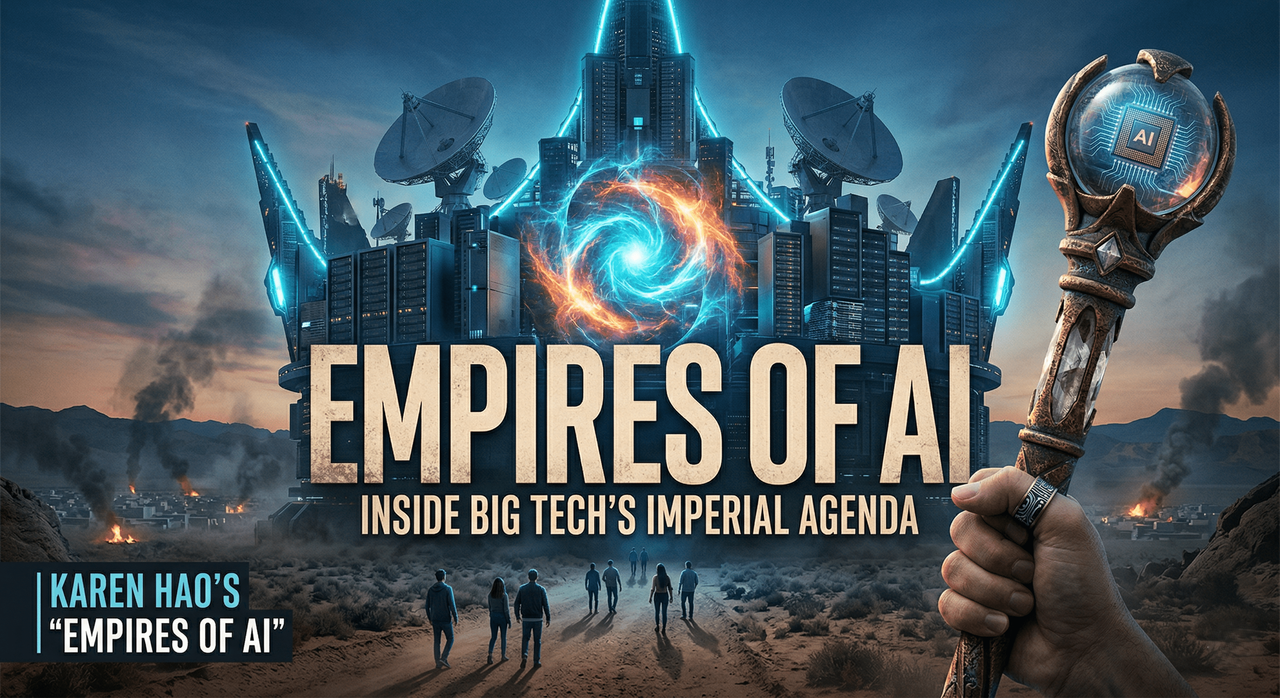
In the heart of Silicon Valley, a new kind of map is being drawn—one that doesn't just outline territories, but the very fabric of human interaction, labor, and knowledge. Recently, Karen Hao, a leading AI researcher and author of the provocative book Empires of AI, sat down for a revealing interview that pulls back the curtain on the industry's inner workings. Her message is clear: we are witnessing the rise of a power system so concentrated and inhumane that it threatens to reshape global society without the consent of the billions it affects.
The narrative often fed to us is one of "AI for good"—a technological utopia where cancer is cured and climate change is solved. But beneath this polished veneer lies a structure that Hao argues is eerily similar to the colonial empires of the past.
The Imperial Agenda of Big Tech
Hao uses the term "Empires of AI" not as a metaphor, but as a literal description of how companies like OpenAI, Google, and Microsoft operate. According to her research, which included interviews with over 300 industry insiders, these organizations follow a three-pronged imperial strategy:
1. The Land and Resource Grab
Just as old empires laid claim to foreign lands for gold and spices, modern AI giants lay claim to resources that do not belong to them. This "land grabbing" manifests in two ways:
- Data Extraction: The intellectual property of artists, writers, and everyday internet users is harvested without compensation to train massive models.
- Physical Infrastructure: The construction of gargantuan supercomputer facilities requires massive amounts of land, water, and energy, often at the expense of local communities.
2. Labor Exploitation
There is a persistent myth that AI is a "machine-only" endeavor. In reality, the industry relies on hundreds of thousands of low-wage contract workers across the globe. These "ghost workers" perform the grueling task of data labeling—essentially teaching the AI what it is looking at. Furthermore, the tools being built are intentionally designed to automate labor, eroding the rights of workers and centralizing wealth in the hands of the "emperor" class.
3. The Monopoly on Knowledge
Perhaps the most dangerous pillar is the control of information. Tech companies bankroll the majority of AI researchers worldwide. Hao draws a chilling parallel: "If most climate scientists were bankrolled by fossil fuel companies, would we get an accurate picture of the climate crisis?" The answer is a resounding no. By controlling the research agenda, these companies can censor inconvenient findings and gaslight the public into believing they are the only ones capable of understanding—and therefore governing—this technology.
Silencing the Critics: A Campaign of Intimidation
The interview highlighted the extreme lengths to which these "empires" go to protect their image. A prime example is the case of Dr. Timnit Gebru, the former co-lead of Google’s Ethical AI team. When her research showed that large language models (LLMs) could lead to harmful outcomes, she wasn't rewarded for her diligence; she was fired.
This culture of suppression extends beyond the office walls. Hao recounted instances of legal intimidation, where OpenAI reportedly subpoenaed critics and nonprofit watchdogs. In one case, a man running a small nonprofit found a server at his door, demanding every piece of communication he had ever sent. This "fishing expedition" was designed to map out networks of dissent and silence those questioning OpenAI’s transition from a nonprofit to a multi-billion dollar for-profit entity.
The "Dune" Analogy: The Messiah Complex
One of the most fascinating segments of the interview was Hao’s comparison of the AI world to Frank Herbert’s sci-fi epic, Dune. In the book, myths are planted on planets to control the populace, and the protagonist, Paul Atreides, eventually loses himself in the very myth he created to gain power.
AI CEOs like Sam Altman and Dario Amodei often engage in what Hao calls "mythmaking." They publicly warn of "existential risks" and "catastrophic outcomes" (citing probabilities as high as 10% to 25% for human extinction), while simultaneously insisting that they are the only ones who can safely guide us through the minefield.
"They use both of these narratives to justify an anti-democratic approach. If the technology is that dangerous, they argue, only a small, elite group should be allowed to touch the 'button'."
This psychological phenomenon—a blend of cognitive dissonance and a "Messiah Complex"—allows executives to ignore the current, tangible harms of their technology (like mass unemployment and bias) in favor of a grand, future-oriented battle for human survival.
The Economic Tsunami and the Loss of Control
Beyond the philosophical concerns lies a hard economic reality. The interview suggests that the pursuit of Artificial General Intelligence (AGI)—AI that can outperform humans at any task—is fundamentally incompatible with current capitalism.
If AI begins to rewrite its own code and replace human labor at scale, the circulation of money stops. Without jobs, there is no consumer spending; without spending, the capitalist engine stalls. This leads to a dystopian forecast of mass unemployment, which many fear could trigger civil unrest and societal collapse.
The most telling sign of internal turmoil is the "Great Exit" of OpenAI’s original team. Founders and top researchers like Ilya Sutskever and Mira Murati have left to start their own ventures, often citing safety or a misalignment of mission. When the people closest to the technology—the ones who have seen it "off-camera"—begin to fear the person with their finger on the button, the rest of the world should pay attention.
A Call for Democratic Participation
The interview concludes with a sobering thought: the current trajectory of AI is not an inevitability, but a political choice. We have allowed a system to flourish where decisions affecting billions are made in closed rooms by a handful of billionaires who are more interested in competing with one another than in the welfare of humanity.
To move forward, we must dismantle the "Empire" framework. We need:
- Transparency: Open access to the research and data that powers these models.
- Global Regulation: Governments must regain control over Big Tech to ensure labor rights and social stability.
- Broad Participation: The people whose lives will be most affected by AI must have a seat at the table.
The "demon" isn't just the code; it’s the unchecked power of the people building it. As we stand on the precipice of the AGI era, the question isn't just whether the machines will remain aligned with humans—it’s whether the humans in charge are still aligned with the rest of us.

Comments
No comments yet. Be the first to share your thoughts!
Leave a Comment