

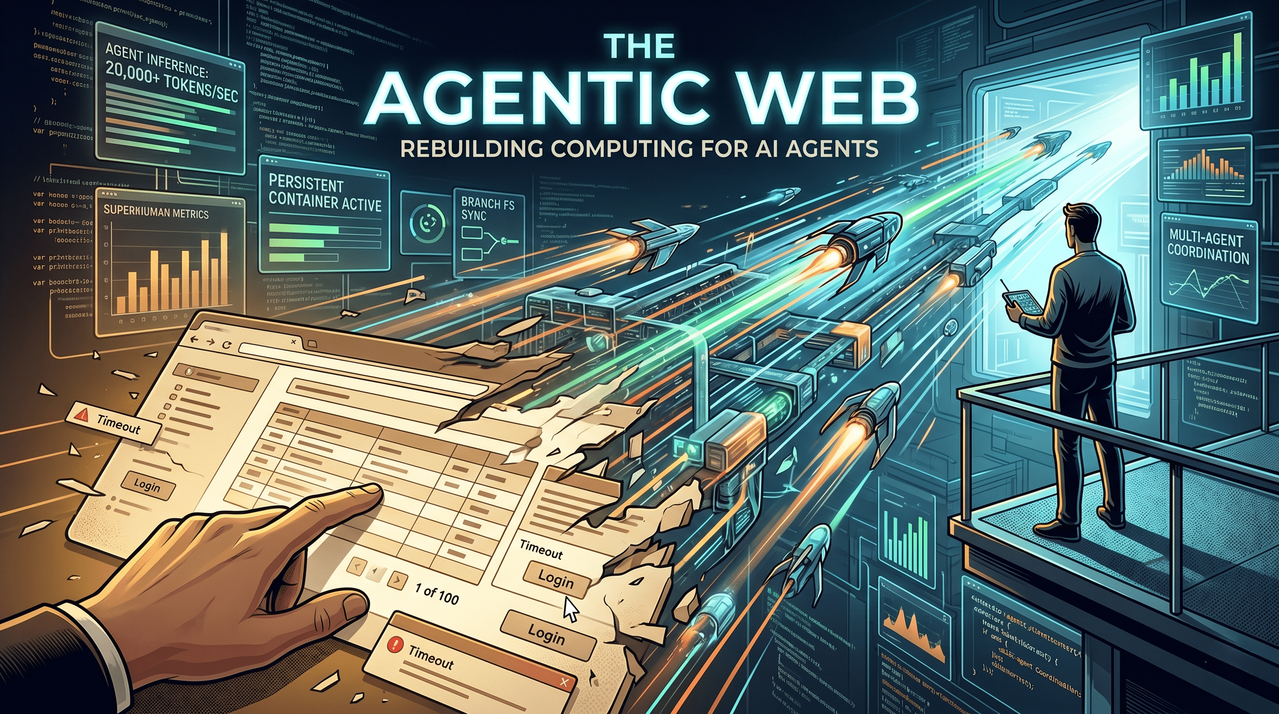
The Great Architectural Shift: Building a Web for Agents, Not Just Humans
For the last half-century, the fundamental axiom of computing was simple: the human was the center of the universe. Every line of code, every user interface, and every database query was calibrated to the speed of human thought and the limitations of human biology. We designed spreadsheets to be scanned by eyes, APIs to be paginated for readable chunks, and authentication flows to wait for a finger to tap a screen.
However, as we move through 2026, we are witnessing the sunset of this human-centric era. Computing is no longer primarily about us. We are entering the age of the Agentic Web—a digital ecosystem being rebuilt from the ground up to accommodate a new class of consumer: the autonomous AI agent.
The Bottleneck of Human Affordances
The current strain on our digital infrastructure isn't a flaw in engineering; it is a byproduct of its success. Our systems are "human-friendly," which in the world of high-speed inference, is synonymous with "unbearably slow."
Consider the modern software stack. A CRM dashboard exists because a human needs to visualize data. An API limits results to 100 rows because a human can't process 10,000 at once. These are human affordances. While they served us perfectly until 2025, they have now become the primary bottlenecks for AI agents that reason at 10x to 50x human speed.
Experts like Google’s Jeff Dean have noted that even if we make AI models "infinitely fast," we might only see a 2x or 3x improvement in actual productivity. Why? Because the agent is forced to wait for human-centric tools. It waits for a compiler to start, a page to load, or an API to paginate. The trillion dollars spent on AI intelligence is currently being sucked into the "wall clock time" of tools designed for a species that takes coffee breaks.
[Image comparing human information processing speed vs AI agent token consumption speed]
The Three Layers of the Agentic Rebuild
The transition to an agent-native infrastructure is already occurring across three distinct layers. This isn't a prediction; it is a linear extrapolation of current development patterns in the tech sector.
1. The Optimization Layer
The first step involves making existing tools faster and more "legible" for AI. We see this in the mass migration of the JavaScript ecosystem toward languages like Rust, Go, and Zig. While these migrations were initially driven by human developers' desire for speed, these languages are inherently better for AI.
For instance, Rust’s strict compiler acts as a natural verification system. If an AI-written block of code compiles in Rust, it is significantly more likely to be functionally correct than a similar block in a more permissive language. The toolchain and the agent are beginning to co-evolve.
2. The Native Primitive Layer
The second layer is more radical: replacing human abstractions with agent-native primitives. This means creating environments where the consumer doesn't have eyes or hands.
We are seeing the rise of:
- Persistent Containers: Environments where agents install dependencies once and stay "alive" for days, eliminating startup latency.
- Branch FS: Copy-on-write file systems that allow for sub-second branch creation, enabling agents to test thousands of iterations instantly.
- Shared KV Caches: Facilitating multi-agent coordination through direct memory sharing rather than slow, text-based communication.
3. The Full-Stack Replacement
The final layer follows "The Bitter Lesson" of AI research: general methods that leverage computation eventually outperform human-engineered solutions. We are reaching a point where "optimizing" old tools is a losing game. As models get faster at reasoning, the overhead of human-designed scaffolding (like UIs and manual step-by-step API calls) becomes an even larger percentage of the total processing time. To stay relevant, the entire software stack must become agent-native.
The Human Promotion: Five Roles for the Future
The shift to an agentic economy often sparks fears of obsolescence. However, a more accurate view is that humans are being promoted to the most difficult and valuable jobs in computing. The "execution" is being automated, leaving the "direction" to us.
In this rebuilt world, five core human roles will dominate the professional landscape:
1. The Tool-Using Generalist (The Spark)
This individual is the catalyst. They understand which AI tools to activate and how to drive a complex, long-running agentic process toward completion. They aren't just "vibe coders"; they are architects of intent who know how to spark a project into existence using the agentic web.
2. The Pipeline Engineer
As agents handle more of the "thinking," humans must handle the "plumbing." This role focuses on infrastructure, security, and data flow. They ensure the pipelines are robust, the agents have the right permissions, and the system is measurable. They are the guardians of the agentic environment.
3. The Relationship Closer (The Human Face)
Commerce remains a human-to-human endeavor. Even an agent-run company will eventually hit a ceiling where a deal requires a handshake, a dinner, and mutual trust. We will likely see AI-led corporations hiring high-level human salespeople specifically to provide the "human face" necessary to close high-stakes business deals.
4. The "Adult in the Room" (The Strategic Lead)
With superhuman speed comes the risk of superhuman mistakes. We need leaders with the maturity to "put a brake on the system." This role involves deciding where not to aim the AI, maintaining ethical boundaries, and managing the human team members. This is the strategic CEO who understands that some inefficiencies are worth pursuing for the sake of long-term vision.
5. The Creative Visionary
Finally, there is the "Steve Jobs" chair. This role is for those who can imagine experiences that don't yet exist. They provide the polish, the "soul," and the seamlessness that AI, for all its speed, cannot yet synthesize from pure data. They define the what and the why, while the agents handle the how.
Conclusion: Preparing for the 1,000ms Eternity
In a world where agents measure time by CPU clock cycles, a 1,000-millisecond delay is an eternity. As a developer, educator, or business leader, you must stop thinking in terms of "human speed."
The web is being rebuilt for a consumer that never sleeps and processes 20,000 tokens per second. Our task is not to compete with that speed, but to build the scaffolding that supports it and the vision that directs it. This is not a demotion; it is the most significant promotion in the history of technology.
The agentic web is coming—and it’s moving faster than you think. The question is: which of the five roles will you choose to inhabit?

Comments
No comments yet. Be the first to share your thoughts!
Leave a Comment