

The Signal and the Noise: A Definitive Guide to This Week’s AI Revolution
It has been a whirlwind week in the world of artificial intelligence. Between the usual industry turbulence and the inevitable "noise" that accompanies April Fools' Day, finding the actual signal—the news that genuinely impacts developers, businesses, and everyday users—requires a bit of digging.
This report breaks down the most significant shifts from the past few days, moving beyond the headlines to analyze the technical breakthroughs and strategic pivots that are shaping our "agentic" future.
1. The Anthropic Leak: Unveiling "Chyros" and the Post-Prompting Era
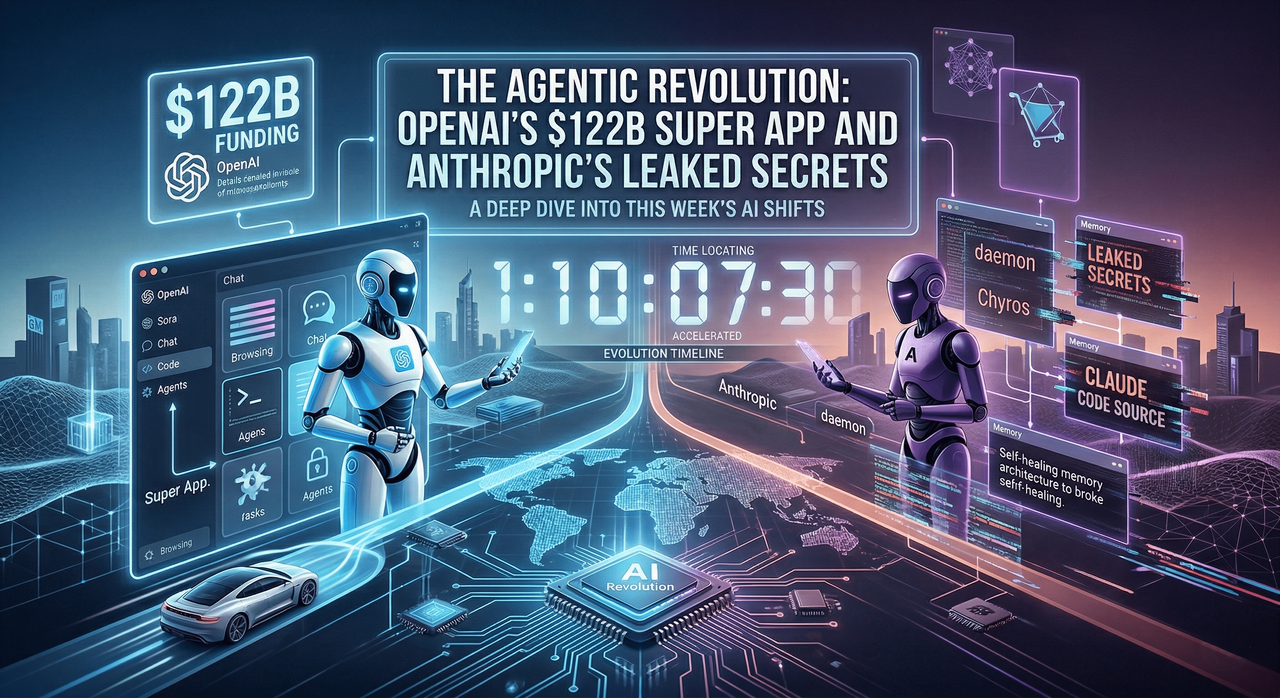
The most startling news of the week was the accidental leak of Anthropic’s Claude Code source code. Discovered via a map file in an npm registry, the code spread rapidly before DMCA takedowns could stem the tide. While Anthropic typically keeps its cards close to its chest, this leak provided an unprecedented look at their architectural direction.
A Sophisticated Memory Architecture
The leaked code revealed a three-layer memory system that signals a departure from traditional "store everything" retrieval. Instead of clogging the context window with raw data, the system uses Memory MD: a lightweight index of pointers perpetually loaded into the context. It doesn't store data; it stores locations. When Claude needs information, it uses "grep" (a pattern-searching tool) to find specific identifiers within raw transcripts, keeping the operation efficient and contextually aware.
The Rise of the "Daemon" Mode: Chyros
The real "star" of the leak is a background agent named Chyros. This represents a fundamental shift in user experience—an autonomous "daemon" (a program running in the background) that acts proactively.
- The Heartbeat: Every few seconds, Chyros receives a "heartbeat" prompt asking, "Anything worth doing right now?"
- Proactive Capabilities: It can fix code errors, respond to messages, and update files while the user sleeps.
- Exclusive Tools: Unlike standard Claude, Chyros has access to push notifications, file delivery (sending things you didn't ask for but might need), and pull request subscriptions to monitor GitHub activity autonomously.
This move toward "post-prompting" suggests a future where AI isn't something you talk to, but something that learns your workflow and acts on your behalf.
2. OpenAI’s $122 Billion Super App Ambition
OpenAI continues its record-breaking trajectory, recently raising $122 billion at a staggering $852 billion valuation. This makes it one of the fastest-growing companies in history, reportedly generating $2 billion in revenue per month—four times faster than the early growth of Alphabet or Meta.
The Unified Super App
Beyond the financial milestones, OpenAI revealed a strategic pivot buried in their fundraising announcement: the creation of a unified AI super app. The company argues that as models become more capable, the bottleneck shifts from "intelligence" to "usability."
Users are tired of jumping between a browser for research, ChatGPT for writing, and Codec for programming. OpenAI’s goal is a single system that understands intent and operates across all applications and workflows. This "agent-first" experience aligns with their recent hiring of Peter Steinberger (creator of OpenClaw), signaling a hard lean into autonomous agents.
The Cost of Innovation: Sora's Shutdown
The report also clarified why OpenAI recently phased out Sora. Internal data suggests the video generation model was losing roughly $1 million per day. In a landscape where efficiency is becoming as important as capability, a $365 million annual loss on a single feature was simply unsustainable.
3. Creative Revolutions: ReCraft V4 and Professional Aesthetics
For the design community, the launch of the ReCraft V4 family of models is a game-changer. Unlike general-purpose image generators, ReCraft is built for "agency-quality" assets.
The V4 release includes:
- V4 Pro: Focuses on photorealistic scenes, mockups, and complex compositions that understand lighting and negative space like a human art director.
- V4 Vector: Perhaps the most impressive feature, this model generates native SVG vector graphics. These aren't just "fake" vectors; they are scalable, editable files ready for professional production.
The model’s strict prompt adherence and ability to handle text without the usual "AI wonkiness" make it a top-tier tool for brand visuals and packaging design.
4. The LLM Landscape: Open Weights vs. Frontier Models
The week saw a flood of new Large Language Models (LLMs), bridging the gap between open-source accessibility and closed-source power.
Google’s Gemma 4
Google released Gemma 4, an open-weight model designed specifically to run on modern Android devices and laptop GPUs. Under the Apache 2.0 license, it offers a powerful option for developers who want to run agentic systems locally without relying on cloud APIs.
Alibaba’s Qwen 3.5 & 3.6
Alibaba’s cloud division dropped two heavy hitters:
- Qwen 3.5 Omni: An omnimodal model capable of "vibe coding." You can describe a vision to your camera, and the model instantly builds a functional website or game.
- Qwen 3.6 Plus: Designed for real-world agents, featuring a 1 million token context window by default. Benchmarks show it rivaling models like Opus 4.5 in document recognition and video reasoning.
5. Practical AI: Microsoft, Slack, and the Real World
Away from the high-level LLM wars, AI is becoming deeply embedded in our tools and physical environments.
Microsoft MAI Transcribe 1
Microsoft released MAI Transcribe 1, a speech recognition model achieving best-in-class accuracy across 25 languages. In tests measuring Word Error Rate (WER), it significantly outperformed Whisper and Gemini 3.1 Flash, particularly in noisy environments.
Agentic Slack
Salesforce is transforming Slack from a chat app into an "ultimate teammate." New capabilities include:
- Meeting Transcription: Automatic note-taking and summarization.
- MCP Client: Native customer management that reads channels and updates contacts automatically.
- Multi-Platform Integration: Recording and summarizing meetings even when they happen on Zoom.
AI in the Physical World
- General Motors: GM is using AI to compress design timelines, transforming sketches into concept videos and running aerodynamic testing before a physical prototype is ever built.
- Instacart Smart Carts: The future of grocery shopping involves "Caper Carts" equipped with Nvidia Jetson chips. These carts use cameras and scales to track items and provide real-time recommendations as you walk through the aisles.
Conclusion: Shifting to the Background
The overarching theme of this week is the "disappearance" of AI. Whether it’s Anthropic’s background daemons, OpenAI’s unified super app, or Slack’s autonomous teammate, we are moving away from the "chatbot" era.
We are entering a period where the AI sits in the plumbing—proactively fixing errors, managing our calendars, and designing our products—before we even think to ask. As these models become "agentic" by default, the goal for developers and users alike is to filter the noise and leverage the tools that provide a true, proactive signal.

Comments
No comments yet. Be the first to share your thoughts!
Leave a Comment