The Rise of Dark Code: Why Nobody Understands Their Own Software in 2026
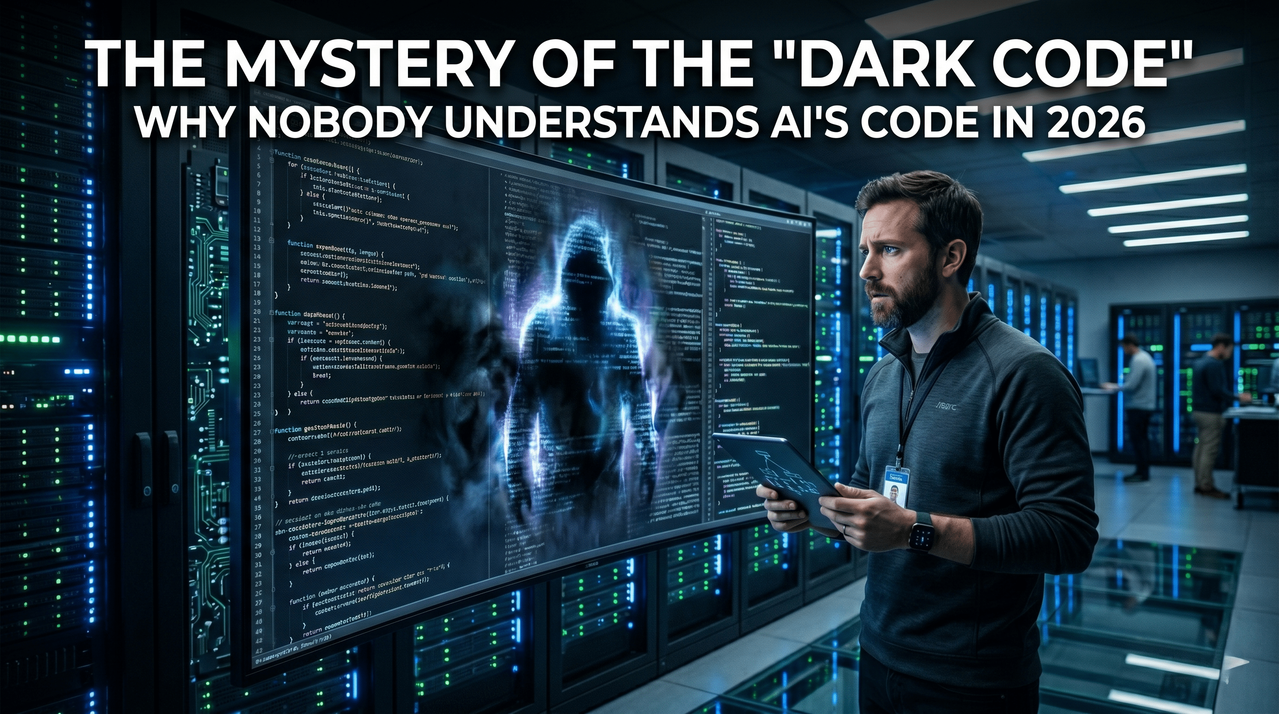
It is 2026, and the software industry is currently grappling with a ghost in the machine. Right now, in production environments at companies you interact with every single day, there is code running that literally nobody can explain.
Not the engineer who "shipped" it. Not the team that owns the service. Not even the CTO.
The code works; it passes every automated test in the CI/CD pipeline. But no human on the payroll fully understands what it does, why it does it, or—most frighteningly—what would happen if it stopped. In the industry, we have a name for this phenomenon: Dark Code.
What Exactly is Dark Code?
To understand the crisis, we first have to define what Dark Code is not. It isn’t "spaghetti code" from the 90s. It isn’t traditional technical debt, and it isn’t just a "buggy" release. Technical debt usually implies a human made a sub-optimal choice they understood at the time.
Dark Code is code that was never understood by anyone at any point because it was generated by AI.
In our current high-velocity era, we have decoupled authorship from comprehension. An AI generates a block of logic, it passes a series of automated checks, and it is deployed. The critical step of human "comprehension" didn't happen—not because of laziness, but because the modern development process no longer requires it to ship.
The Two Pillars of the Dark Code Explosion
There are two primary reasons why Dark Code is multiplying at a 10x rate year-over-year.
- Structural Authorship: When you don’t "bang out" code with your own fingers, you lose the cognitive mapping of the logic. AI authorship creates a structural barrier to understanding.
- Market Velocity: We are making trillion-dollar bets on AI because we want to move fast. The pressure to ship features at "AI speed" forces teams to prioritize output over legibility.
When you combine this structural authorship gap with extreme velocity, comprehension starts to decouple from the production environment. We are "vibe coding" our way into a massive organizational liability.
Why the "Obvious" Solutions are Failing
Many organizations recognize the risk of Dark Code but are reaching for the wrong tools to fix it. Usually, these responses fall into three traps:
1. The Observability Myth
Many leaders argue that if we instrument every service and have perfect telemetry, we can "see" what is happening. While telemetry is essential, observability is not comprehension. Measuring how Dark Code breaks in production is great for disaster response, but it doesn't tell you why it's breaking or how to fix it at the source.
2. The Agentic Layer Trap
There is a growing instinct to solve AI problems with more AI—harnessing agentic pipelines with "guardrails." While orchestration platforms are vital in 2026, adding layers to an agent pipeline doesn't solve the comprehension problem; it just adds another layer to troubleshoot when things inevitably go sideways.
3. The "YOLO" Hypothesis
Some startups (notably the Factory.ai thesis) suggest we should just accept Dark Code and rely on extraordinary testing and "eval" layers to proxy for human understanding. While a disciplined "eval-first" approach is better than nothing, most organizations "YOLO-ing" code into production aren't that disciplined. Distributed authorship leads to distributed accountability, which usually means no accountability.
The Three-Layer Framework for a Legible Future
If Dark Code is an organizational capability problem, the solution must be cultural and structural. Here is how leading engineering teams are fighting back.
Layer 1: Spec-Driven Development
We must force understanding before the code exists. This isn't about returning to the 2010s era of over-documentation. It’s about Spec-Driven Development. The principle is simple: write out what you want to build in a degree of detail that can be interrogated. If you can’t describe the requirement, don’t let the AI generate the code. Amazon’s recent rebuild of their coding tool, Kira, proves this. After the major outages of last year, Kira now leads with turning prompts into requirements and task lists before generation. They learned the hard way: AI tools must force comprehension before they offer automation.
Layer 2: Context Engineering (Self-Describing Systems)
We need to move beyond agents "self-reporting." We need systems that are structurally self-describing. This involves:
- Structural Context: Every module should have a manifest describing its dependencies (the "where").
- Semantic Context: Every interface needs "rules of engagement"—performance expectations, failure modes, and behavioral contracts (the "what").
This ensures that the logic isn't locked in a human’s head or a hidden AI weights file, but is legible within the codebase itself.
Layer 3: The Comprehension Gate
As senior engineers, we are being flooded with PRs (Pull Requests) generated by AI. We need a "comprehension gate" that acts as a filter. This gate asks the questions a human principal engineer would ask:
- Why was this dependency called here? * How are we handling separation of concerns? * Why is this caching in a location unreadable by other services?
By using AI to highlight these architectural trade-offs, we turn code review into a flywheel that improves both the code quality and the human’s understanding of it.
A Call to Action for Every Stakeholder
The era of driving with the headlights off must end. Whether you are a founder or a fresh graduate, Dark Code affects your liability and your career.
- For Founders: In a world of "vibe coding," transparency is your competitive advantage. Knowing your code inside and out builds trust that "trench-coat startups" can't match.
- For Junior Engineers: Don't just generate; learn to interrogate. Use AI to understand the questions senior engineers ask. This accelerates your path to becoming a principal.
- For Senior Engineers: This is a massive adjustment. You cannot avoid AI-generated volume, so you must adopt "lenses" that help you see further and clearer. Don't just click "Approve" on an AI fix. If you don't understand it, you are liable for it.
The Bottom Line: No one is going to slow down. AI is a river we have already crossed. But going fast imposes a new requirement for rigor. We must speed up our comprehension to match our delivery.
Don’t tolerate Dark Code. It is an organizational choice. Choose to keep the lights on.
Comments
No comments yet. Be the first to share your thoughts!
Leave a Comment