
The AI Revolution of Spring 2026: From OpenAI’s "Spud" to the Great Hardware Shift
If you thought the pace of artificial intelligence was going to plateau, this past week has officially proven us all wrong. We are currently witnessing a historic convergence of software breakthroughs and geopolitical hardware shifts that are redefining the industry. From OpenAI’s mysterious "Spud" model to the rise of domestic Chinese silicon, the landscape of 2026 is moving faster than most developers can keep up with.
In this report, I’ll break down the most significant developments of the week, looking at what these changes mean for developers, businesses, and the future of global AI competition.
OpenAI’s Next Move: The Mystery of "Spud" and GPT Image 2
The headline news this week is undoubtedly OpenAI's Spud model. For months, the community has speculated about the successor to the GPT-5 era, and it seems OpenAI is finally ready to pull the curtain back this spring.
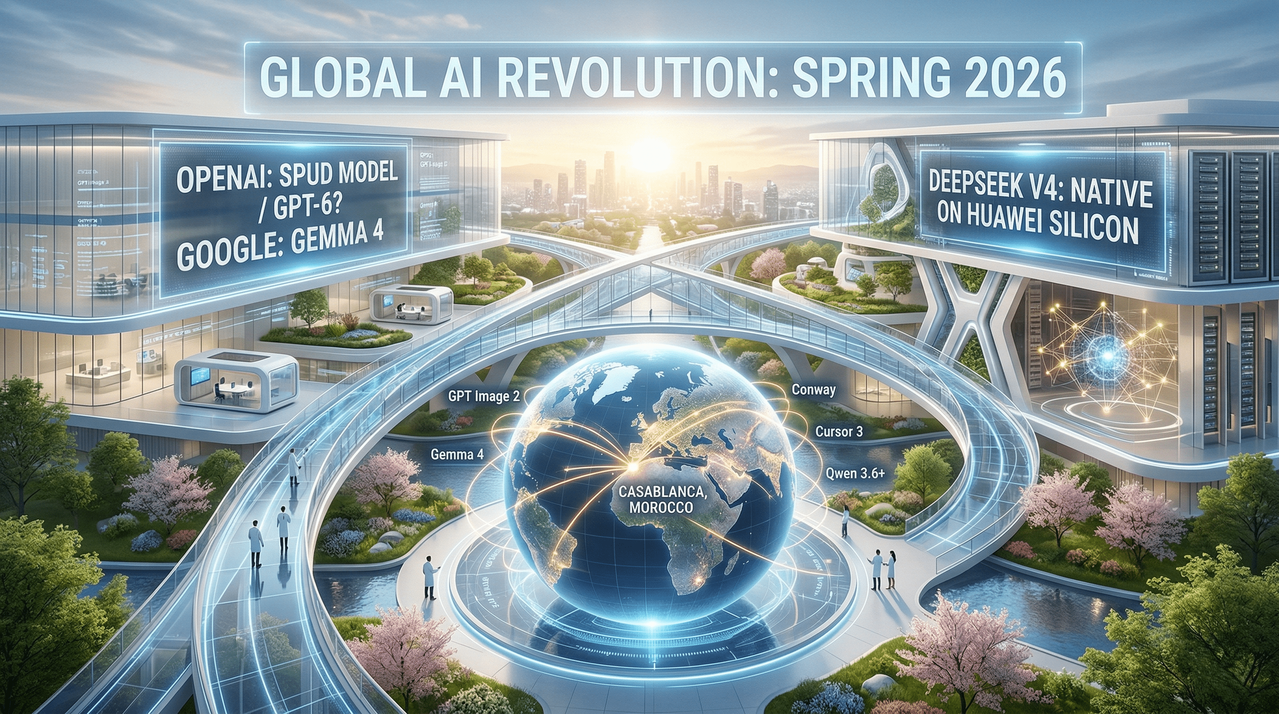
While internal sources are currently labeling the next iteration as GPT 5.5, there is a strong sentiment among researchers that "Spud" might actually be the foundation for GPT-6. OpenAI has reportedly shifted massive resources away from secondary projects like Sora to focus entirely on raw intelligence. OpenAI President Greg Brockman has described the new model as having a "big model smell"—a leap forward that feels more flexible, intuitive, and capable of handling complex, long-term tasks that previous versions simply couldn't touch.
Simultaneously, OpenAI has quietly released an early checkpoint of its new image generation model, GPT Image 2, on the Model Arena. Under the aliases Masking Tape Alpha, Gaffer Tape Alpha, and Packing Tape Alpha, this model is demonstrating near-perfect text rendering and deep world knowledge. It can flawlessly replicate a doctor’s handwritten note or design complex corporate logos with zero spelling errors—an area where even Nano Banana Pro has struggled in the past.
Anthropic’s Evolution: Conway and the End of the "Arbitrage" Era
Anthropic has also been busy, but their updates come with a mix of excitement and a bit of a "bummer" for power users.
First, the exciting part: Conway. This is Anthropic’s new "always-on" agent. Unlike traditional chat interfaces, Conway runs in its own UI instance, capable of operating browser connectors and triggering webhooks. It supports a new standard called CNV-zip, allowing developers to build custom UI tabs and context handlers. This isn't just a chatbot; it’s a system designed to automate entire business functions.
However, the ecosystem is also getting more expensive. Anthropic recently announced that as of April 4th, Pro and Max subscriptions will no longer cover third-party tools like OpenClaude. The "arbitrage era," where users ran thousands of dollars of agentic workloads through a $200 monthly plan, is officially over. Starting mid-April, users will need to switch to API-based billing. While Anthropic is offering one-time credits to soften the blow, it’s a clear signal that the cost of high-compute agentic workflows is finally catching up with the market.
On a brighter note, Claude Code has introduced the Ultra Plan. This feature allows for detailed design planning on the web before implementation, offering a more collaborative environment for remote teams to align on code architecture before a single line is written locally.
The Great Hardware Shift: DeepSeek V4 and Huawei Silicon
Perhaps the most significant long-term story this week involves DeepSeek Version 4. Set to launch this spring, DeepSeek V4 represents a massive strategic shift in the AI hardware landscape. For the first time, a frontier-level model is being trained and run natively on Huawei Ascend 95 PR chips.
This is a major milestone for China’s domestic AI compute stack. By deliberately giving early access to Chinese chip makers while denying Nvidia, DeepSeek is helping to erode the long-term dominance of the CUDA ecosystem. Just two years ago, a domestic stack capable of supporting a frontier model didn't exist; now, Alibaba, ByteDance, and Tencent are placing bulk orders for these Huawei chips, driving prices up by 20% in a matter of weeks. For the global market, this signals a move toward hardware diversification that could eventually challenge Nvidia's "lock-in" advantage.
The Rise of Open and Agentic Models: Qwen 3.6 and Gemma 4
While the giants battle for frontier supremacy, the open-model space is seeing unprecedented growth.
Alibaba Cloud’s Qwen 3.6 Plus has hit the scene with a staggering 1 million token context window. It is currently outperforming Claude Opus 4.5 on several benchmarks, particularly in coding and multimodal understanding. Its ability to "see" and interact with screens like a human user makes it one of the most versatile tools for practical, real-world automation.
Not to be outdone, Google dropped Gemma 4, an open-weight model family built on the Gemini 3 foundation. Released under the Apache 2.0 license, Gemma 4 is already ranking #3 on the global Arena leaderboards. What makes Gemma 4 truly revolutionary is its efficiency. The Gemma 4 E2B variant is now running locally on the iPhone 17 Pro at speeds of 40k tokens per second. Having a model that can reason, understand images, and process audio—all locally on a smartphone—is a game-changer for privacy and on-the-go productivity.
Redefining the Developer Experience: Cursor 3
Finally, the developer environment is evolving to match these agentic capabilities. The Cursor team introduced Cursor 3, a complete redesign of the popular IDE. The new interface assumes a world where agents handle the bulk of the coding. It features a separate window that surfaces relevant parts of the codebase only when the agent needs them, and it allows for multiple agents to run across local, remote SSH, or cloud environments simultaneously.
Final Thoughts
The spring of 2026 is shaping up to be the most transformative period in AI history. We are moving away from simple "chatbots" and toward autonomous agents and specialized hardware ecosystems. Whether it’s OpenAI’s pursuit of raw intelligence with Spud, Anthropic’s push into agentic UI with Conway, or Google’s mastery of on-device AI with Gemma 4, the goal is clear: making AI more intuitive, more local, and more integrated into our daily workflows.
The "arbitrage" days might be ending, and the hardware wars might be heating up, but for those of us building in this space, there has never been a more exciting time to be alive. Stay tuned as we continue to track these models through their release cycles.
If you want to stay ahead of these drops and get access to the latest workflows before they go mainstream, make sure to subscribe to the newsletter and join our community. The world of AI doesn't wait for anyone.


Comments
No comments yet. Be the first to share your thoughts!
Leave a Comment