

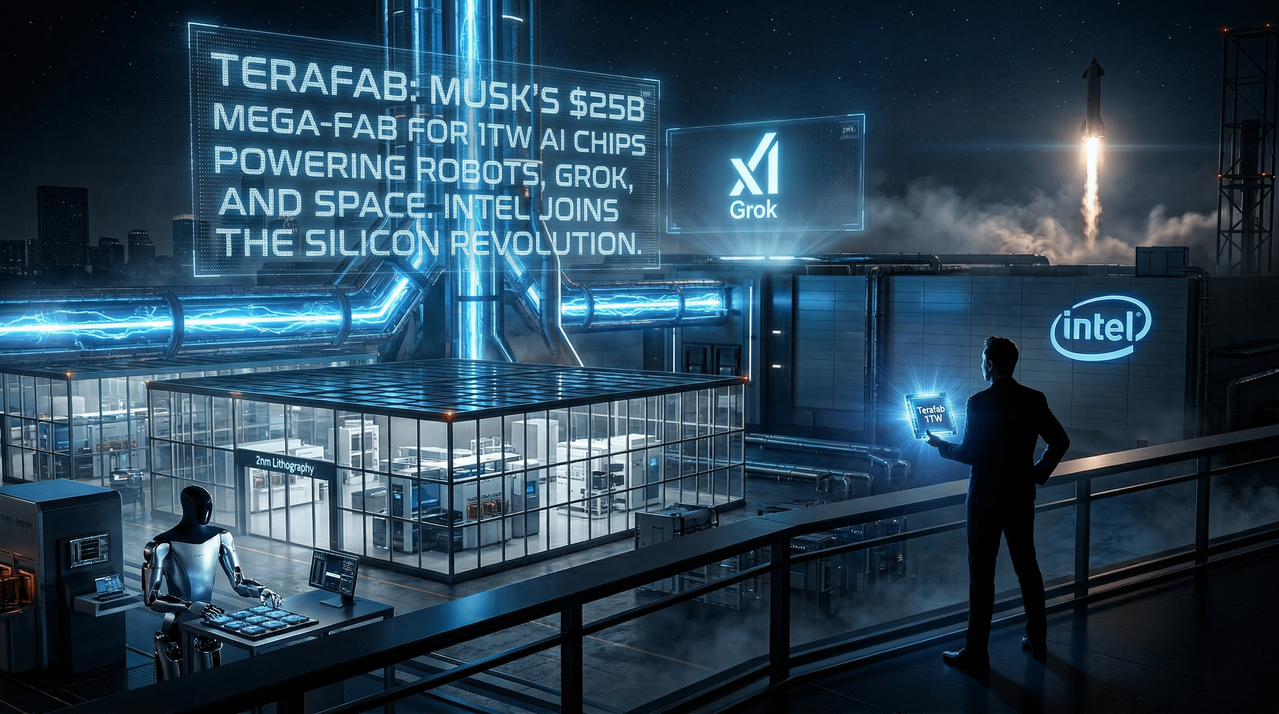
Terafab: SpaceX, xAI, Tesla & Intel's 1TW AI Chip Factory – What It Means for You
In the blistering race for AI dominance, Elon Musk's ecosystem—Tesla, SpaceX, xAI, and now Intel—is dropping a semiconductor bombshell: Terafab, a $20-25 billion mega-factory poised to churn out 1 terawatt (1TW) of AI compute power per year. That's not hyperbole; it's roughly equivalent to twice the entire U.S. electricity consumption today, all funneled into chips for robots, self-driving cars, Grok AI, and even orbital data centers.34
Announced in March 2026 and supercharged by Intel's partnership on April 7, Terafab isn't just another fab—it's a vertically integrated beast combining design, 2nm lithography, fabrication, memory production, advanced packaging, and testing under one massive roof in Austin, Texas.56 Spanning nearly 1 million square feet (10x Giga Texas), it targets Terafab AI supremacy, slashing reliance on TSMC and Nvidia while fueling xAI hardware for the multi-planetary future.3
If you're in AI, robotics, autonomous vehicles, or just betting on the AI chips 2026 boom, this changes everything. Compute costs could plummet 50% or more by 2028, democratizing edge AI for everyone from indie devs to enterprises.7 Let's break it down: the tech, timeline, impacts, and why you should care.
What is Terafab? The Ultimate Vertical Integration Play
Terafab (stylized as TeraFab or TERAFAB) is a joint venture redefining AI chips 2026. Born from Musk's frustration with global chip shortages—"We either build Terafab or we don’t have the chips"—it's custom-built for his empire's insane compute hunger.3
Key Specs at a Glance:
| Feature | Details |
| Capacity | 1TW AI compute/year (100K-1M wafer starts/month) |
| Location | Giga Texas North Campus, Austin, TX |
| Cost | $20-25B |
| Process Node | 2nm+ advanced lithography |
| Integration | Logic, memory, packaging in-house |
| Chips Produced | AI5/AI6 inference for edge (FSD, Optimus); radiation-hardened for space |
| Partners | Tesla (20% output: FSD/Optimus/Dojo), xAI (Grok inference), SpaceX (80%: orbital AI/satellites), Intel (design/fab expertise) |
Unlike Nvidia's GPUs, which guzzle power in massive data centers, Terafab focuses on efficient edge inference chips. Think billions of low-power units for:
- Tesla: Full Self-Driving (FSD), Cybercab robotaxis, millions of Optimus humanoids.
- xAI: Grok models running real-time inference at scale.
- SpaceX: Radiation-proof chips for Starship missions and orbital data centers (bypassing Earth's energy grids).1011
Intel's entry? A lifeline. The chip giant brings foundry muscle, boosting shares 11% overnight, while Musk gets U.S.-based sovereignty amid CHIPS Act subsidies.12
Terafab Timeline: From Announcement to 1TW Dominance
Visualize this timeline graphic for your blog (embed as SVG or Canva infographic):
2026 Mar: Announcement (Tesla/SpaceX/xAI JV) → Construction starts @ Giga TX
2026 Q4: AI5 small-batch production (Tesla FSD pilot)
2027: Volume ramp → 100K wafers/mo; Intel full integration
2028+: 1M wafers/mo → Full 1TW/year; SpaceX orbital deployment
2030: Global expansion? (Multi-fab network)
- March 22-24, 2026: Musk unveils Terafab via X livestream—goes viral with 785+ likes on key posts.13
- April 7, 2026: Intel joins ("proud to refactor silicon fab tech").2
- Late 2026: First AI5 chips for Tesla Optimus pilots.
- 2027: Scale to terawatt output, powering 80% space apps.8
This isn't pie-in-the-sky; construction's already underway next to Giga Texas.14
Why Terafab Matters for AI Chips 2026: Breaking Nvidia's Grip?
xAI hardware like this flips the script on AI chips 2026. Current shortages? Obsolete. Terafab's scale crushes external foundries:
Impact Predictions (Data-Driven Forecasts):
- Cost Drop: 50%+ by 2028 – In-house production halves fab costs (no TSMC markups). Edge AI inference: $0.01-0.05 per query vs. $0.10+ today.
- Supply Chain Immunity – No more Nvidia queues; captive output for MuskCos.
- Edge AI Explosion – Optimus fleets (millions by 2030) need trillions of inferences/day.
- Space Compute Revolution – Orbital AI sidesteps Earth's 1-10% grid losses.
- U.S. Leadership – 50x global AI chip output boost, per analysts.15
| Metric | Today (2026) | Post-Terafab (2028) |
| Global AI Compute | ~0.02 TW/year | +50x surge |
| Chip Cost/Watt | $10-20 | <$5 |
| Edge Efficiency | 100-500 TOPS/chip | 1K+ TOPS (AI6) |
| Radiation-Hard Chips | Scarce/Expensive | Mass-produced |
Nvidia? Threatened. Musk's vertical stack (silicon → software → deployment) could undercut H100s for robotics/autonomy.16
What It Means for YOU: Consumers, Devs, Investors
For Everyday Users:
- Cheaper Tesla FSD/Optimus: Robotaxis at $0.20/mile; home helpers under $20K.
- xAI hardware ubiquity: Grok apps run locally, privacy-first.
For Businesses/Devs:
- Affordable Terafab AI access? Musk hinted ecosystem partnerships post-ramp.
- Robotics boom: Train/deploy humanoids 10x faster.
Investors: INTC +11%, TSLA primed. Watch for $25B CHIPS funding.12
Global Ripple: U.S. "silicon sovereignty" accelerates AGI, but raises monopoly fears.
FAQ: Your Burning Terafab Questions
Q: What is Terafab AI exactly?
A: A mega-fab for 1TW/year AI chips, focused on inference for Tesla/xAI/SpaceX.17
Q: How does Intel fit in?
A: Provides design/fab expertise; "refactor silicon" for 2nm+ nodes.1
Q: Will compute costs drop 50%?
A: Likely—scale + vertical integration mirrors Tesla's battery cost cuts (90% since 2010).
Q: SpaceX's role?
A: 80% output for orbital AI (Starlink data centers, Starship autonomy).11
Q: Public access to chips?
A: Initially captive; potential sales post-2028.
Q: Risks?
A: Delays (fabs take 3-5 years), $25B burn rate, tech hurdles.
The Future: Terafab Ushers in AI Abundance
Terafab isn't just AI chips 2026—it's the silicon backbone for abundance. Robots in factories, AIs in orbit, cars that drive themselves flawlessly. Musk's vision: Compute so cheap, intelligence is everywhere.



Comments
No comments yet. Be the first to share your thoughts!
Leave a Comment