

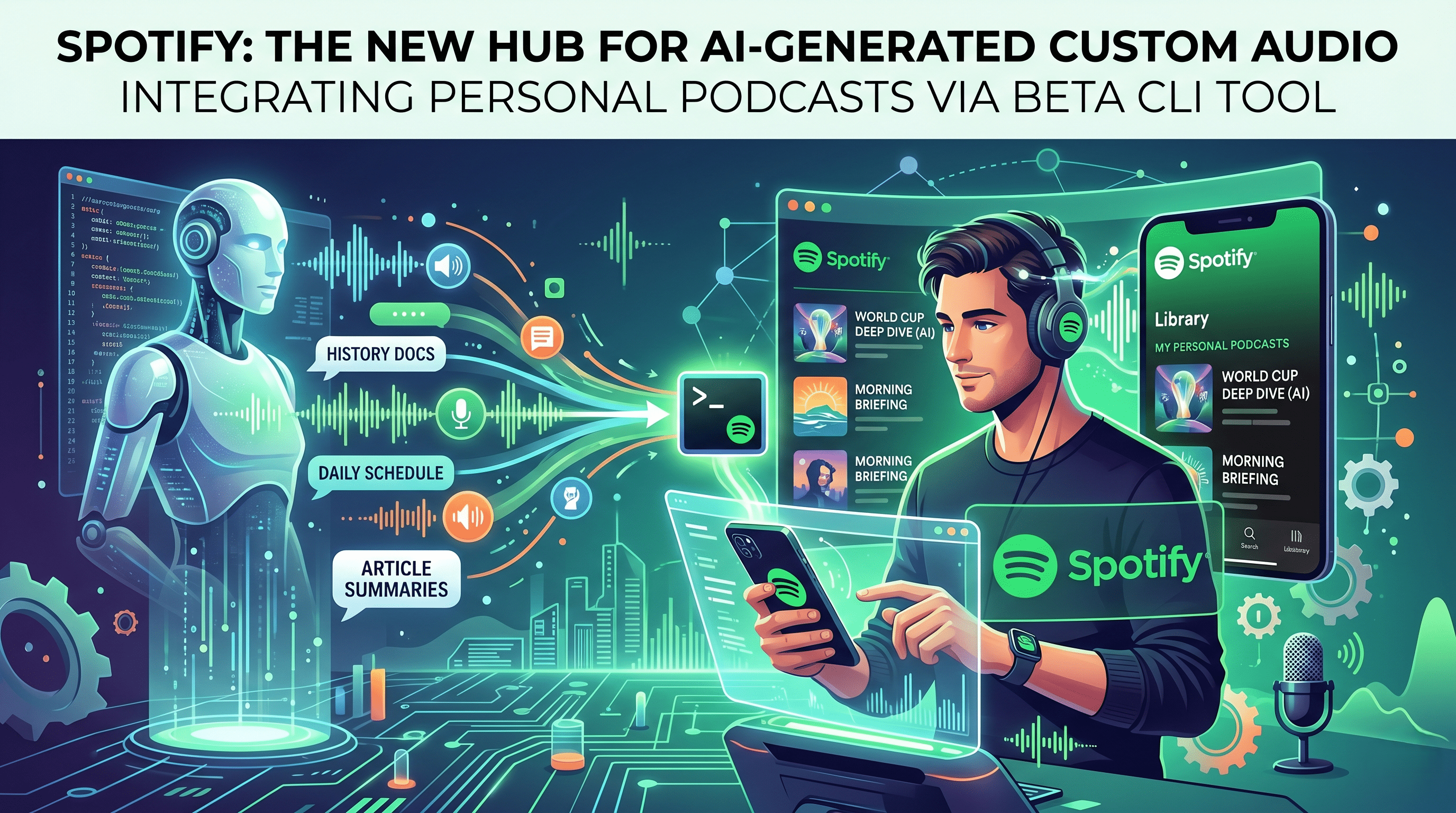
Spotify’s Next Frontier: Transforming the App into the Ultimate Hub for AI-Generated Personal Audio
The landscape of digital audio consumption is undergoing a massive paradigm shift. Over the past few years, the artificial intelligence industry has successfully bridged the gap between static text and dynamic, conversational audio. Applications such as Google’s NotebookLM, Hero, and recently updated productivity suites like Adobe Acrobat have introduced a groundbreaking feature: the ability to transform existing, dry materials—ranging from lengthy corporate documents and daily schedules to complex research articles—into engaging, radio-quality podcasts. However, a significant friction point remained for the end-user. Once these personal podcasts were generated, they lived in isolated silos, completely separated from the platforms where users actually spend their time listening to music and mainstream shows.
Now, Spotify is moving decisively to eliminate that friction. In a highly anticipated move, the streaming giant has introduced a framework that allows users to access their custom, AI-generated podcasts directly within the Spotify app. However, this is not a simple drag-and-drop consumer feature just yet; it represents a sophisticated integration requiring specific programming tools and AI agents to execute.
The Rise of Hyper-Personalized Audio
To understand the magnitude of Spotify’s latest update, one must look at current consumer behavior regarding generative AI. The concept of "personal audio" is rapidly evolving beyond curated playlists. Users are no longer just consuming content created by third-party broadcasters; they are actively generating their own highly tailored listening experiences.
According to recent technical dispatches from Spotify, the company recognized that consumers are increasingly leveraging autonomous AI agents to orchestrate their daily lives. Individuals are generating personal audio tracks that serve as tailored guides for their day. This ranges from comprehensive, conversational summaries of university class notes designed for exam preparation, to morning briefings that detail an executive’s complex calendar and emails. The demand was clear: users wanted a seamless pipeline to push these hyper-personalized audio files directly into Spotify, the centralized platform where they already consume their favorite music and public podcasts.
The Technical Backbone: Spotify’s Beta CLI Tool
To facilitate this new era of personalized audio, Spotify has launched a new Command Line Interface (CLI) tool, which is currently operating in beta. This tool is specifically designed to work in tandem with advanced AI coding assistants and agents.
The integration specifically targets power users, developers, and AI enthusiasts who already utilize sophisticated models to automate their digital workflows. Spotify has explicitly stated that users operating tools such as OpenAI’s Codex, Anthropic’s Claude Code, or the emerging OpenClaw framework can seamlessly leverage this new CLI tool. By utilizing these agents, users can orchestrate the creation of a custom podcast and automatically import the resulting audio file directly into the Spotify ecosystem for later consumption.
This represents a brilliant strategic maneuver by Spotify. Rather than building a native, potentially resource-heavy text-to-podcast generator directly inside the mobile app—which would compete with established giants like Google and Adobe—Spotify is positioning itself as the ultimate, agnostic destination platform. They are building the infrastructure to host the audio, regardless of which external AI engine generated it.
Privacy and the Personal Library
A critical concern surrounding AI-generated content involving personal data—such as private schedules, proprietary corporate documents, or personal study notes—is security. Spotify has addressed this by ensuring a strict, privacy-first architecture for this feature.
When an AI agent uses the CLI tool to push a newly minted podcast to the platform, that audio file is strictly ring-fenced. The customized podcasts will appear seamlessly within the individual user’s private Spotify library, ensuring easy, on-the-go access across all their devices. However, these generated tracks are completely sandboxed; they are absolutely inaccessible to other Spotify users, and they will not appear in public search results or algorithmic recommendations. Your morning briefing remains entirely yours.
A Step-by-Step Report: How the Integration Functions
For those equipped with the necessary technical proficiency, the pathway to integrating AI-generated audio into Spotify follows a logical, secure pipeline. The workflow requires user authentication and direct agent prompting:
- Accessing the Repository: Users must first navigate to the dedicated GitHub page for Spotify's beta CLI tool. Here, comprehensive documentation and installation instructions are provided for setting up the local environment.
- Authentication and Linking: Following the initial setup, users are prompted to authenticate the connection. This involves logging into their active Spotify account via a secure web browser interface, granting the local CLI tool the necessary permissions to write data to their private library.
- Agent Prompting: Once the infrastructure is linked, the user can deploy their preferred AI agent (e.g., Claude Code or Codex). The interaction is driven by natural language prompts.
- Generation and Delivery: The AI agent processes the request, generates the audio file using its underlying text-to-audio capabilities, and interfaces with the Spotify CLI to upload the track. The user is then provided with a direct, private Spotify listing link to their newly generated show.
To illustrate the power of this workflow, consider a complex informational request. A user can write a highly specific prompt to their agent, such as: "Build me an audio session that dives deep into the history of the World Cup with details about key players, where it’s been held, and what I should know about the games this year." The agent will synthesize the vast amount of historical and current data, format it into a conversational podcast structure, render the audio, and seamlessly save it directly to the user's Spotify account.
GEO Implications: The Global Impact of Localized AI Audio
From a Generative Engine Optimization (GEO) and global content strategy perspective, this development is revolutionary. Traditional podcasting relies on a creator making content that appeals to a broad enough audience to justify production costs. Spotify’s new CLI integration flips this model entirely, introducing the era of the "Audience of One."
This capability transcends geographical and linguistic boundaries. A user in Tokyo can prompt their agent to generate a daily digest of European financial news, translated into highly colloquial Japanese audio, and pushed to their Spotify for their morning commute. Similarly, a student in Brazil could feed complex scientific papers written in English into their agent and request a simplified, Portuguese audio breakdown to listen to while at the gym. This level of hyper-localization and absolute relevance is the ultimate endpoint of personalized media, making the Spotify platform infinitely more valuable to the individual user.
The Future of Streaming
Spotify’s decision to open its gates to AI-generated personal audio marks a profound shift in how we define a streaming platform. It is no longer just a digital record store or a distribution network for global broadcasters. By providing the tools to import agent-generated, hyper-specific audio, Spotify is evolving into a personalized auditory operating system for everyday life. While currently gated behind CLI tools and requiring a basic understanding of AI agents, this beta phase is undoubtedly the foundational step toward a future where our Spotify libraries are equally split between our favorite artists and our own custom-built, private audio companions.


Comments
No comments yet. Be the first to share your thoughts!
Leave a Comment