

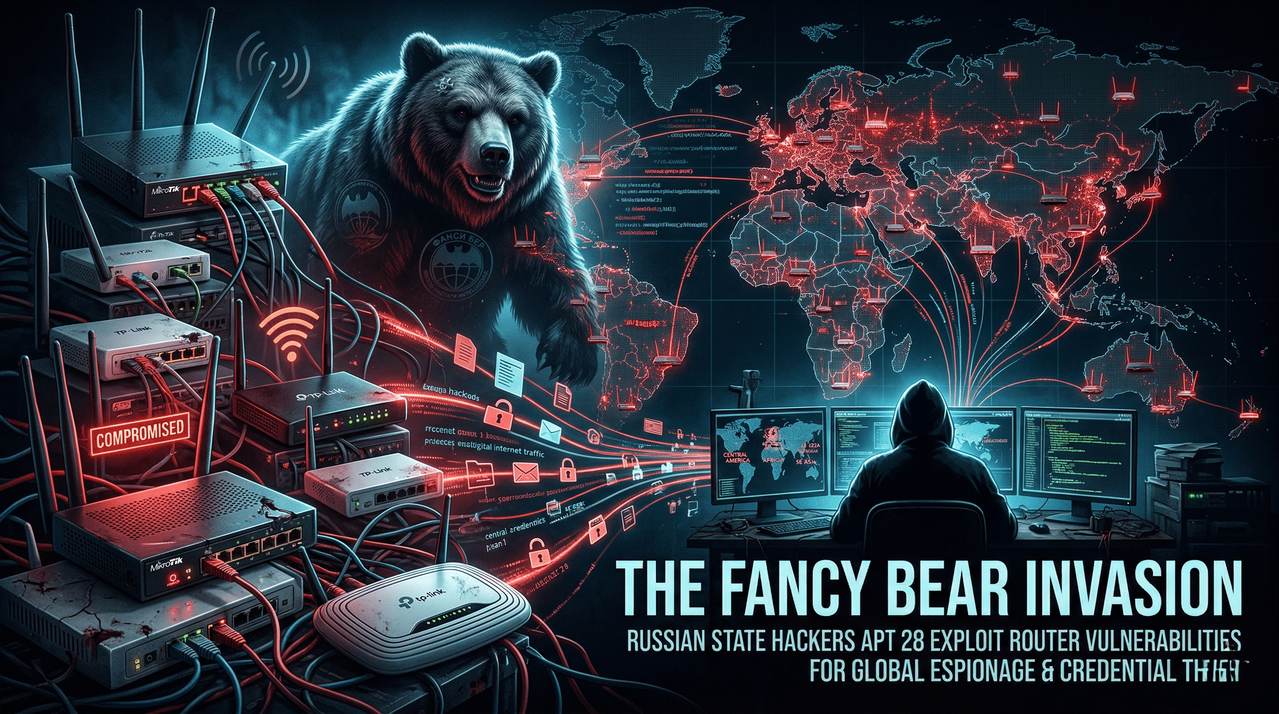
Global Cyber Alert: Russian State Hackers 'Fancy Bear' Hijack Thousands of Routers in Massive Global Espionage Campaign
In an era where remote work and interconnected devices define our daily digital lives, the humble home and small business router has quietly become the frontline of international cyber warfare. On Tuesday, a coalition of prominent security researchers and government authorities issued a stark warning: a sophisticated group of Russian government-backed hackers has successfully hijacked thousands of home and small office network routers around the globe.
This ongoing, highly orchestrated campaign is designed with a singular, malicious purpose—to stealthily redirect victims' internet traffic, harvest sensitive passwords, and steal critical access tokens. By infiltrating these essential gateways to the internet, threat actors are effectively bypassing modern security measures, turning the hardware we rely on daily into a weapon of state-sponsored espionage.
Here is a comprehensive report on the situation, the threat actors involved, the geographic scope of the attack, and what this means for global cybersecurity.
The Culprits: The Return of Fancy Bear (APT28)
Cybersecurity analysts have attributed this massive infrastructure compromise to a notoriously aggressive and long-running Russian hacking collective widely known in the intelligence community as Fancy Bear, or APT28 (Advanced Persistent Threat 28). Cybersecurity experts and international intelligence agencies widely assess that this group operates under the direct purview of Russia’s military intelligence agency, the GRU.
Fancy Bear is not a new player in the world of cyber espionage. The group has a storied history of executing high-profile, destructive hacks and sophisticated spying operations that have shaped geopolitical landscapes. They are perhaps most infamous for the highly publicized breach of the Democratic National Committee (DNC) during the 2016 United States elections. More recently, they were implicated in the destructive cyberattack that crippled the satellite internet provider Viasat in 2022, an event that coincided with the onset of the conflict in Eastern Europe.
This latest tactical shift toward targeting consumer-grade and small business networking equipment marks a concerning evolution in their methodology, moving away from exclusively targeting hardened enterprise networks toward exploiting the softer underbelly of global internet infrastructure.
The Methodology: Exploiting MikroTik and TP-Link
According to coordinated intelligence releases from the U.K. government’s National Cyber Security Centre (NCSC) and Black Lotus Labs (the threat research arm of Lumen Technologies), the hacking group primarily targeted unpatched, off-the-shelf routers manufactured by networking giants MikroTik and TP-Link.
The attackers did not rely on zero-day vulnerabilities (unknown flaws). Instead, they capitalized on previously disclosed, well-documented vulnerabilities that network administrators and home users had simply failed to patch. Because many home and small business routers run on heavily outdated firmware and are rarely monitored, they are incredibly susceptible to remote compromise. Owners are almost never aware that their devices have been breached.
The NCSC characterized the initial stages of these operations as "likely opportunistic in nature." The threat actors essentially cast a massive, automated net across the public internet, scanning for any vulnerable device they could find. Once a massive botnet of compromised routers was established, the hackers could quietly sift through the compromised networks, "narrowing in on targets of intelligence interest as the attack develops."
The Mechanics of the Attack: Bypassing 2FA
The technical execution of this campaign highlights a frightening reality about modern web security. Once Fancy Bear infiltrates a router, they modify the device's fundamental network settings—specifically, its DNS (Domain Name System) configurations.
When a victim on a compromised network attempts to visit a secure website (such as an email portal, a government database, or a corporate login page), the hacked router surreptitiously intercepts the request. The internet traffic is then routed through clandestine infrastructure operated by the Russian hackers.
Victims are quietly redirected to visually identical "spoofed" websites entirely controlled by APT28. When users enter their credentials, the hackers not only steal their usernames and passwords but also intercept their session tokens. This is the most critical aspect of the breach: by stealing active session tokens, the hackers can authenticate themselves into the victim's online accounts without ever needing to trigger or intercept Two-Factor Authentication (2FA) codes.
Global Reach and Geographic Targeting (GEO Impact)
The scale of this espionage campaign is staggering, highlighting the deeply interconnected nature of global internet infrastructure. According to the detailed forensic analysis provided by Black Lotus Labs, Fancy Bear successfully compromised at least 18,000 victims. The geographic footprint of this attack is massive, spanning approximately 120 countries worldwide.
While the net was cast globally, researchers noted a distinct geographic and demographic focus once the attackers began narrowing their targets. The campaign heavily impacted high-value targets across specific geopolitical regions, particularly:
- North Africa
- Central America
- Southeast Asia
Within these regions, the hackers specifically targeted government departments, regional law enforcement agencies, and local email service providers.
Microsoft, whose threat intelligence teams released corroborating details of the campaign on Tuesday, noted in a comprehensive blog post that they had identified over 200 distinct organizations and 5,000 consumer devices actively affected by these hacking operations. Alarmingly, Microsoft confirmed that this included at least three major government organizations located within the African continent, underscoring the strategic geopolitical interests driving this cyber espionage.
International Retaliation: The FBI Botnet Takedown
In response to this sprawling global threat, an international coalition of government and private sector entities has taken decisive kinetic action in cyberspace. Lumen Technologies confirmed that it operated as part of a joint task force, which heavily involved the United States Federal Bureau of Investigation (FBI), to actively disrupt the botnet's command and control (C2) servers.
Through coordinated technical and legal maneuvers, the coalition successfully targeted and dismantled the infrastructure supporting the attacks, taking several malicious domains offline and effectively severing the hackers' connection to the thousands of hijacked routers.
The FBI is expected to make a formal public announcement detailing the full scope of the takedown operations in the coming days. As of publication, an official spokesperson for the FBI had not responded to requests for comment regarding the specifics of the disrupted domains.
Securing the Digital Perimeter
This massive global breach serves as a stark reminder that cybersecurity is not just an enterprise issue; it begins in the living rooms and back offices where the internet enters our environments. To protect against state-sponsored actors and opportunistic cybercriminals alike, users must treat their routers as critical security appliances:
- Update Firmware Immediately: Regularly check for and install firmware updates for your MikroTik, TP-Link, or any other brand of router.
- Change Default Credentials: Never leave a router secured by its factory default username and password.
- Disable Remote Management: Ensure that the router's administrative interface cannot be accessed from the public internet, restricting access strictly to the local network.
- Reboot Devices: In some instances, malware residing purely in the router's memory can be cleared by performing a hard reboot, though patching remains essential to prevent reinfection.
As state actors continue to blur the lines between civilian infrastructure and military intelligence gathering, maintaining foundational network hygiene is our first, and often best, line of defense.



Comments
No comments yet. Be the first to share your thoughts!
Leave a Comment