

Pentagon Expands Classified AI Strategy with Nvidia, Microsoft, AWS, and Reflection AI Deals
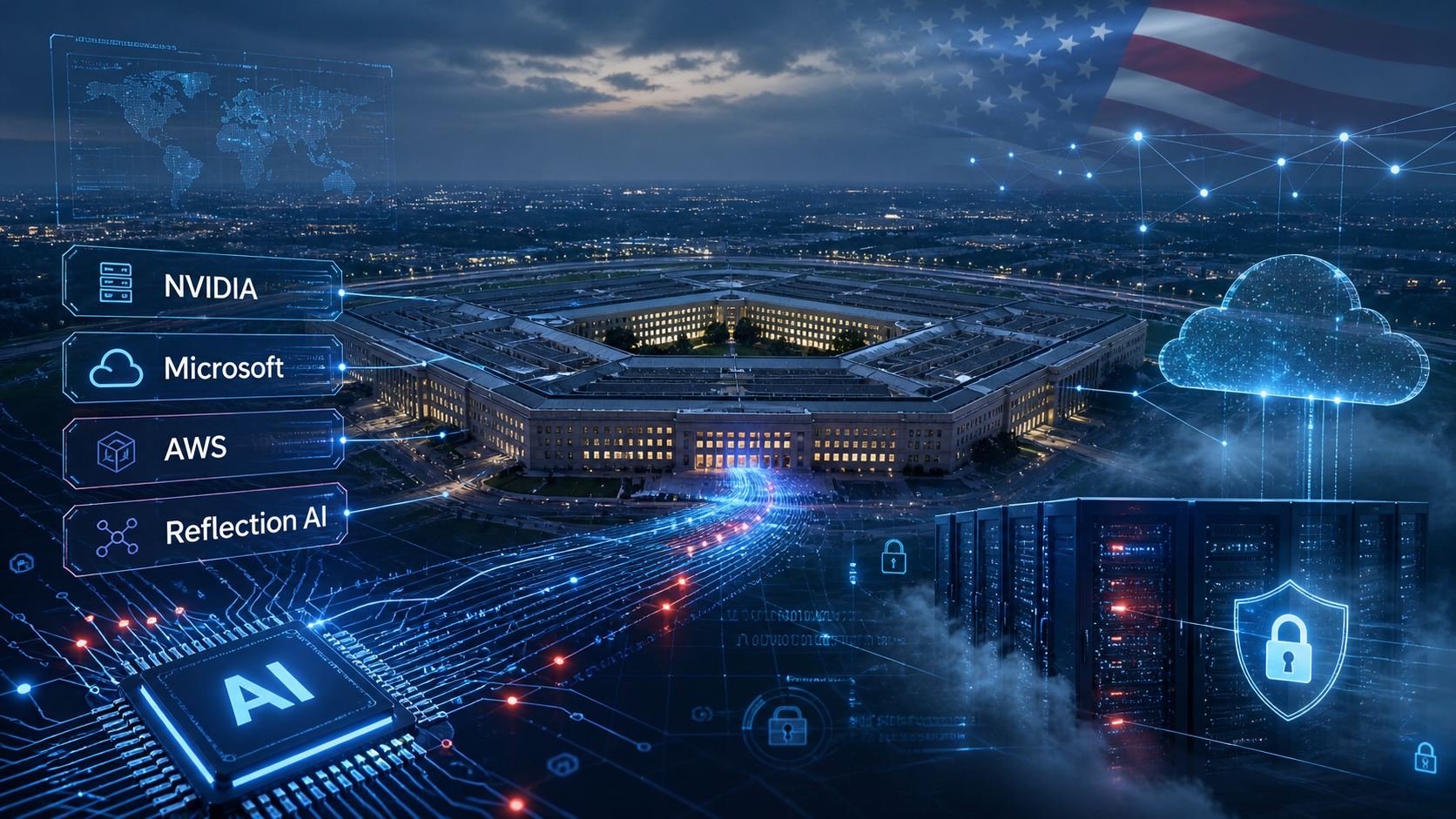
The United States Department of Defense has taken another major step in its artificial intelligence strategy by signing new agreements with Nvidia, Microsoft, Amazon Web Services, and Reflection AI to deploy advanced AI technologies on classified military networks. The move signals a broader push by the Pentagon to build a secure, flexible, and vendor-diverse AI ecosystem capable of supporting national security operations across multiple domains.
Announced on Friday, May 1, 2026, the agreements allow the Department of Defense to use AI hardware, cloud infrastructure, and advanced models from some of the most influential American technology companies inside classified environments. According to the Pentagon, these tools will be used for “lawful operational use,” with the goal of strengthening military decision-making, improving situational awareness, and accelerating data analysis for defense personnel.
The announcement comes shortly after the Defense Department reached similar arrangements with Google, SpaceX, and OpenAI, showing that the U.S. military is rapidly expanding its AI partnerships beyond a small group of providers. This diversification is especially important as artificial intelligence becomes central to the future of defense planning, intelligence processing, battlefield coordination, and cyber operations.
Pentagon Moves Toward an AI-First Military Force
The Department of Defense described the new agreements as part of its transformation toward making the United States military an “AI-first fighting force.” This phrase reflects a strategic shift in how the Pentagon views artificial intelligence: not merely as a support tool, but as a core capability that can shape modern warfare.
In practical terms, AI can help defense teams process large volumes of intelligence data, summarize complex information, detect patterns, support logistics, analyze threats, and improve the speed of operational decisions. In classified military environments, these capabilities become even more sensitive because they may involve national security data, mission planning, secure communications, and battlefield intelligence.
By integrating technologies from Nvidia, Microsoft, AWS, and Reflection AI into classified networks, the Pentagon aims to provide U.S. warfighters with tools that can improve decision superiority. Decision superiority refers to the ability to understand a situation faster and more accurately than an adversary, then act before the opponent can respond effectively. In modern defense operations, where information moves quickly and threats can evolve in real time, this advantage is considered critical.
Why Nvidia, Microsoft, AWS, and Reflection AI Matter
Each company involved in the new Pentagon agreements brings a different part of the AI technology stack.
Nvidia is a global leader in AI chips and accelerated computing. Its graphics processing units, commonly known as GPUs, are widely used to train and run artificial intelligence models. For classified defense networks, access to high-performance AI hardware can be essential for processing large datasets and supporting advanced machine learning systems.
Microsoft already plays a major role in government cloud computing and enterprise software. Its AI and cloud services can support secure collaboration, data management, and model deployment across government-approved environments. Microsoft’s existing presence in federal technology infrastructure makes it a natural partner for expanded defense AI initiatives.
Amazon Web Services is one of the largest cloud providers in the world and has long served government and defense customers through specialized secure cloud offerings. AWS can provide scalable infrastructure for running AI systems, storing sensitive data, and supporting mission-critical workloads.
Reflection AI, while less widely known than the other three companies, represents the Pentagon’s interest in accessing a broader range of AI model providers. Including smaller or newer AI companies may help the Department of Defense avoid dependence on only the largest technology firms and maintain flexibility as the AI market evolves.
Classified Networks and High-Security Environments
The Department of Defense said the companies’ AI technologies will be deployed in Impact Level 6 and Impact Level 7 environments, commonly known as IL6 and IL7. These are among the highest security levels used for government cloud and information systems.
IL6 environments are designed for classified national security information. IL7 environments are even more sensitive and are associated with highly protected classified workloads. Systems operating at these levels require strict security protections, including physical safeguards, access controls, monitoring, auditing, and compliance with defense cybersecurity standards.
Deploying AI inside IL6 and IL7 environments is significant because it shows that the Pentagon is not limiting generative AI and machine learning tools to unclassified administrative tasks. Instead, the department is preparing to use AI in secure settings where classified data can be analyzed without leaving protected networks.
This approach may help the military use AI more effectively while reducing the risks of exposing sensitive information to public or commercial systems. It also reflects a growing recognition that defense AI must be built around secure infrastructure, trusted vendors, and strong governance.
Avoiding AI Vendor Lock-In
One of the most important points in the Pentagon’s statement is its emphasis on avoiding AI vendor lock-in. Vendor lock-in happens when an organization becomes too dependent on a single technology provider, making it difficult or costly to switch to alternatives.
For the U.S. military, avoiding vendor lock-in is not only a business concern. It is also a national security issue. Relying too heavily on one AI provider could limit flexibility, create operational risk, or make the Defense Department vulnerable if a vendor changes its terms, pricing, technology roadmap, or security posture.
By working with Nvidia, Microsoft, AWS, Reflection AI, Google, SpaceX, and OpenAI, the Pentagon is building a multi-vendor AI architecture. This gives the Joint Force access to different models, cloud environments, hardware systems, and technical capabilities. It also allows defense leaders to select tools based on mission needs rather than being restricted to one company’s ecosystem.
The Department of Defense stated that access to a diverse suite of AI capabilities from across the American technology stack will give warfighters the tools they need to act with confidence and safeguard the nation against threats. This language highlights the Pentagon’s belief that AI diversity and resilience are essential to military readiness.
The Anthropic Dispute and the Push for More AI Providers
The new agreements also arrive in the context of the Pentagon’s ongoing dispute with Anthropic, one of the major U.S. artificial intelligence companies. The disagreement reportedly centers on the Defense Department’s desire for broad access to Anthropic’s AI tools and the company’s insistence on usage restrictions.
Anthropic has sought to prevent its technology from being used for areas such as domestic mass surveillance and autonomous weapons. The Pentagon, by contrast, has pushed for fewer restrictions on how it can use AI systems in defense contexts. The conflict escalated into a legal fight, and in March, Anthropic won an injunction against the Pentagon’s attempt to label the company a “supply-chain risk.”
This dispute appears to have reinforced the Defense Department’s motivation to diversify its AI suppliers. By expanding relationships with multiple companies, the Pentagon can reduce the impact of disagreements with any single vendor and maintain access to critical AI capabilities.
GenAI.mil and the Growth of Defense AI Adoption
The Pentagon also reported that more than 1.3 million Department of Defense personnel have used GenAI.mil, its secure enterprise platform for generative AI. GenAI.mil provides access to large language models and related AI tools inside government-approved cloud environments.
Unlike classified AI deployments, GenAI.mil is primarily designed for non-classified tasks. These may include research support, document drafting, summarization, data analysis, and administrative work. Even so, the scale of adoption is notable. More than 1.3 million users suggests that generative AI is quickly becoming a regular part of the Defense Department’s digital workflow.
The success of GenAI.mil may have helped build confidence inside the Pentagon that AI tools can be deployed securely and effectively across a large federal workforce. It also creates a foundation for more advanced use cases, including classified data synthesis and operational decision support.
What This Means for the Future of U.S. Defense Technology
The Pentagon’s latest AI agreements show that artificial intelligence is becoming a permanent pillar of U.S. defense modernization. The focus is no longer only on experimentation or limited pilot programs. The Department of Defense is now building the infrastructure needed to deploy AI at scale, including on classified networks.
For the American defense sector, this development may lead to deeper collaboration between the federal government and major technology companies. It may also increase competition among AI labs, cloud providers, chipmakers, and cybersecurity firms seeking to serve national security customers.
At the same time, the expansion of AI in military settings will continue to raise questions about governance, safety, accountability, and ethical limits. The disagreement with Anthropic shows that not all AI companies agree with the Pentagon on how military AI should be controlled. As AI becomes more powerful, these debates are likely to become more important.
Still, from the Pentagon’s perspective, the objective is clear: build a secure, resilient, and flexible AI ecosystem that gives the United States military an advantage in future conflicts. By bringing Nvidia, Microsoft, AWS, and Reflection AI into classified environments, the Department of Defense is accelerating its transition toward AI-enabled operations.

Comments
No comments yet. Be the first to share your thoughts!
Leave a Comment