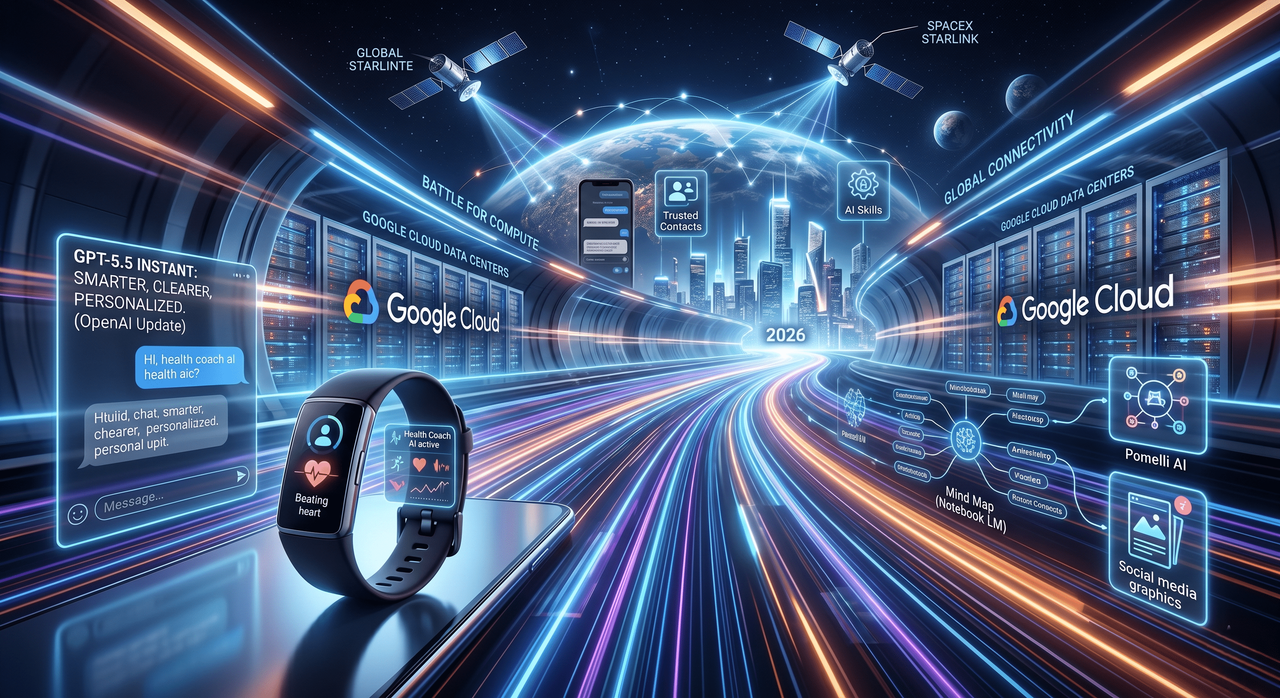
The AI Revolution Hits High Gear: OpenAI’s GPT-5.5, Google’s Health Pivot, and the Battle for Compute
The pace of artificial intelligence development isn't just accelerating; it’s practically breaking the sound barrier. In the past week alone, we’ve seen a massive shift in how the "Big Two"—OpenAI and Google—are positioning their flagship models. From smarter, less "annoying" conversationalists to AI health coaches that know your fitness level better than you do, the landscape of 2026 is looking remarkably different than it did even six months ago.
As someone who tracks these updates daily, I’ve noticed a clear trend: the industry is moving away from "more data" and toward "better utility." Here is a comprehensive report on the most significant updates in the AI ecosystem and what they mean for the average user.
OpenAI’s "Less is More" Strategy: The Rise of GPT-5.5 Instant
For months, power users (myself included) have voiced a similar complaint regarding ChatGPT: it became too verbose. Every simple query was met with a wall of text, repetitive summaries, and unnecessary fluff. OpenAI has finally addressed this with the release of GPT-5.5 Instant.
This new default model is a breath of fresh air. In side-by-side testing against the previous GPT-5.3, the difference is stark. While 5.3 tends to lecture, 5.5 is concise, smarter, and feels more personalized. It answers the question directly without the usual "AI throat-clearing."
Safety and Emotional Intelligence
Beyond raw performance, OpenAI is leaning into the social responsibility side of AI. They’ve introduced Trusted Contacts within ChatGPT. If the model detects a user is experiencing an emotional crisis, it can—if opted into—alert a pre-designated contact. This is a subtle but profound acknowledgment that millions of people are now using LLMs as a form of emotional support, for better or worse.
Furthermore, Sam Altman has signaled a renewed focus on Voice Mode. While the API has received high-fidelity real-time voice models, the consumer app still lags slightly. Altman’s recent comments suggest that voice is the "next frontier" for OpenAI, aiming to make it as fluid and natural as text-based chat.
Google’s Ecosystem Play: Health, Gemini, and "Skills"
Google is currently winning the "value for money" race. Their strategy is simple: bundle everything. By rebranding Fitbit to Google Health and introducing the Fitbit Air (a screenless wearable similar to a Whoop band), they’ve integrated AI directly into the human body’s data stream.
The AI Health Coach
The new Google Health Coach, included with AI Pro and Ultra subscriptions, is a game-changer. It doesn’t just track steps; it acts as a personal trainer that understands context. If you tell it you’ve tweaked your back, it doesn’t just record the injury—it automatically adjusts your workout plan to avoid further strain. It can even swap gym routines for at-home sessions if you mention you’re working late.
Gemini’s Global Reach and Customization
For users in the European Union (EU), the wait is over. Gemini’s "Personal Intelligence" features are finally rolling out. This allows the AI to pull from your travel history and preferences to plan detailed trips. In my own testing, Gemini planned a cross-country road trip, suggesting dog-friendly stops and dietary-specific restaurants without being prompted—it simply "remembered" my life context.
Additionally, two major productivity updates have hit:
- Persistent Instructions in Docs: You can now set "always-on" rules (e.g., "always keep my reports concise") so you don’t have to repeat your style preferences.
- Gemini Skills: Now available in Chrome, "Skills" act as saved prompts. Instead of typing a 500-word meal planning prompt every week, you simply invoke the "Meal Planner" skill.
The Desktop War: Codeex vs. Claude Co-work
The battle for your computer's operating system is heating up. Codeex, a desktop-first AI app, has just released a Chrome plugin. This allows the AI to control your browser, navigate websites, and interact with local files simultaneously.
Unlike many cloud-based tools, Codeex processes data locally, which is a massive win for privacy-conscious users. It is currently the primary competitor to Claude Co-work, though Perplexity has also entered the ring with its "Personal Computer" app for Mac. However, Perplexity’s offering comes with a premium price tag on top of the standard subscription, making Codeex a very attractive middle ground for many.
Scaling the Unscalable: Anthropic’s Compute Crisis
Anthropic (the makers of Claude) has faced a "good" problem: they are too popular. They’ve struggled to keep up with user demand due to compute limitations. To solve this, they recently signed a massive compute deal with SpaceX and Google Cloud.
This highlights a brutal reality in 2026: Great models aren't enough; you need the hardware to run them. Google’s massive infrastructure gives them a unique advantage, while Anthropic is forced to partner with giants to stay in the race. This deal has already resulted in higher usage limits for "Claude Code," much to the relief of developers worldwide.
Productivity Deep Dive: Notebook LM and Pomelli
For the researchers and small business owners, two tools stole the show this week:
- Notebook LM Mind Maps: Google’s research tool now generates interactive, smooth mind maps. You can ask it to map out a sequence of events—like the steps to gold panning—and it produces a visual, zoomable chart that is far more intuitive than a text list.
- Pomelli’s "Catalog" Feature: This free marketing tool now allows businesses to simply paste a URL, and the AI will scrape product images, descriptions, and "brand DNA" to create instant social media campaigns. It’s an "all-in-one" marketing department for people with zero budget.
The Uncanny Valley: What is Real?
Perhaps the most unsettling news of the week didn't come from a corporate press release, but from a viral Reddit post. A user demonstrated a "meta-hallucination" by asking ChatGPT to generate a realistic iPhone screenshot of a chat... wherein the AI was pretending to show a fake photo.
It was a triple-layer of deception that was indistinguishable from reality. As we move further into 2026, the question of "how do we tell what is real?" is no longer a philosophical debate—it’s a daily technical challenge.
Final Verdict
This week proved that the "AI winter" is nowhere in sight. OpenAI is refining the user experience, Google is eating the health and productivity markets, and Anthropic is securing the power it needs to survive.
If you haven't checked your settings lately, I highly recommend running a "prompt audit." As models like GPT-5.5 and Claude 4.6 get smarter, they actually require fewer instructions. Cleaning out your old, cluttered custom instructions might actually result in a better, faster, and more "human" response.
Stay curious, stay informed, and most importantly, stay skeptical of those "real" screenshots.

Comments
No comments yet. Be the first to share your thoughts!
Leave a Comment