

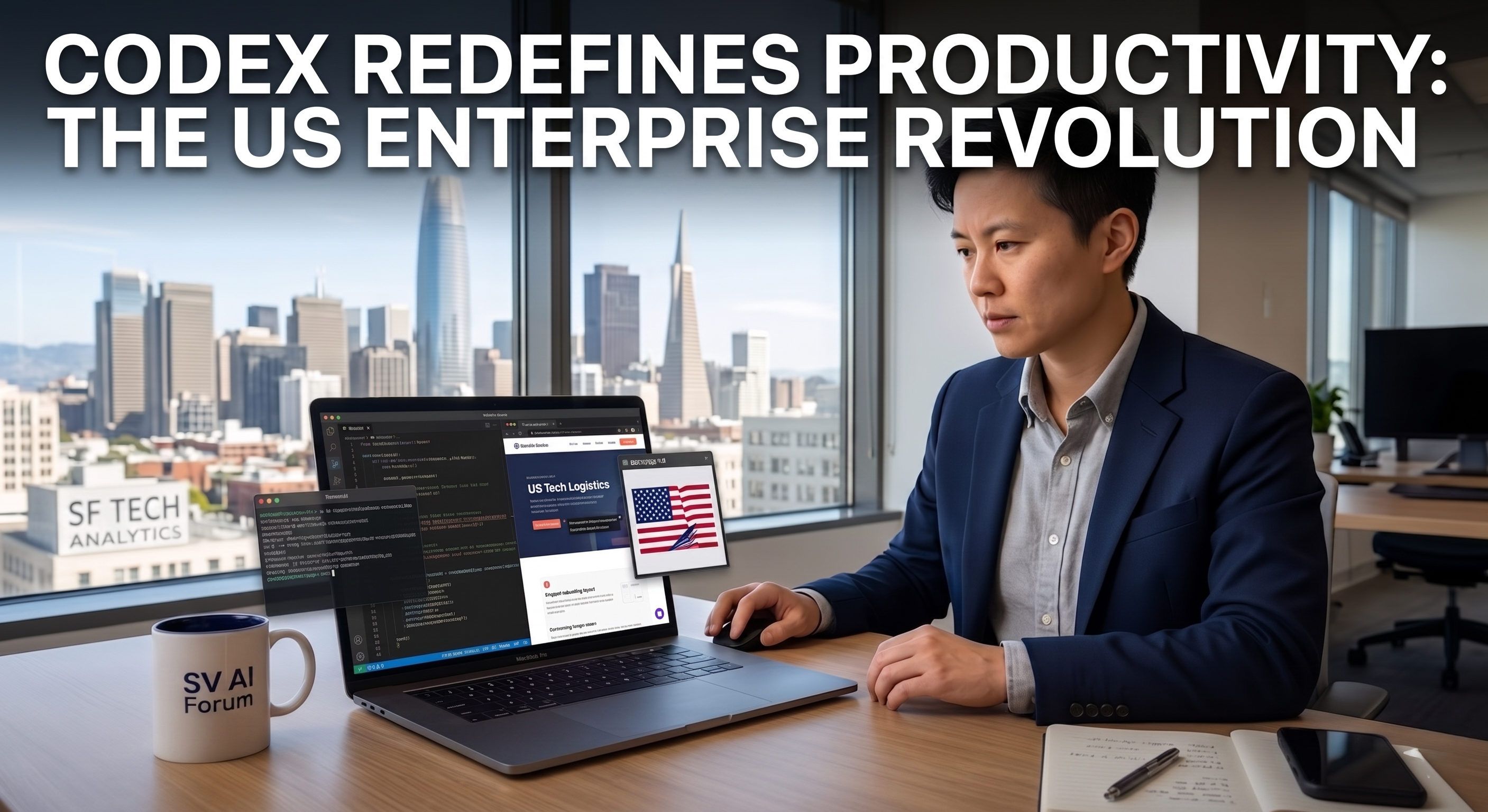
OpenAI Codex Just Transformed How We Work: Background OS Control, In-App Browsing, and the Push for a "Super App"
As I write this from our Silicon Valley headquarters—overlooking the sprawling tech campuses that define American innovation—it is abundantly clear that we have officially crossed a new threshold in human-computer interaction. On April 16, 2026, OpenAI fundamentally shifted the landscape of software development and enterprise productivity with the launch of an immensely powerful new version of the Codex desktop app.
If you thought AI was just a glorified autocomplete tool living in a browser tab, it is time to recalibrate your operational strategy. This latest update brings a smorgasbord of new features and architectural changes. Ranging from unprecedented developer capabilities to a massive expansion into general knowledge work, OpenAI is quietly laying the groundwork for a massive paradigm shift in the US labor market. We are no longer just looking at a coding assistant; we are witnessing the foundational layers of OpenAI’s ultimate “super app.”
In this comprehensive report, we will break down exactly what these new Codex features entail, how they function on American enterprise networks, and what this means for the global workforce—from Wall Street to Austin’s Silicon Hills.
1. The Invisible Co-Worker: Background Computer Control on Mac
The absolute crown jewel of this update is Codex’s newfound ability to perform tasks natively on your Mac in the background. According to OpenAI's official blog post, Codex has evolved from a passive responder into an active, independent agent.
How It Works in Practice: With background computer use enabled, Codex can now interact with all of the applications installed on your machine. It does not just send API calls or operate within a sandboxed environment; it genuinely operates the machine by seeing the screen, clicking interface elements, and typing with its own independent, virtual cursor.
What makes this a total game-changer for American digital professionals—already accustomed to remote and asynchronous work—is the non-intrusive nature of the architecture. Multiple AI agents can now operate on your Mac in parallel, grinding away on complex tasks without ever interfering with the window you are actively working in. Think of it as a virtual VNC connection that doesn't need your physical screen real estate.
For software engineers, this unlocks incredible workflows:
- Iterating Frontend Changes: You can have an agent continuously tweak CSS and layout files in the background while you focus on backend logic.
- App Testing: Codex can autonomously run full end-to-end tests through graphical user interfaces.
- Legacy App Integration: Because it uses a visual cursor and simulated clicks, it can work seamlessly within older, proprietary applications that do not expose an API—a huge win for US manufacturing, finance, and logistics sectors trying to modernize without costly full-system replacements.
Furthermore, OpenAI has introduced a robust scheduling feature that is perfect for optimizing US productivity across timezones. Codex can now schedule work hours, days, or even weeks in advance. It has the authorization to wake your machine from sleep, execute the planned tasks at the exact scheduled time (say, 3 AM while you sleep), and report back when you log in the next morning.
2. The In-App Browser: Visual Feedback and gpt-image-1.5
Writing code is only half the battle; seeing the result and iterating on the design is where bottlenecks usually occur. Recognizing this, OpenAI has equipped the new Codex app with a fully functional in-app web browser.
This is not just a portal to view web pages. It is a highly interactive canvas designed to give the AI context. When a US designer or developer is building a website, this browser allows them to assess the work Codex is doing in real-time. More importantly, it introduces a "comment mode" that mimics the workflow of popular American web design collaboration tools (like Figma, headquartered in San Francisco). Users can drop a pin on a specific DOM element or a particular part of the rendered page and leave direct instructions. The AI instantly understands the spatial and visual context of your comment and adjusts the code accordingly.
Enter gpt-image-1.5: Alongside the browser, Codex now deeply integrates OpenAI's new gpt-image-1.5 model. If a developer or project manager needs a placeholder image, a specific UI mockup, or a graphic asset, Codex can generate high-fidelity images on the fly and immediately inject them into the project.
While currently optimized for local web development, OpenAI has big plans for this feature. As they noted in their release: "Over time we plan to expand it so Codex can fully command the browser beyond web applications on localhost." This signals a near future where Codex can navigate the live internet, research competitors, and scrape data visually with zero human intervention.
3. Expanding the Horizon: 90 New Plugins and Terminal Mastery
While Codex is clearly broadening its target demographic, it has not forgotten its power-user roots. Developers will be thrilled to see that Codex can now manage multiple terminal tabs simultaneously. It can compile code in one tab, monitor server logs in another, and run Git commands in a third. It even has the capability to autonomously read GitHub review comments and take direct action to resolve pull request feedback—streamlining the DevOps pipelines standard in the American software industry.
However, the addition of 90 new plugins is what truly pushes Codex out of the "developer-only" sandbox and into the realm of general knowledge work.
These plugins act as connective tissue to enterprise software (CRMs, ERPs, Slack) and data analysis tools used by American companies daily. By slotting into existing corporate workflows, Codex is suddenly a viable tool for project managers, digital marketers, and financial analysts on Wall Street. It can pull data from a marketing dashboard, draft a comprehensive report, and email it to stakeholders—all while the human operator is busy in a Zoom meeting.
4. The Grand Vision: Evolving into the OpenAI "Super App"
When you look at this smorgasbord of updates—background OS control, localized browsing, visual feedback loops, image generation, and a massive plugin ecosystem—it looks like a random platter of disparate changes. But as a market analyst, the unifying theme is glaringly obvious: Consolidation.
OpenAI is no longer just building a coding assistant; they are creating the definitive workspace OS. These features are the modular building blocks of OpenAI’s heavily rumored "super app." This eventual ecosystem is expected to seamlessly combine the company’s Atlas web browser, the Codex engine, and other agentic tools into a single, unified interface that rules your digital life. It will be the "one ring to rule them all" for digital productivity.
During a recent media briefing, Codex lead Thibault Sottiaux confirmed this exact sentiment, giving reporters a candid look at their strategy:
"We’re actually doing the sneaky thing where we’re building the super app out in the open and evolving it out of Codex."
By disguising their super app as a developer tool, OpenAI is able to beta-test their most advanced, OS-level AI agents with the most forgiving and technically literate audience possible: programmers. Once the friction is smoothed out, this underlying architecture will undoubtedly be repackaged for the average American consumer.
Final Thoughts: Impact on the US Market
As we process this monumental update, the economic implications for the American tech sector are immense. We are witnessing the democratization of high-level productivity. While some may view this with trepidation regarding labor disruption, I view it as an upskilling opportunity.
American businesses must embrace the operational reality of "agentic AI." Tools like the new Codex desktop app require shift from "doing the work" to "managing the work." The AI agent revolution isn't coming; as of April 16, it is already running in the background of your Mac.



Comments
No comments yet. Be the first to share your thoughts!
Leave a Comment