

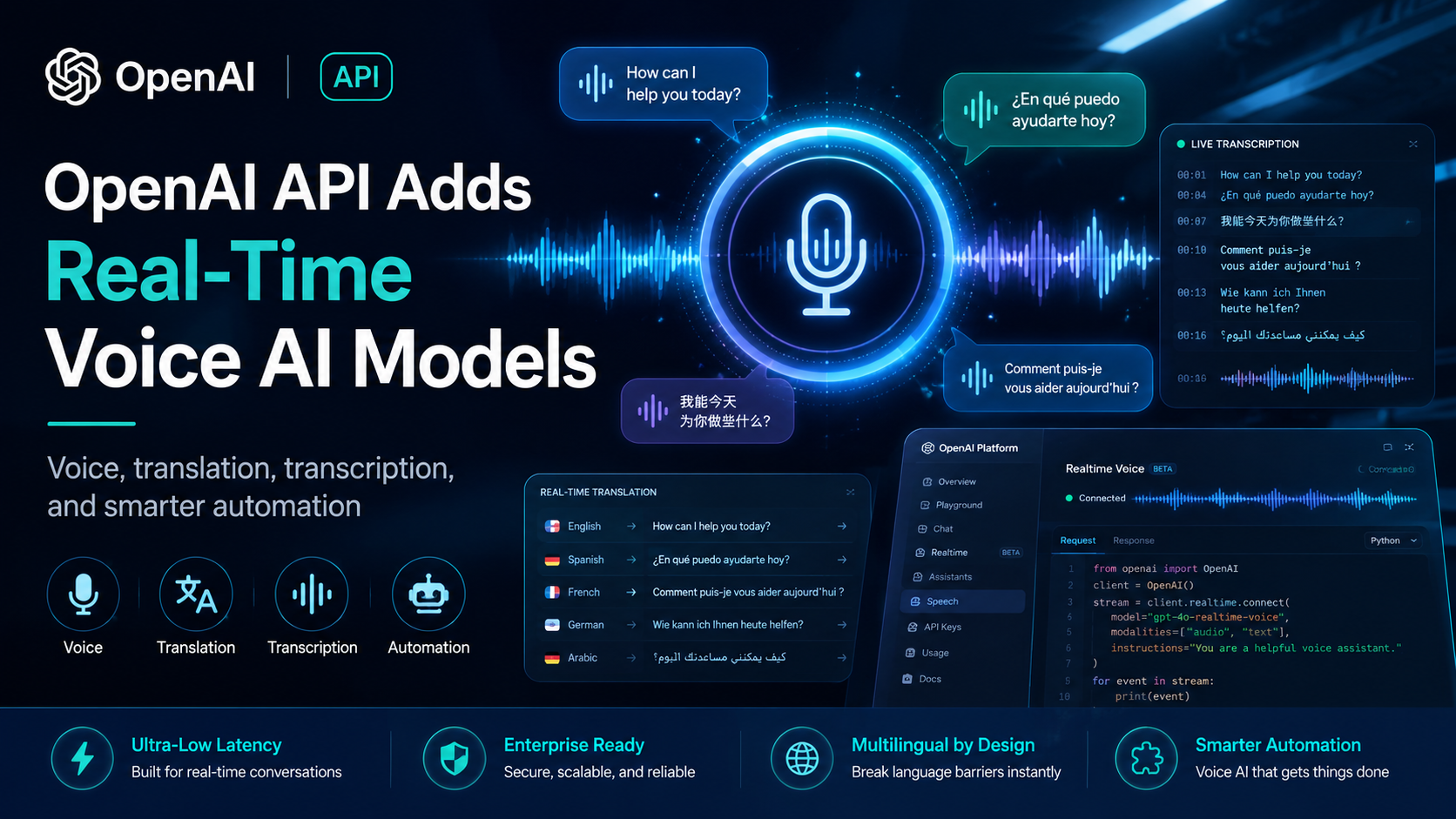
OpenAI Launches New Voice Intelligence Features for Developers
OpenAI has introduced a new generation of voice intelligence features in its API, marking a major step toward more natural, real-time, and action-oriented voice applications. The launch brings three new audio models to developers: GPT-Realtime-2, GPT-Realtime-Translate, and GPT-Realtime-Whisper. Together, these tools are designed to help companies build applications that can speak with users, understand complex requests, translate live conversations, and transcribe speech as it happens.
For years, voice technology has been treated mainly as a support feature. Businesses used it for call centers, dictation, automated phone menus, or basic speech-to-text tools. OpenAI’s latest release suggests a different direction. Voice is no longer being positioned as a simple input method. It is becoming an intelligent interface that can listen, reason, respond, translate, and trigger actions during a live conversation.
A New Step for Real-Time Voice AI
The most important model in this release is GPT-Realtime-2, a voice model built for real-time conversation. Unlike earlier voice systems that often depended on separate speech recognition, text processing, and text-to-speech tools, OpenAI’s Realtime API is designed for live, low-latency voice interactions. The company says GPT-Realtime-2 is its first voice model with GPT-5-class reasoning, which means it is intended to handle more complex requests and continue conversations in a more natural way.
This matters because many voice assistants still struggle when users change direction, interrupt, speak casually, or ask multi-step questions. A customer may begin by asking about a product, then switch to billing, then ask to change an appointment. Traditional voice bots often fail in these situations because they follow fixed scripts. A more advanced real-time reasoning model can better understand intent, maintain context, and help complete tasks.
For developers, this creates opportunities in industries such as customer service, healthcare, education, real estate, travel, banking, media, and live events. A company could build a voice agent that helps users book appointments, compare service plans, troubleshoot technical issues, or receive spoken guidance without waiting for a human operator.
Real-Time Translation for Global Communication
OpenAI also launched GPT-Realtime-Translate, a model focused on live speech translation. According to OpenAI, the model supports more than 70 input languages and can translate into 13 output languages while keeping pace with the speaker.
This feature could be especially valuable for international businesses, online education platforms, global conferences, multilingual customer support teams, and creator platforms. Instead of relying only on subtitles or delayed interpretation, companies may be able to build live voice experiences where people from different language backgrounds communicate more easily.
For example, an online course platform could let a teacher speak in English while students hear translated audio in another language. A global support center could help customers in different regions without requiring every agent to speak every language. Event organizers could offer real-time translation for panels, product launches, and webinars.
From a GEO perspective, this is important for businesses targeting global markets. Voice translation can help brands serve users across the United States, Europe, the Middle East, Africa, Asia, and Latin America with fewer language barriers. For digital platforms expanding internationally, this type of AI translation could become a competitive advantage.
GPT-Realtime-Whisper Brings Live Transcription
The third model, GPT-Realtime-Whisper, is designed for live speech-to-text transcription. It captures spoken language as conversations happen, making it useful for meetings, interviews, classrooms, podcasts, video platforms, customer calls, and accessibility tools. OpenAI lists GPT-Realtime-Whisper as a streaming speech-to-text model for real-time transcription in its API model catalog.
Live transcription is already important in many professional environments. Businesses use it to document meetings. Journalists use it to capture interviews. Students use it to review lectures. Customer support teams use it to analyze call quality. Media companies use it to create captions and searchable content.
With a real-time transcription model, developers can build applications that create instant notes, summarize conversations, generate captions, detect key topics, or trigger workflows based on spoken content. For example, a meeting assistant could transcribe a discussion and identify follow-up tasks. A customer service system could transcribe a call and send the issue to the right department.
Why This Launch Matters for Businesses
OpenAI’s new voice intelligence features arrive at a time when companies are looking for more efficient ways to interact with customers. Text-based chatbots have already become common, but voice remains a more natural channel for many users. People often prefer speaking when they need fast support, hands-free access, or a more human-feeling experience.
The new models could help businesses move beyond basic chatbots and build more advanced voice agents. These agents may be able to understand customer needs, ask clarifying questions, translate conversations, transcribe interactions, and connect with business tools.
Customer service is one of the clearest use cases. A voice agent could answer common questions, check order status, schedule appointments, process returns, or guide users through troubleshooting. In education, AI voice tools could support tutoring, language learning, and classroom transcription. In media, they could power live captions, translated broadcasts, or interactive audio experiences. In events, they could provide multilingual support for attendees.
The pricing model also reflects different use cases. OpenAI says GPT-Realtime-Translate is billed by the minute, GPT-Realtime-Whisper is also billed by the minute, while GPT-Realtime-2 uses token-based pricing. Current OpenAI pricing lists GPT-Realtime-Translate at $0.034 per minute and GPT-Realtime-Whisper at $0.017 per minute.
Safety and Abuse Concerns
As powerful as these tools may be, voice AI also creates serious safety concerns. Realistic voice systems can be misused for spam, fraud, impersonation, social engineering, and automated abuse. A more natural voice agent could make scam calls more convincing if not properly controlled.
OpenAI says it has built safety systems into the new models to reduce misuse. The company states that conversations can be halted when they are detected as violating harmful content guidelines.
This is an important issue for developers and businesses. Companies using real-time AI voice tools will need strong policies around identity verification, consent, data protection, and human escalation. For customer-facing systems, users should know when they are speaking with AI. For transcription and translation tools, businesses must also consider privacy laws, especially when handling sensitive conversations.
A Shift From Voice Response to Voice Action
The bigger story behind this launch is the shift from simple voice response to voice action. Earlier voice assistants were often limited to answering basic questions or following predefined commands. OpenAI’s new models are designed to support more dynamic interactions where the system can reason through a request and potentially connect to tools that complete tasks.
This could reshape how people use software. Instead of clicking through menus, typing forms, or waiting for support agents, users may simply explain what they need. A voice system could then interpret the request, ask for missing information, and complete the process.
For developers, this means voice interfaces may become a core product layer, not just an optional feature. Apps in finance, travel, healthcare, education, productivity, and e-commerce could all become more conversational. The companies that adopt these tools carefully may create faster and more accessible user experiences.
Conclusion
OpenAI’s launch of GPT-Realtime-2, GPT-Realtime-Translate, and GPT-Realtime-Whisper shows how quickly voice AI is evolving. These models are not only about making machines sound more natural. They are about making voice interfaces more intelligent, useful, and globally accessible.
For businesses, the opportunity is clear. Real-time voice AI can improve customer support, expand multilingual services, enhance accessibility, support education, and create new interactive media experiences. For developers, the Realtime API offers a path to build applications that listen, understand, translate, transcribe, and act during live conversations.
At the same time, the risks cannot be ignored. Voice AI must be deployed responsibly, with strong safeguards against fraud, abuse, and privacy violations. If companies balance innovation with safety, OpenAI’s new voice intelligence tools could become a major foundation for the next generation of human-computer interaction.


Comments
No comments yet. Be the first to share your thoughts!
Leave a Comment