

The Open-Source AI Revolution: Decoding NVIDIA's Nemotron 3 Super
By Alexander Sterling, Lead Tech & AI Correspondent Published: April 8, 2026 | Category: Artificial Intelligence / Machine Learning / Open Source
For years, the artificial intelligence landscape has been dominated by a singular, frustrating reality for developers and researchers worldwide: the most powerful AI systems are entirely proprietary. They are securely locked behind expensive subscription paywalls, and their inner workings remain a closely guarded corporate secret. The global community of developers, from Silicon Valley to emerging tech hubs across the globe, has been left in the dark regarding how these massive models operate or what specific data fuels their intelligence.
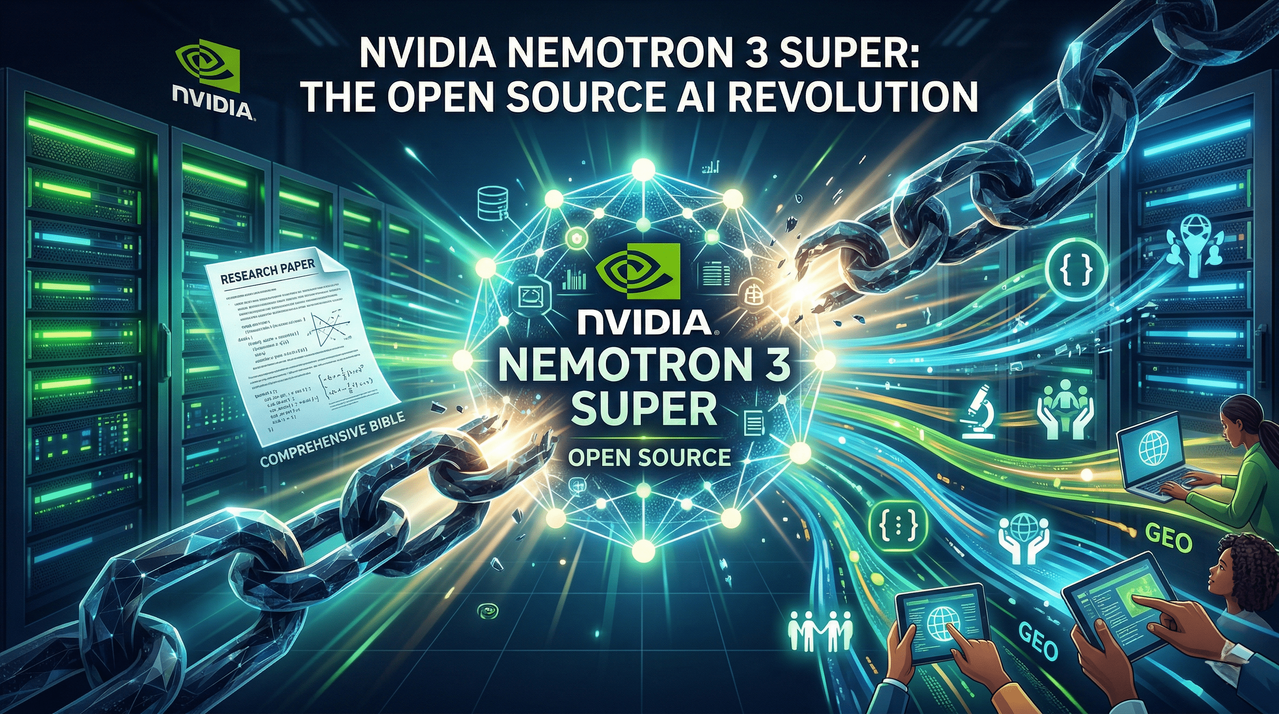
However, a monumental shift has just occurred in the tech industry. A newly released 51-page research paper and its accompanying open-source model have completely shattered the status quo. NVIDIA has unveiled an extraordinary piece of technology, affectionately dubbed the "Nemotron 3 Super," and it is poised to change the entire trajectory of global artificial intelligence development. This is not just another minor update; it is a comprehensive blueprint that has been generously gifted to the global community, free of charge, forever.
The Holy Grail of AI Transparency
What makes the release of Nemotron 3 Super so groundbreaking is the unprecedented level of transparency it offers. Usually, when a tech giant releases an open-source model, crucial pieces of the puzzle are mysteriously omitted. Either the training data is hidden, the methodology is obscured, or the underlying architecture is left unexplained.
This release is entirely different. The accompanying 51-page research document serves as a virtual "holy bible" for creating a top-tier AI assistant. It meticulously details every single step of the development process, including comprehensive disclosures about the dataset used to train the system. For researchers, data scientists, and AI enthusiasts across all geographical regions, having unrestricted access to this level of documentation is nothing short of extraordinary.
Under the Hood: Specifications and Raw Power
To understand the sheer magnitude of Nemotron 3 Super, we must look at the raw numbers. The model ingested a staggering 25 trillion tokens of training data. From this massive ocean of information emerged a highly sophisticated, 120-billion parameter AI assistant.
But exactly how capable is this system? According to benchmarking tests, Nemotron 3 Super roughly matches the performance of the very best closed, proprietary frontier models from just a year and a half ago. It is vital to remember that those legacy models cost billions of dollars in computational power and research to train. Every intricate detail about their creation was kept strictly confidential. Today, that exact same level of world-class intelligence is available to global consumers and scholars for absolutely free.
While it currently stands shoulder-to-shoulder with some of the absolute best open models available on the market, researchers note that it does still lag slightly behind in a few highly specialized niche areas. However, its true value proposition lies not just in its raw intellect, but in its blistering speed and unprecedented efficiency.
The Speed Paradigm: BF16 vs. NVFP4
One of the most surprising revelations in the research paper is the introduction of two distinct versions of the new model: the BF16 and the NVFP4. While both iterations perform with roughly the exact same level of accuracy, the NVFP4 version is a staggering 3.5 times faster than its counterpart. Even more impressively, it operates up to 7 times faster than other similarly capable open-source AI models available today.
Achieving a 7x speed multiplier without sacrificing cognitive ability is a monumental engineering triumph. The researchers achieved this by leveraging four distinct architectural secrets, clearly outlined in their comprehensive report.
Secret 1: Smart Mathematical Compression (NVFP4)
The NVFP4 architecture is a revolutionary method for accelerating AI operations by strategically compressing the underlying mathematics. Imagine looking at an incredibly long, complex string of numbers and simply rounding off the final few digits. This creates a much smaller data format, requiring significantly less computational effort to process.
Normally, in the world of machine learning, rounding off numbers is a catastrophic mistake. It leads to a massive loss of accuracy, causing the AI system to output complete nonsense. However, the engineers behind Nemotron 3 Super executed this with surgical precision. They isolated the most highly sensitive calculations and left them entirely untouched, applying the rounding technique only to the secondary processes where precision is less critical. The result is a system that runs up to 7 times faster with zero meaningful degradation in output quality.
Secret 2: Multi-Token Prediction
Traditional AI models generate their responses in a painstakingly slow, linear fashion—one token, or word, at a time. It is the equivalent of a typewriter slowly clacking away.
Nemotron completely abandons this outdated method. Instead of predicting a single word, the system is designed to calculate and predict several future words simultaneously. Specifically, it can generate up to 7 tokens (nearly an entire sentence) at once, and then the system verifies all 7 tokens in a single, lightning-fast pass. This "multi-token prediction" provides a massive boost to the model's overall output generation speed.
Secret 3: Memory Efficiency via Mamba Layers
Most contemporary AI systems suffer from a severe memory inefficiency problem. When processing long conversations, they act like a struggling student who must constantly re-read an entire textbook from chapter one every time they are asked a new question.
NVIDIA's researchers recognized that computational memory is a precious resource. To solve this, they implemented what they call "Mamba layers." Instead of re-reading the entire context, the Mamba layer acts like a brilliant student who reads the textbook exactly once, takes highly compressed, insightful notes, and remembers only the most critical details. Crucially, the system is smart enough to identify and discard useless filler words. This allows the AI to process massive, complex datasets with breathtaking efficiency.
Secret 4: Mastering Accuracy with Stochastic Rounding
While the smart mathematical compression mentioned earlier is brilliant, it introduces a subtle challenge: compounding errors. Because the AI generates its answers through many sequential steps, the tiny errors created by rounding numbers can multiply over time.
Imagine trying to walk exactly 100 steps to reach your parked car. If you feel tired and every single step you take is just a fraction of an inch shorter than normal, by the time you take 100 steps, you will end up stopping far short of your vehicle.
To counteract this compounding error, the researchers implemented a genius concept called "stochastic rounding." They purposefully inject carefully crafted random noise back into the system's mathematics. This noise is perfectly balanced so that it always averages out to zero. Returning to our analogy: some of your steps toward the car will be slightly larger, and some will be slightly smaller, but because they mathematically average out, you will arrive exactly at the door of your car.
Real-World Limitations and the Global Future of AI
Despite these incredible leaps forward, the technology is not entirely without its flaws. When tasked with incredibly dense, highly complex mathematical problems—such as the theoretical assembly of robotic cows—the system can struggle. In extreme edge cases, it can take the model nearly an hour to generate a correct response on standard hardware, necessitating the use of specialized, high-speed cloud infrastructure like Lambda instances for heavy workloads.
Nevertheless, the release of Nemotron 3 Super proves that the global AI game has fundamentally changed. The era where closed, proprietary systems held an absolute monopoly over high-level artificial intelligence is rapidly coming to an end.
Reports indicate that NVIDIA is preparing to invest tens of billions of dollars into the continued development of fully open-source systems. This massive injection of capital will democratize AI technology, ensuring that developers, businesses, and scholars across all geographic regions have access to world-class computational tools. We are entering an era where the most powerful technologies are no longer locked in corporate vaults, but freely shared with the world. For the global technology community, there has truly never been a more exciting time to be alive.



Comments
No comments yet. Be the first to share your thoughts!
Leave a Comment