

Meta’s Comeback: Deep Dive into the Muse Spark AI Model
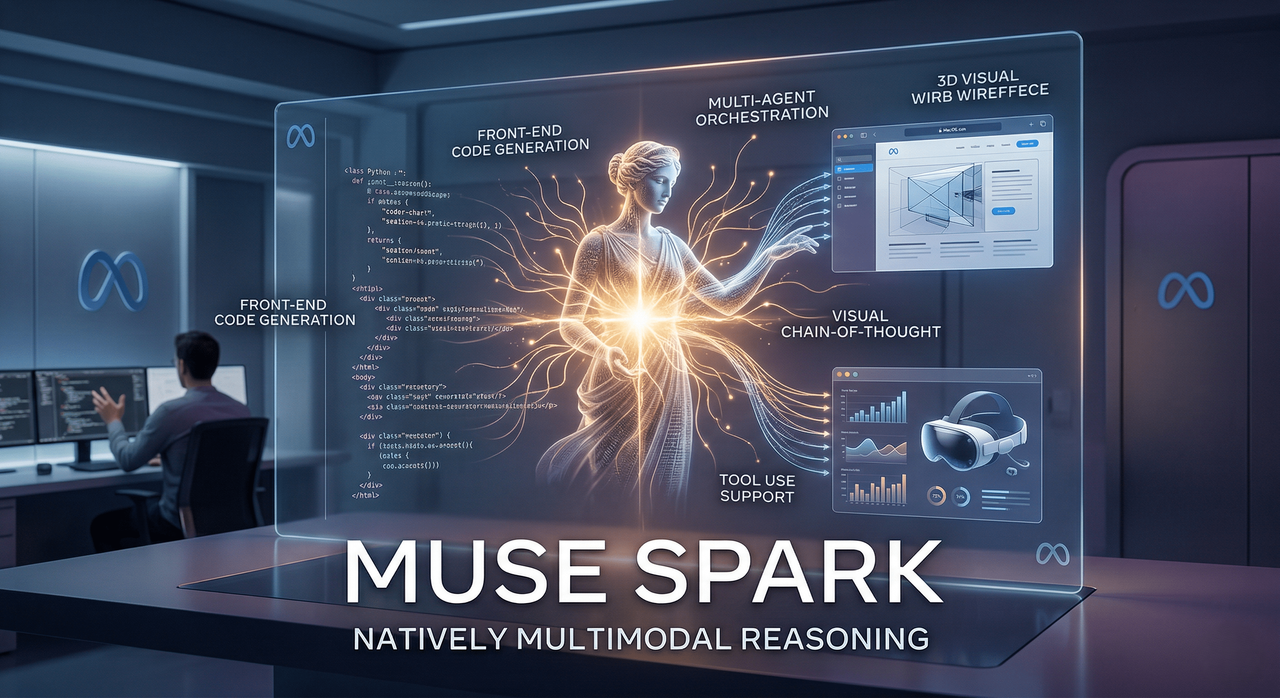
The artificial intelligence landscape is shifting once again, and it looks like Meta is finally back in the spotlight with a brand-new model series. Kicking things off is Muse Spark, the first iteration in the highly anticipated Muse family from Meta AI. Rumored previously in tech circles as the "Avocado model," Muse Spark is a natively multimodal reasoning powerhouse built with robust support for tool use, visual chain-of-thought processing, and multi-agent orchestration.
If you have been waiting for Meta to make a definitive return to the top tier of AI development, this release signals a massive leap forward. Here is a comprehensive report on what Muse Spark brings to the table, how it benchmarks against industry giants, and real-world testing of its coding and visual capabilities.
A Solid All-Rounder: Multimodal Reasoning and Agent Workflows
Overall, Muse Spark is proving to be a highly capable all-rounder model. In early testing, it is already showing superiority over models like Grok 4.2. It performs exceptionally well at complex reasoning and coding tasks. For instance, generating a functional Flappy Bird clone—a task where many contemporary models still struggle—is handled fairly easily by Muse Spark.
Where this model truly shines is on the front-end development side. It is especially adept at generating system-themed sites and intricate UI components. Performance-wise, it handles multimodal reasoning, deep visual perception, health-related analytical tasks, and agent-based workflows with impressive accuracy. While there are still minor gaps in long-horizon autonomous agent tasks and the most advanced back-end coding scenarios, Meta is clearly scaling their stack rapidly.
Introducing "Contemplating Mode"
One of the most exciting features of Muse Spark is the introduction of Contemplating Mode. This feature runs multiple AI agents in parallel to achieve deeper, more thorough reasoning on complex prompts.
Thanks to this architecture, Muse Spark is posting incredibly competitive benchmark scores:
- 58% on Humanity's Last Exam
- 38% on Frontier Science
These numbers place Muse Spark right on the heels of top-tier, state-of-the-art systems like Gemini, Deep Think, and GPT Pro. Because it was built from the ground up to integrate visual information seamlessly across various domains and tools, it performs exceptionally well on visual STEM tasks, entity recognition, and spatial localization. This enables highly interactive, real-world use cases, such as dynamically annotating visuals on your screen or successfully troubleshooting home appliances via uploaded images.
The Rise of the AI Employee: Integration with Goose Works
The capabilities of models like Muse Spark are paving the way for true AI automation in business. Imagine being able to literally hire an AI employee, assign it real business tasks, and walk away. Not just a chatbot that you sit and prompt endlessly, but an actual AI coworker.
This is becoming a reality through platforms like Goose (a featured integration in today's AI workflow discussions). Goose represents the next step in practical AI application. It is an AI entity that possesses its own email address, phone number, and persistent memory. You can assign it tasks such as:
- Finding and qualifying leads
- Researching market competitors
- Drafting and sending outbound marketing emails
You can leave the AI to its work and return 15 minutes later to find the tasks completed. There is no complex coding or API headache required to set it up. With over 100 built-in skills for SEO audits, content creation, and outreach, you can even message it through Slack or Telegram just like a real teammate. It bridges the gap between raw model power and usable, everyday business workflows.
Under the Hood: Technical Upgrades and Efficiency
On the technical side, Muse Spark scales magnificently across three key areas: pre-training, reinforcement learning, and test-time reasoning.
- Pre-Training Efficiency: Meta has implemented major upgrades making this model far more efficient. Muse Spark achieves top-tier performance using over 10 times less compute than previous generations. In an industry constrained by processing power, this is a monumental achievement.
- Reinforcement Learning: The model utilizes stable predictive environments to boost accuracy and reliability, allowing it to generalize incredibly well to entirely new tasks.
- Test-Time Reasoning: Muse Spark utilizes optimal thinking protocols with fewer tokens, leveraging multi-agent collaboration to deliver stronger performance even as latency increases.
Currently, Muse Spark is consumer-ready but developer-locked. This means that while the API is not yet available for back-end integration (and pricing structures are yet to be announced), consumers can access and test the model today completely for free via the Meta AI chatbot and the LMSYS Chatbot Arena.
Real-World Testing: Code, 3D, and Vision
To truly understand Muse Spark's capabilities, we ran it through a series of rigorous stress tests across different modalities.
1. The Mac OS Web Clone (Score: 8/10)
When tasked with creating a browser-based Mac OS clone, the model delivered highly impressive front-end code. While it missed the Apple logo, it successfully recreated the functional bottom toolbar, opened different app windows (Safari, iMessage, Photos, Notes, and a VS Code clone), and even included background sound effects. The top toolbar was remarkably functional, allowing for Wi-Fi toggling, brightness adjustments, and theme switching (Light/Dark mode). The only drawback was its reliance on basic emojis for SVG icons, but the structural coding was exceptional.
2. 3D Simulations and Advanced UI (Score: 10/10)
Surprisingly, Muse Spark excels at generating complex visual code. When prompted to create a 360-degree rotation product dashboard for a 3D headset, it generated an absolutely stunning, interactive UI. The shaders, visual elements, and camera rotation controls worked flawlessly. Similarly, it managed to generate a decent 3D physics simulation of a car traversing a mountain range, complete with camera angle controls and slow-motion features.
3. Wireframe to Code
When provided with a rough sketch/wireframe of a landing page and asked to code it using a dark-and-white theme with light blue accents, Muse Spark accurately mapped the header, feature forms, video gallery, and footer into clean, responsive HTML/CSS. It is rapidly becoming a vital tool for UI/UX developers.
4. Multimodal Reasoning: The Fridge Test
To test its object detection and visual chain-of-thought, the model was fed an image of a fully stocked refrigerator and asked to count distinct items while excluding obvious duplicates. Utilizing its Contemplating Mode, the model identified exactly 29 distinct items. Furthermore, it accurately characterized and grouped them by spatial location (e.g., middle shelf, door, crisper drawer), proving its deep attention to detail in multimodal environments.
Final Verdict
Meta has undoubtedly made a strong reset in the AI race with Muse Spark. It is deeply integrated into Meta's ecosystem and proves to be an exceptional tool across multiple domains—especially in front-end coding and complex visual reasoning. While we await potential open-source releases and full API access, Muse Spark proves that Meta is scaling its stack rapidly and making a massive comeback in the artificial intelligence space.



Comments
No comments yet. Be the first to share your thoughts!
Leave a Comment