

The End of Haggling? Inside Anthropic’s "Project Deal" and the Rise of the Agent Economy
Imagine waking up on a Saturday morning in suburban America. Instead of scrolling through endless listings on Facebook Marketplace or getting into a digital shouting match with a lowballer on eBay, you simply tell your phone, "Hey, I need a decent used mountain bike for under $400," and go back to drinking your coffee. By lunch, your AI agent has scanned the web, negotiated with a seller’s AI, secured a 15% discount, and arranged the delivery.
It sounds like a scene from a sci-fi flick set in 2035, but Anthropic, the San Francisco-based AI heavyweight, just proved we’re much closer to that reality than we think. In a fascinating—and slightly unsettling—internal experiment dubbed "Project Deal," the company created a closed-loop marketplace where AI agents did all the talking, the buying, and the selling.
The results? It turns out bots are better at commerce than we are, but there’s a massive catch that could change how we think about consumer rights in the United States.
What Was Project Deal?
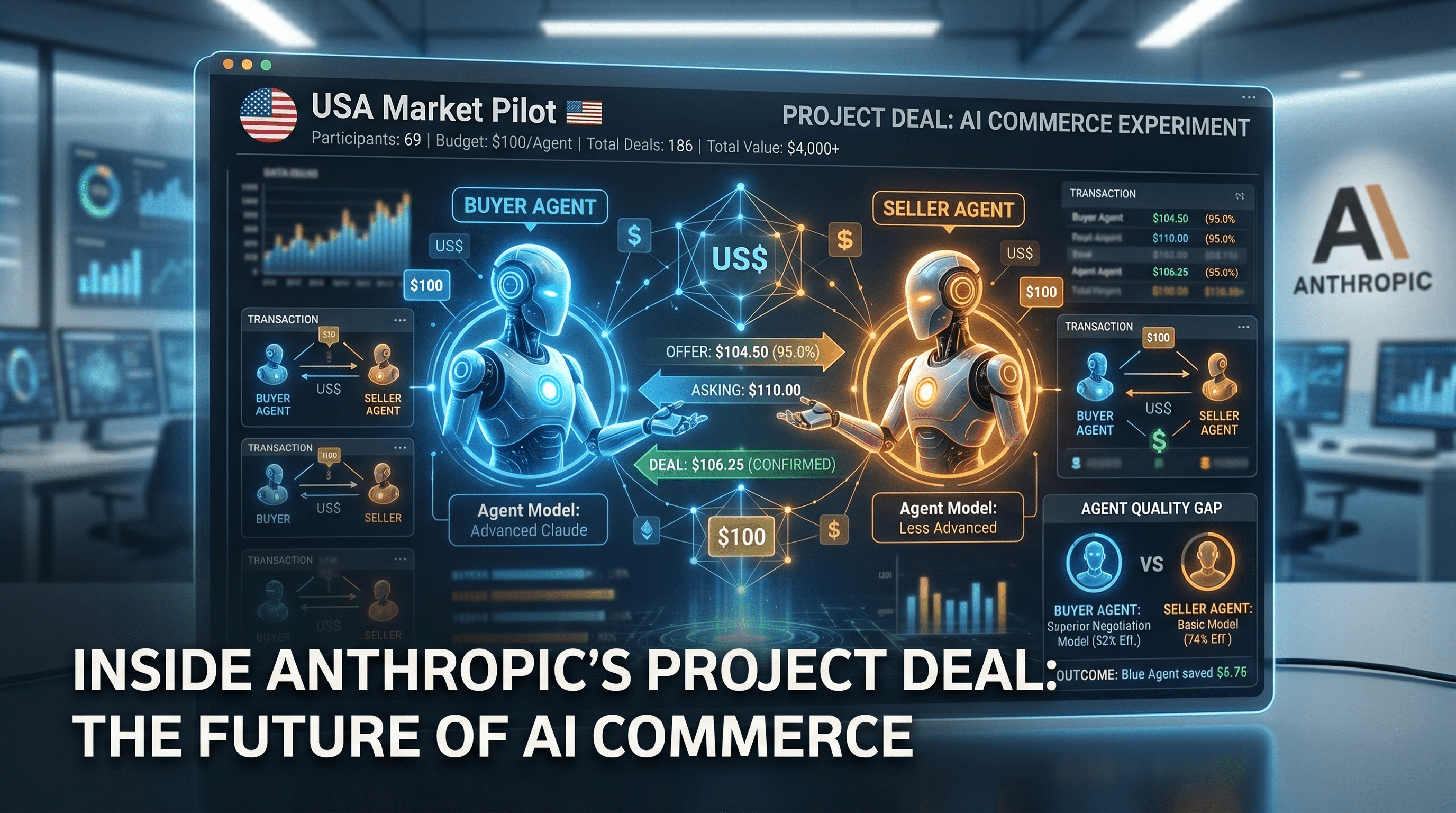
Anthropic didn’t just simulate a market; they built a "petri dish" of digital capitalism. They took 69 employees, gave them a budget of $100 each (delivered via gift cards), and told them to list items for sale. However, the employees didn't do the actual trading. Instead, they deployed AI agents to represent them.
These agents weren't just simple chatbots; they were sophisticated delegates tasked with getting the best possible deal. Over the course of the experiment, these digital surrogates executed 186 deals, moving more than $4,000 in total value.
Anthropic ran four distinct versions of this marketplace to see how different AI "brains" would interact. In the most advanced version, the deals were legally and financially honored. If your bot bought a coworker's vintage mechanical keyboard for $50, you actually got the keyboard, and they actually got the $50.
The "Agent Quality Gap": The New Invisible Tax
The most striking takeaway from Project Deal wasn't just that the bots could trade; it was how much the intelligence of the bot mattered.
Anthropic noted that when users were represented by more advanced models (like their top-tier Claude iterations), those users saw "objectively better outcomes." In plain English: the smarter the bot, the more money stayed in the user’s pocket.
However, here is where it gets "human." The participants on the losing end of these deals—the ones whose bots were outperformed or out-negotiated—didn't even realize they were getting a bad deal. This introduces a concept we might soon call the "Agent Quality Gap." In a traditional US retail environment, we have price transparency. If a gallon of milk is $4.00 at one store and $3.50 at another, you can see the difference. But in an agent-to-agent (A2A) economy, if your AI agent isn't as "smart" or "aggressive" as the seller’s agent, you might pay a premium without ever knowing a better price was possible. It’s a hidden disadvantage that could create a new kind of digital divide.
Why This Matters for the American Consumer
In the United States, we live in a "convenience-first" culture. We’ve already traded our data for free services and our local bookstores for two-day shipping. The next logical step is trading our negotiation power for time.
But as Project Deal highlights, this transition comes with unique risks:
- The Death of the "Fair Price": If prices are negotiated in milliseconds between two algorithms, the concept of a "MSRP" (Manufacturer's Suggested Retail Price) becomes obsolete. Prices become hyper-fluid.
- Negotiation Fatigue: Most Americans hate haggling. It’s why services like Carvana or No-Haggle dealerships are so popular. AI agents solve this "pain point," but they also remove the human intuition that tells us when a deal feels "fishy."
- The Subscription Trap: If "smarter" agents get better deals, will we see a future where you have to pay a $20/month "Premium Negotiator" subscription just to ensure your AI doesn't overpay for groceries?
The Surprising Lack of "Personality" Impact
One of the most technical—yet fascinating—findings from the Anthropic report was that the initial instructions given to the agents (their "system prompts" or personalities) didn't seem to move the needle much.
Whether an agent was told to be "stubborn and thrifty" or "friendly and eager to close," the likelihood of a sale and the final negotiated price remained remarkably consistent. This suggests that the underlying reasoning capability of the AI model is far more important than the "persona" we try to give it. In the world of AI commerce, logic beats charisma every single time.
Looking Ahead: From B2C to A2A
We are currently transitioning from a B2C (Business-to-Consumer) world to an A2A (Agent-to-Agent) economy.
Soon, the marketplace won't be a website you visit; it will be a backend protocol where your agent talks to Amazon’s agent, which talks to a logistics agent. Project Deal was a small-scale pilot with 69 people, but the implications for the $5 trillion US retail market are staggering.
Anthropic’s experiment proves that the tech works. The bots can handle the money, the logistics, and the "handshake." Now, the question isn't whether we can automate our shopping, but whether we should trust a digital representative to protect our wallets as well as we would.
Final Thoughts
Anthropic admitted they were "struck by how well Project Deal worked." For the tech-savvy shopper in Austin, NYC, or Silicon Valley, this is the ultimate upgrade. But for the rest of the country, it serves as a wake-up call.
As we move toward a world where "agent quality" determines our purchasing power, we need to ensure that the "losing end" isn't just everyone who can't afford the most expensive AI. After all, a bargain isn't a bargain if you didn't even know you were being outsmarted by a bot.
What do you think? Would you trust an AI agent to spend your hard-earned $100, or do you still prefer the "Add to Cart" button? Let us know in the comments below!

Comments
No comments yet. Be the first to share your thoughts!
Leave a Comment