

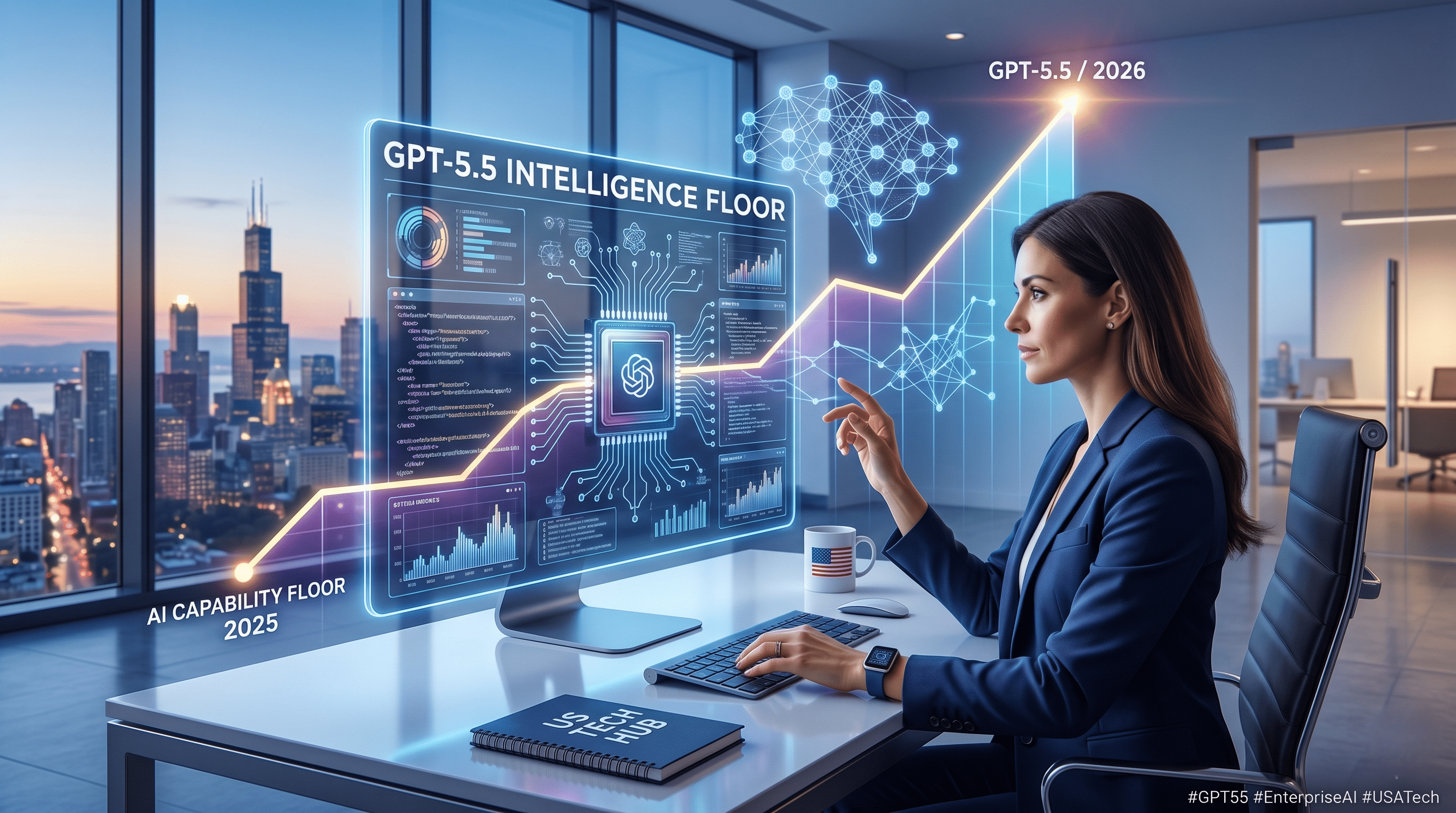
The New Ceiling: Why GPT-5.5 is the Defined High-Water Mark for AI in 2026
The landscape of artificial intelligence in 2026 has moved past the era of "neat tricks" and entered the era of "real work." With the release of GPT-5.5, OpenAI hasn't just iterated on a version number; they have effectively moved the floor of what we can reasonably expect from an autonomous system. While much of the recent industry progress has leaned on inference-time compute—giving models more "thinking time"—GPT-5.5 feels like a massive, smarter pre-train showing up for duty.
For professionals navigating this frontier, the question is no longer "Can the model answer this?" The question has become "Can the model carry this?" ### Moving the Floor: Intelligence vs. Inference
The most significant shift with GPT-5.5 is that it requires less hand-holding. In the past, achieving high-level results required complex "Chain of Thought" prompting or extensive tool-calling loops. GPT-5.5 is sharper in its "fast mode" and significantly more robust in its "reasoning mode."
Public benchmarks back this up, with an 82% on Terminal Bench (software engineering) and 84% on GPQA (high-level knowledge work). Perhaps most impressively, it achieves these scores while using fewer tokens than its predecessor, GPT-5.4. It is not just smarter; it is more efficient.
The Private Bench: Testing Where Models Fail
To truly understand a model's limits, we must move beyond public benchmarks that models are often trained to pass. Real-world utility is found in the "ugly" work—the underspecified briefs, the messy data, and the high-stakes judgment calls.
I put GPT-5.5 through three rigorous, "designed-to-fail" tests: Dingo and Company, Splash Brothers, and Artemis 2.
1. Dingo & Company: The Executive Handoff
This test involved a fictional Anchorage-based startup selling automated litter boxes for exotic dingo hybrids. The task: generate 23 deliverables in a single prompt—including decks, spreadsheets with live formulas, legal risk assessments, and interactive dashboards.
- The Result: GPT-5.5 dominated with a score of 87.3, compared to Claude Opus 4.7’s 67.0.
- The Difference: It didn't just write "about" the launch; it built the launch. It produced 17 real PowerPoint slides and 26 media files. More importantly, it displayed judgment. It recognized the legal sensitivity of exotic pet ownership and framed the marketing as a "narrow, qualified release" rather than a broad novelty campaign.
2. Splash Brothers: The Data Migration Trap
The "Splash Brothers" test is a nightmare folder of 465 messy files—corrupted JSONs, handwritten receipt scans, and conflicting CSVs. The goal was a clean database migration.
- The Breakthrough: GPT-5.5 was the first model to catch "planted" human errors. It rejected fake records like "Mickey Mouse" and "ASDF," and correctly merged seven duplicate customer pairs that previous models missed.
- The Caveat: It still struggled with "boring" backend hygiene, such as enum normalization and service code preservation. This highlights a crucial workflow shift: use GPT-5.5 for the heavy lifting of extraction and audit, but maintain human-in-the-loop validation for final canonical status.
3. Artemis 2: The Visual and Research Build
This test asked for an interactive 3D visualization of NASA’s Artemis 2 mission without provided facts.
- The Showdown: Both GPT-5.5 and Claude Opus 4.7 got the mission science right. However, the "vibe" differed. GPT-5.5 leaned into information density—it was a better learning tool but looked slightly "cartoonish." Claude Opus 4.7 maintained an edge in visual taste and composition, producing a more grounded, professional-looking scene.
The Workflow Revolution: Systems Over Weights
In 2026, the "best model" matters less than the system surrounding it. GPT-5.5 is a monster, but it is at its most lethal when paired with Codeex.
Inside a standard chat window, the model is underutilized. Inside Codeex, GPT-5.5 can:
- Inspect local file directories.
- Run terminal commands and drive browsers.
- Generate, test, and self-correct code.
- Render an artifact, notice a layout error, and fix it without human intervention.
This "agentic loop" is where the most value is generated. When the model has a place to act, intelligence and agency multiply each other.
The 2026 Routing Guide: How to Work Today
Based on extensive testing, here is how you should route your professional tasks to maximize the current frontier:
| Task Category | Primary Model | Why? |
| Complex Execution | GPT-5.5 (Codeex) | Best at carrying a task through multiple messy steps. |
| Blank Canvas Design | Claude Opus 4.7 | Maintains a superior "blank page" aesthetic and visual taste. |
| UI/UX Implementation | Images 2.0 + 5.5 | Use Images 2.0 for the reference; use 5.5 to build it faithfully. |
| Software Engineering | Opus (Plan) + 5.5 (Execute) | Use Claude for high-level planning; 5.5 for testing and iteration. |
| Long-Form Writing | GPT-5.5 | Uniquely capable of holding the "shape" and build of an argument. |
Availability as a Feature
A model’s intelligence is irrelevant if you can’t access it. In recent weeks, we have seen a disparity in reliability. While Anthropic has struggled with "one nine" (90% range) availability due to overwhelming demand, OpenAI has maintained "two to three nines" (99.9% range) of uptime. For professionals relying on these systems for daily production, that reliability is a deciding factor.
Final Thoughts: The New Ambition
We are still on a "rainbow" curve with no visible end. GPT-5.5 proves that scaling is still working and that the gains are compounding. It is no longer enough to ask an AI to summarize a meeting; we are now asking it to build a company’s data infrastructure or manage an entire executive handoff.
If you are still testing AI on easy tasks, you are living in 2025. To see the power of 5.5, you have to give it the work that used to break the models just months ago. The frontier has moved, and our ambitions must move with it.
Author’s Note: While GPT-5.5 is a landmark achievement, it is not a replacement for human judgment. It is a high-water mark for what a single model can carry—but the final mile of production still belongs to the person who knows what "good" looks like.

Comments
No comments yet. Be the first to share your thoughts!
Leave a Comment