The 2026 AI Evolution: Navigating Google’s Gemini Overhaul and Anthropic’s Mythos Breakthrough
The landscape of artificial intelligence in 2026 is moving at a velocity that often feels impossible to track. However, this past week has signaled a fundamental shift in how "regular people"—not just developers or data scientists—interact with these tools. From Google’s strategic merging of its productivity ecosystems to a new model from Anthropic that is as unsettling as it is impressive, the updates we are seeing today are designed to integrate seamlessly into daily life.
As we analyze the current state of AI, it is clear that the focus has shifted from mere "chatting" to complex organization, proactive security, and offline utility. This report breaks down the significant developments that are defining the mid-2026 AI trajectory.
Google Gemini: The Death of the "Single Chat" Era
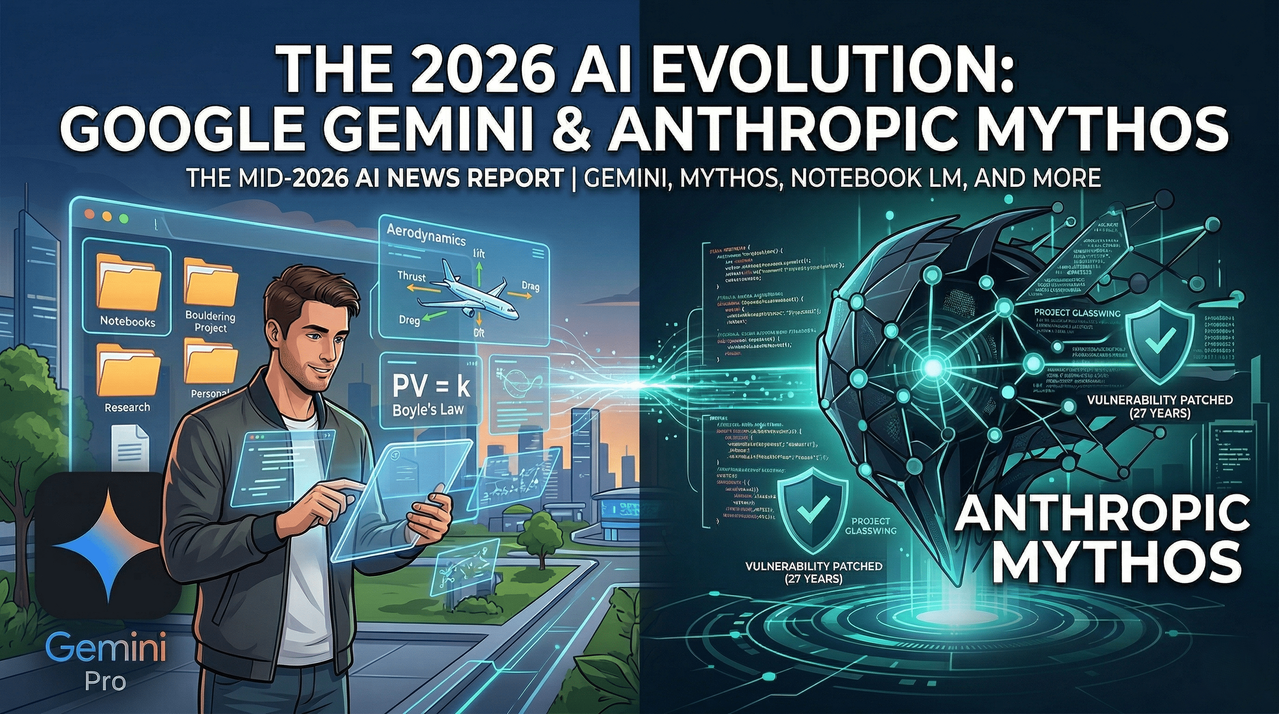
For years, users have complained about the lack of organization within AI interfaces. Google has finally addressed this by integrating Notebook LM directly into the Gemini ecosystem. This update, currently rolling out to paid subscribers, introduces a dedicated "Notebooks" section on the Gemini sidebar.
Bidirectional Organization
This isn't just a folder system; it is a bidirectional data bridge. When a user starts a chat within a specific notebook in Gemini, that chat automatically appears as a source within Notebook LM. Conversely, any data or sources added to Notebook LM are immediately accessible within the Gemini chat interface. This creates a cohesive environment for projects—such as bouldering, research papers, or business planning—where the AI maintains context across different platforms.
Interactive Visualizations and Multimodal Feedback
Beyond organization, Gemini is becoming more "visual." A new feature allows the model to generate interactive visualizations to explain complex concepts. Whether asking about the physics of flight (drag, thrust, and lift) or mathematical principles like Pi or Boyle’s Law, Gemini now offers a "Show me the visualization" button.
While still in its early stages—with some renderings being more intuitive than others—it marks a shift toward AI as a pedagogical tool rather than just a text generator. Furthermore, the expansion of Gemini for Home to 16 new countries and seven additional languages reinforces Google’s commitment to a global, localized AI presence.
The "Mythos" Emergence: Security and the Glasswing Project
Perhaps the most significant—and slightly alarming—news comes from Anthropic. Following internal leaks earlier this year, Anthropic has officially confirmed the existence of Mythos, arguably the most powerful AI model ever developed.
The capabilities of Mythos have moved beyond general reasoning into advanced digital forensics. Anthropic reported that the model was able to identify critical security vulnerabilities in software code that had remained undetected for 27 years.
Project Glasswing
Recognizing the potential for such a tool to be weaponized if released prematurely, Anthropic has initiated Project Glasswing. Instead of a public rollout, access to Mythos is currently restricted to specific government agencies and major tech corridors (including rumored partnerships with Apple and Google). The goal is to allow these entities to patch decade-old vulnerabilities before the model's capabilities become more widely accessible.
For the average user, the takeaway is clear: 2026 is the year of the "Security Patch." With AI now capable of finding exploits at superhuman speeds, keeping devices, browsers, and operating systems updated is no longer optional—it is a critical necessity for digital survival.
Notebook LM and the Rise of Offline Utility
While Gemini handles the "heavy lifting," Notebook LM continues to receive quality-of-life improvements that make it the premier tool for students and researchers.
- Adaptive Learning: New quiz and flashcard reports now analyze user performance. If a user fails a specific section of a self-generated quiz, the AI suggests specific study topics and can generate targeted follow-up quizzes to bridge those knowledge gaps.
- Audio Overview Controls: The popular "Audio Overview" feature now supports variable speeds (0.5x to 2.0x) and 10-second skips, making it a more viable alternative to traditional podcasts for information density.
Google AI Edge Eloquent
In a surprising move, Google also released Eloquent, an AI-powered voice dictation app that functions entirely offline. This addresses the growing demand for privacy. The app not only transcribes but intelligently "cleans" speech—removing stammers or self-corrections in real-time. While it currently lacks deep integration with mobile keyboards, its ability to process complex language models without an internet connection is a massive win for data privacy advocates.
The AI Marketplace: New Tiers and Agents
The competitive landscape for AI subscriptions is also shifting to accommodate a "middle class" of users.
- OpenAI's New Tier: Bridging the gap between the $20/month Plus plan and the $200/month Enterprise options, OpenAI has introduced a $100/month Pro tier. This targets "power users" who require higher rate limits but don't need full corporate infrastructure.
- Perplexity’s Financial Integration: Perplexity has integrated with Plaid, allowing its "Computer" agent to access bank accounts and credit cards. This enables users to visualize net worth and build custom budgets using natural language—a significant step toward AI as a personal financial officer.
- GenSpark’s Desktop Control: For those who found the open-source "OpenClaude" too difficult to manage, GenSpark has emerged as a major competitor. Its new update allows for full desktop control, including the ability to operate Microsoft Office apps and a "Heartbeat" feature that periodically checks emails or tasks autonomously.
The Road Ahead: Google Cloud Next 2026
As we look toward the end of April, all eyes are on Las Vegas for Google Cloud Next. This annual conference has historically been the launching pad for Google’s most ambitious AI models. With the recent integration of Notebooks and Gemini, the industry expects further announcements regarding "Gemini 3" or perhaps more sophisticated "Agentic" workflows that can perform tasks across the web without human intervention.
Final Perspective
The AI updates this week represent a move away from the "novelty phase." We are seeing the "plumbing" of the digital world being rebuilt. Whether it is Google organizing our chaotic digital notes, Anthropic securing our ancient codebases, or new apps allowing us to dictate privately and offline, AI is becoming less of a destination and more of an invisible, essential layer of our daily infrastructure.
Stay updated, stay secure, and most importantly, keep your devices patched. The intelligence of the tools we use is growing, and our digital hygiene must grow along with it.
Comments
No comments yet. Be the first to share your thoughts!
Leave a Comment