

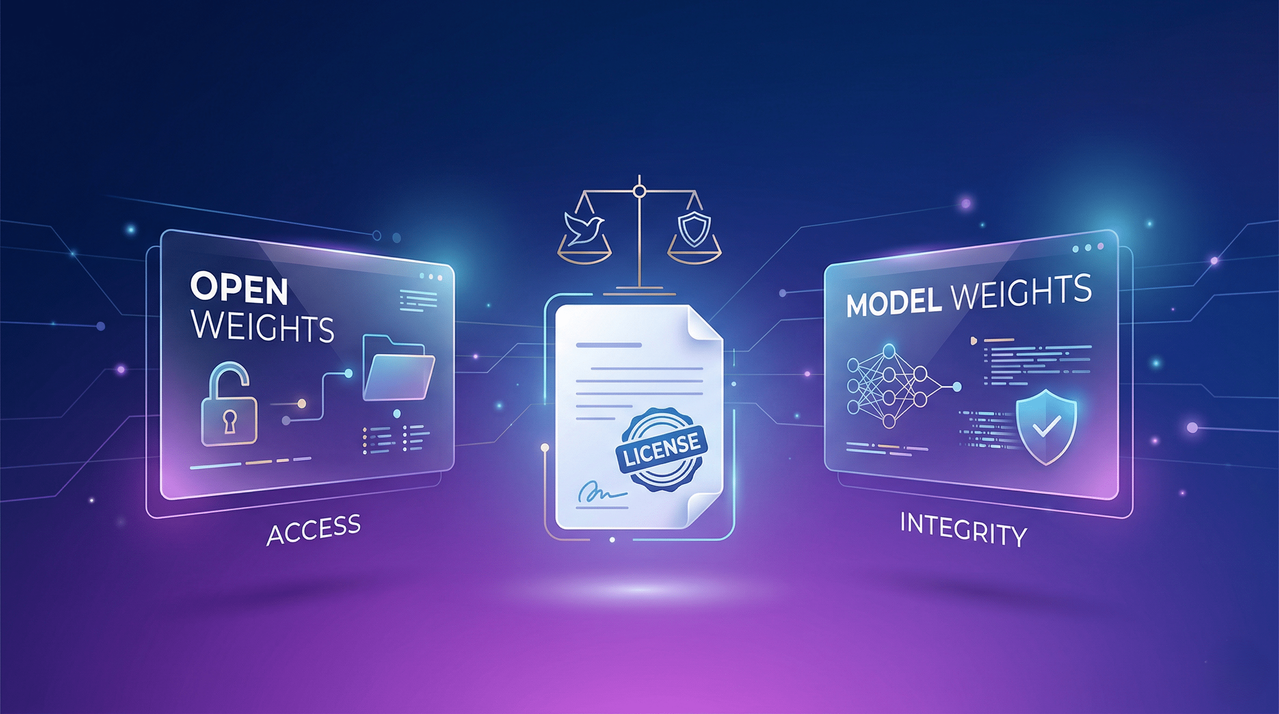
GLM‑5.1 (Z.ai / Zhipu): MIT‑style openness—plus a licensing hygiene footnote
What GLM‑5.1 is (as published on Hugging Face)
On Hugging Face, GLM‑5.1 appears as a flagship “agentic engineering” model with license: MIT shown directly on the model page metadata. 1
The model card also lists multiple paths for local serving—calling out common open deployment stacks such as SGLang and vLLM (among others). 1
The nuance: metadata says MIT, but teams should still verify the actual LICENSE artifacts
A noteworthy Hugging Face discussion thread flags that some GLM weight repositories showed the MIT license in metadata but did not include a full MIT LICENSE file at the time of discussion, and also notes that some related GitHub repos use Apache‑2.0 (intentional split: code Apache‑2.0, model MIT, per the Z.ai org reply). 3
Practical takeaway: for compliance‑minded orgs, GLM‑5.1 is directionally the more “ship‑friendly” story—but you still want your counsel to see a clean paper trail (LICENSE text + copyright notice) that matches how you plan to distribute. 3
MiniMax M2.7: big distribution push (including NVIDIA)—and a license that can block commercial launch
What MiniMax M2.7 is (as published on Hugging Face)
MiniMax M2.7’s Hugging Face page shows license: modified‑mit, and the model card describes strong agentic/productivity positioning and notes availability via NVIDIA NIM Endpoint. 2
The critical detail: the Hugging Face repo LICENSE text is explicitly non‑commercial
In the repository commit that adds the LICENSE, the text begins with “NON‑COMMERCIAL LICENSE” and states:
- Non‑commercial use permitted based on MIT‑style terms
- Commercial use requires prior written authorization
- Commercial use is prohibited without that authorization
- There is also a “Built with MiniMax M2.7” display requirement for commercial use 4
Practical takeaway: if your plan is “download weights → integrate into a paid SaaS,” this license can be a hard stop until you secure written permission. 4
NVIDIA highlighting MiniMax M2.7: what “availability on NVIDIA platforms” actually means
NVIDIA’s technical blog post describes a path to quickly test MiniMax M2.7 via GPU‑accelerated endpoints on build.nvidia.com, then scale to production with NVIDIA NIM (containerized inference microservices deployable on‑prem or cloud/hybrid). 5
NVIDIA’s MiniMax M2.7 model card on build.nvidia.com also spells out that usage is governed by:
- NVIDIA API Trial Terms of Service (for the trial service), and
- the NVIDIA Open Model License (for model use),
- and it links “Additional Information: Modified MIT License.” 6
The licensing reconciliation you must do (don’t skip this)
NVIDIA’s Open Model License states that NVIDIA models released under it are intended to be used permissively and explicitly says: “Models are commercially usable.” 7
But the same license also notes that models may include separate components under other terms, and those terms can matter. 7
So what’s the safe reading?
- If you use MiniMax M2.7 weights from Hugging Face, your starting point is the MiniMax LICENSE text (non‑commercial unless authorized). 4
- If you use MiniMax M2.7 through NVIDIA’s hosted endpoints / NIM, you must follow NVIDIA’s governing terms and reconcile them with any upstream restrictions NVIDIA points to (they link both NVIDIA Open Model License and “Modified MIT License”). 6
Practical takeaway: treat this as a “legal review required” model if money changes hands.
Decision guide: which model fits which builder?
Choose GLM‑5.1 if…
- You want an open‑weight model whose published license metadata is MIT and is positioned for broad use. 1
- You expect to run locally via mainstream stacks (the model card explicitly names vLLM/SGLang etc.). 1
Choose MiniMax M2.7 if…
- You want to experiment with a high‑end agentic/coding model and you’re fine with non‑commercial usage (research, evaluation, internal prototyping), or you can negotiate a commercial authorization. 4
- You want a “fast path” to testing through NVIDIA hosted endpoints and potentially production deployment via NVIDIA NIM—subject to the governing terms. 5




Comments
No comments yet. Be the first to share your thoughts!
Leave a Comment