

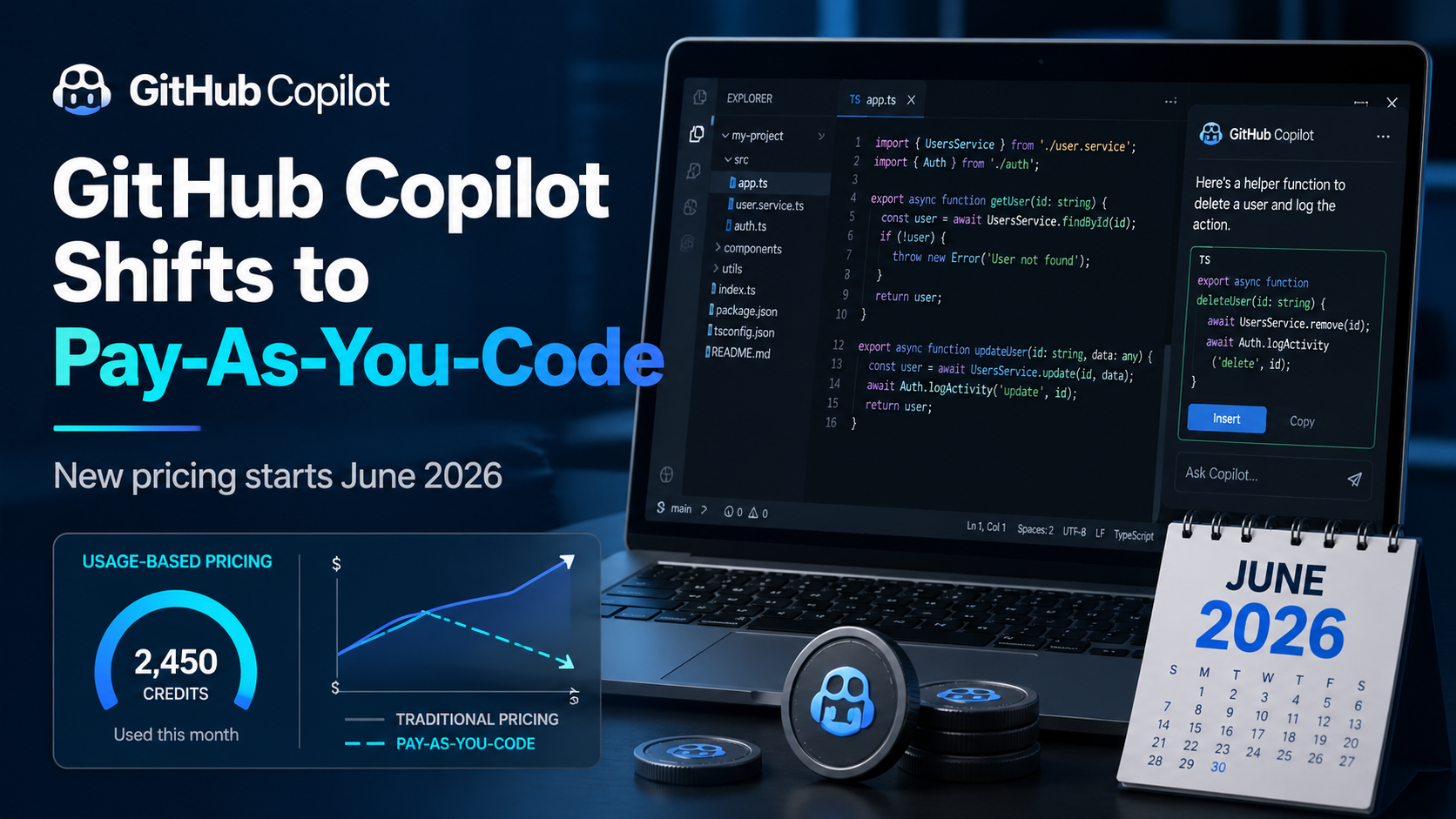
GitHub Copilot’s Reported Pricing Shift: What Pay-As-You-Code Could Mean for Developers in the United States
GitHub Copilot has become one of the most widely used AI coding assistants among software developers, engineering teams, startups, and enterprise organizations. From suggesting code inside an editor to answering technical questions through Copilot Chat, the tool has changed how many developers write, review, and understand code. However, a reported pricing change expected to begin on June 1, 2026, could significantly reshape how developers and companies in the United States pay for AI-powered coding support.
According to the reported update, GitHub Copilot may move away from a traditional subscription model based mainly on fixed monthly fees and included premium requests. Instead, the service is expected to adopt a pay-as-you-code pricing structure, where advanced AI usage is measured through credits. Under this model, one AI credit would reportedly cost $0.01 USD, and users would spend credits depending on the complexity and size of the AI task they perform.
This change would not completely remove GitHub Copilot plans. Instead, existing plans would function more like prepaid credit bundles. Developers and organizations would receive a monthly credit allowance, and once that allowance is used, additional credits could be purchased to continue using advanced Copilot features.
For developers in the USA, this shift matters because it changes GitHub Copilot from a predictable monthly software subscription into a more flexible but potentially less predictable AI utility. The more advanced AI features a user consumes, the more credits they may need.
What Is Changing in GitHub Copilot Billing?
The biggest reported change is the move from fixed subscription-based billing to usage-based billing. In the current style of AI subscriptions, users often pay a flat monthly amount and receive a defined level of access. Some features may be unlimited, while others may come with request limits. The new model would make pricing more closely connected to actual AI consumption.
In practical terms, simple tasks may use only a small number of credits. For example, asking a short question in Copilot Chat or requesting a quick explanation of a small function may cost relatively little. However, larger tasks could consume far more credits. These may include analyzing a large codebase, generating complex project-wide recommendations, using Copilot from the command line, or running autonomous cloud-based coding agents.
This pricing structure reflects a broader trend in the AI industry. Advanced AI systems require significant computing power, especially when they process long prompts, large files, multi-step instructions, or entire repositories. A usage-based pricing model allows GitHub to align customer costs with the amount of AI compute being used.
One important detail is that inline code autocomplete is reportedly expected to remain unlimited for paid users. This is a key point because autocomplete is the feature many developers use most often during daily coding. By keeping autocomplete unlimited, GitHub can preserve the core Copilot experience while charging more directly for heavier AI-powered workflows.
Why GitHub Copilot May Be Moving Toward Credit-Based Pricing
The shift to credit-based pricing is not surprising when viewed in the context of the larger AI software market. Many AI products now use credit systems, token-based billing, or metered usage. This is because AI costs are not always equal from one user to another.
A developer who only uses Copilot for occasional autocomplete suggestions does not consume the same resources as a team running large-scale repository analysis or autonomous AI agents. Under a flat subscription model, light users and heavy users may pay similar amounts even though their actual resource usage is very different.
A credit system helps solve that imbalance. Light users may stay within their monthly allowance, while heavy users can scale their usage by purchasing more credits. For GitHub, this creates a more sustainable pricing model. For customers, it offers flexibility, but it also requires better cost awareness.
This approach may also help organizations manage AI spending across teams. Instead of giving every developer unlimited access to costly AI features, companies may be able to allocate shared credit pools, monitor consumption, and set internal usage policies.
What This Means for Individual Developers
For individual developers in the United States, the reported pay-as-you-code model could be both helpful and challenging.
The main advantage is flexibility. Developers would no longer be limited by a fixed number of premium requests in the same way. If they need more advanced AI support during a busy project, they could buy additional credits and continue working. This may be useful for freelancers, indie hackers, students, open-source maintainers, and developers building side projects.
However, the downside is cost predictability. A flat monthly subscription is easy to understand. A credit-based system requires users to pay attention to how often they use advanced features. Developers who frequently ask Copilot Chat long questions, use the CLI, or request large-scale code analysis may see their credit usage increase quickly.
This could change developer behavior. Instead of treating every AI action as included in a subscription, users may become more selective. They may reserve advanced Copilot features for tasks that truly save time or improve code quality. In that sense, AI usage becomes more like cloud computing: powerful, scalable, and useful, but something that should be monitored.
What This Means for Engineering Teams and Businesses
For businesses, the impact may be even more significant. Software teams in the USA increasingly rely on AI coding tools to speed up development, improve onboarding, reduce repetitive work, and support code review. A usage-based model introduces new financial and operational considerations.
Organizations may benefit from shared credit pools because teams can distribute usage based on actual need. A backend team working on complex architecture may use more credits than a team doing lighter maintenance work. This flexibility can be useful, especially in larger engineering departments.
At the same time, shared pools can create budget risks. A few power users, large repositories, or automated workflows could consume credits quickly. Companies may need dashboards, alerts, spending limits, or internal AI usage guidelines to avoid unexpected costs.
Engineering managers may also need to evaluate which Copilot features provide the highest return on investment. For example, using credits to speed up debugging, improve documentation, or analyze legacy code may be worth the cost. On the other hand, casual or unnecessary long-form AI conversations may need to be limited.
The new model could push teams to treat AI coding tools as strategic infrastructure rather than simple productivity add-ons.
SEO and GEO Impact: Why This Pricing Change Matters
From an SEO and GEO perspective, the topic is important because developers are actively searching for clear explanations of AI tool pricing. Search engines and generative AI platforms are likely to prioritize content that directly answers questions such as:
“What is GitHub Copilot pay-as-you-code pricing?”
“How much will GitHub Copilot credits cost?”
“Will GitHub Copilot autocomplete remain unlimited?”
“What does usage-based billing mean for developers?”
“How will GitHub Copilot pricing affect teams in the USA?”
The reported pricing shift also fits into a broader conversation about the future of AI software subscriptions. As AI tools become more advanced, companies are moving toward pricing models that reflect real computational costs. GitHub Copilot may not be the only developer tool to follow this path. Other AI coding assistants, cloud platforms, and productivity tools may increasingly use credits, tokens, or metered billing.
Final Thoughts
GitHub Copilot’s reported move to a pay-as-you-code pricing structure starting June 1, 2026, could mark a major turning point for AI-powered development tools. The model gives users more flexibility and allows heavy users to scale beyond fixed plan limits. At the same time, it makes cost management more important for both individual developers and engineering teams.
For paid users, the fact that inline code autocomplete is expected to remain unlimited is a strong sign that GitHub wants to protect the everyday coding experience. The bigger change is around advanced AI features such as Copilot Chat, CLI actions, and autonomous agents, which may now draw from a monthly credit allowance.
For developers in the USA, the message is clear: AI assistance is becoming a resource to manage, not just a feature included in a subscription. The teams that benefit most from this model will be the ones that understand their usage, track their costs, and apply AI where it delivers the most value.
As artificial intelligence becomes more deeply integrated into software development, usage-based pricing may become the standard across the industry. GitHub Copilot’s reported billing shift is not just a pricing update. It is a sign of how the economics of AI coding tools are changing.




Comments
No comments yet. Be the first to share your thoughts!
Leave a Comment