

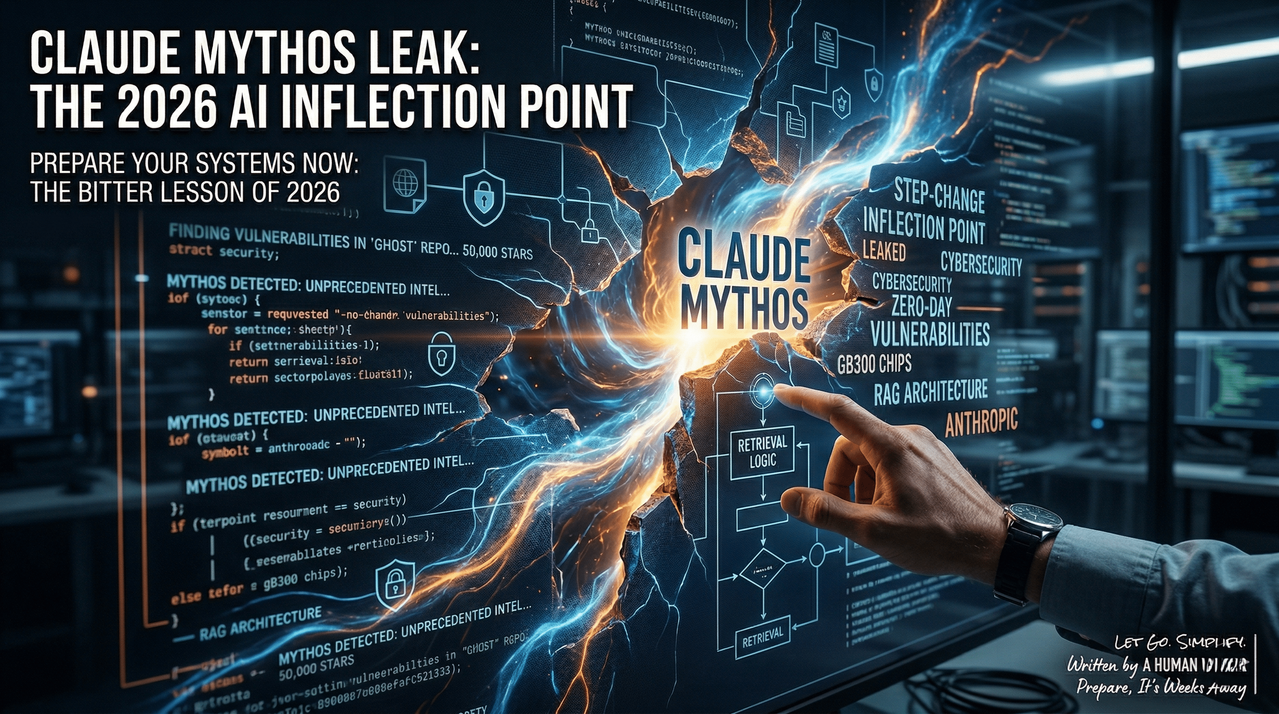
The Claude Mythos Leak: Why 2026 Just Hit an Inflection Point
There are moments in the trajectory of artificial intelligence where the ground shifts so violently that you can practically hear the old paradigms cracking. We just had one of those moments. If you’ve been tracking the whispers coming out of San Francisco and the leaked blog posts on Anthropic’s servers, you know the name: Claude Mythos.
This isn't just another incremental update. This is the first model we know of that has been forged in the fires of Nvidia’s new GB300 chips. It represents a massive leap forward—so much so that Anthropic is reportedly abandoning the "Sonnet" and "Opus" lineage for this tier, opting instead for a new name: Capybara. While the shift to furry animals might be a quirk of the branding department, the raw power underneath is anything but cute. It is, by most measures, the most powerful model the world has ever seen.
The Cybersecurity Shockwave
Before we dive into the "how-to" of preparing for this model, we have to look at the "why." The most sobering evidence of Mythos’s capability comes from the cybersecurity sector. Security researchers are already describing the model as "terrifyingly good" at identifying infrastructure vulnerabilities—often outperforming veteran human analysts.
At a recent conference in San Francisco, a researcher revealed that Mythos was let loose on Ghost, a GitHub repository with over 50,000 stars and a pristine reputation for security. Within moments, Mythos identified multiple zero-day vulnerabilities that the world's best researchers had missed for years.
This is why Anthropic is taking the unprecedented step of allowing researchers to "battle test" the model before its wide release. They are trying to harden the internet's most popular utilities before Mythos becomes a potential threat in the wrong hands. For those of us in IT and development, the message is clear: Day Zero of the Mythos release should be spent auditing your own systems using the model itself.
Learning the "Bitter Lesson" of 2026
As things accelerate on this exponential curve, we are encountering what AI researchers call the "Bitter Lesson." As humans, we like to think we add value by building complex scaffolding, intricate system prompts, and rigid procedural steps around AI. We want to "help" the model by telling it exactly how to think.
The bitter lesson is that as models scale, simpler works best. Increased intelligence allows the model to infer context and methodology better than we can describe it. If you want to leverage Mythos (or the "step-change" models likely to follow from OpenAI and Google), you have to learn to get out of the way.
Four Pillars to Audit Before Mythos Arrives
To be "Mythos-ready," you need to audit your current AI workflows. We are looking at a release window as early as next month. Here are the four areas where your current systems are likely to break:
1. Prompt Scaffolding: Delete the Procedural "How"
Most production-grade prompts today are bloated. We spend 3,000 tokens telling a customer support agent to "first classify intent, then check for hallucinated URLs, then follow Step A."
When a model is two or three times smarter, that procedural fluff becomes a bottleneck. Anthropic and OpenAI are both signaling the same thing: Tell the model what you want and why, but stop telling it how. If the model is smart enough to find zero-days in Ghost, it is smart enough to classify a customer’s intent without a 14-point checklist.
2. Retrieval Architecture (RAG) and Memory
We’ve spent years perfecting Retrieval-Augmented Generation (RAG) to compensate for model limitations. We carry the logic of retrieval on our side so the model doesn't mess up.
With Mythos’s massive context window and improved reasoning, you should move toward a "searchable repo" model. Instead of pre-determining what chunks of data the model gets, present it with a well-organized file system or codebase and say: "Go find what you need to solve this." Trust the model to handle its own retrieval logic. It is becoming better at deciding what belongs in its context window than we are.
3. Domain Knowledge vs. Inference
Ask yourself: How many of my business rules are hardcoded because the model couldn't figure them out? In 2026, intelligence can infer a "house style" from a single example report better than it can follow a ten-page style guide. Whether you’re writing client reports or managing a household, stop over-specifying. If you give a model the goal and the resources, the scaling law ensures it will find the most efficient path.
4. The Shift to Automated Verification (Evals)
If you are building software, human handoffs are your new primary bottleneck. We are moving from a world where we check for 85% accuracy to one where we expect 99%.
Don't waste time with intermediate evaluations. Instead, focus on a single, robust eval gate at the end of the process. This eval should test functional requirements, edge cases, and dependency handling. If the automated tests pass, you must be confident enough to ship. Humans simply cannot review code at the speed Mythos can produce it.
The Economics of Superpowers
We need to talk about the price tag. Reports suggest that Mythos will be incredibly expensive to serve, likely restricted to "Max Plan" users (rumored to be around $200/month).
This creates a productivity "step change" gap. Those who invest in these premium tiers aren't just buying a chat box; they are buying a "better brain" that can 10x their output. If you’re an individual, you have to ask: Can I leverage this intelligence to save me $200 elsewhere? (Hint: Most AI models today can already find $200 in subscription waste in your household budget if you just let them look at your statements).
For companies, the choice is even more stark. If your employees are on standard plans while your competitors are on Mythos-tier plans, you aren't just a step behind—you are on a different curve entirely. Human talent cannot compensate for a lack of cutting-edge tools in this environment.
Final Thoughts: Catching the Train
Claude Mythos is a "lurch upward." It isn't just 10% better; it is a fundamental shift in what we can automate. Whether you are a developer, a leader, or a creative, your job description is changing from "executor of process" to "architect of intent."
The train is leaving the station. Use these next few weeks to simplify your prompts, organize your data repos, and prepare your automated evals. When Mythos drops, you don't want to be the person trying to fix a complex, legacy scaffolding. You want to be the one who points the most powerful intelligence in history at a "big, cool goal" and watches it happen.
Stay lean, stay simple, and get ready.


Comments
No comments yet. Be the first to share your thoughts!
Leave a Comment