
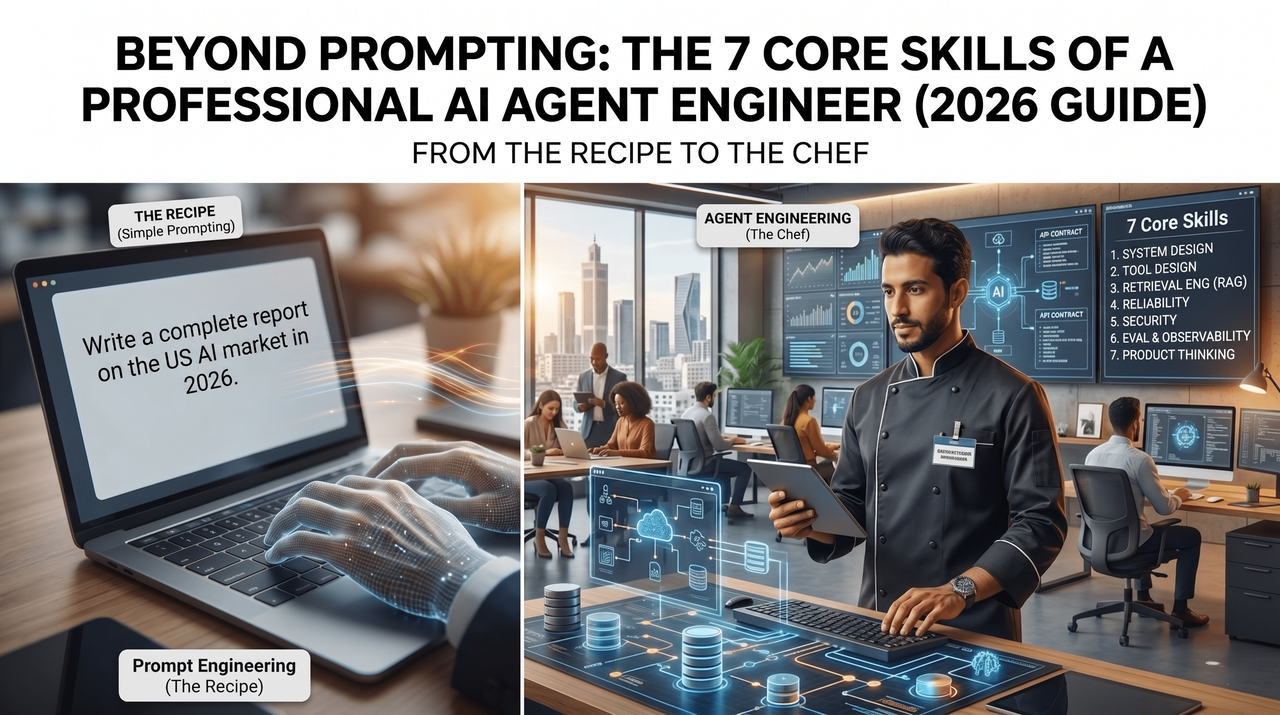
Beyond Prompting: Why "AI Skills" Are the New Operating System for 2026
Since Anthropic first introduced "skills" back in October, the landscape of Large Language Models (LLMs) and autonomous agents has undergone a seismic shift. While much of the public discourse remains focused on the conversational capabilities of models like Claude or GPT-4o, a quieter revolution is happening under the hood.
Skills are no longer just "neat tricks" for power users; they have become the fundamental substrate for predictable, accurate, and scalable AI outcomes in the enterprise. This report explores the transition of skills from personal configurations to organizational infrastructure and provides a roadmap for building agent-readable skills that compound in value.
The Great Shift: From Personal Hacks to Organizational Infrastructure
Six months ago, a "skill" was essentially a refined prompt you kept in a notepad or a personal library. You typed it in, the AI did the thing, and you moved on. Today, that paradigm is dead. We are witnessing the move toward organizational infrastructure.
Modern enterprises are now rolling out skills workplace-wide. They are treated as version-controlled assets, available in sidebars, and callable within the tools we use daily—Excel, PowerPoint, and Co-pilot. The methodology of an organization is no longer carried in the heads of individual employees; it is encoded into agent-readable markdown files.
The Math of the Agent-First World
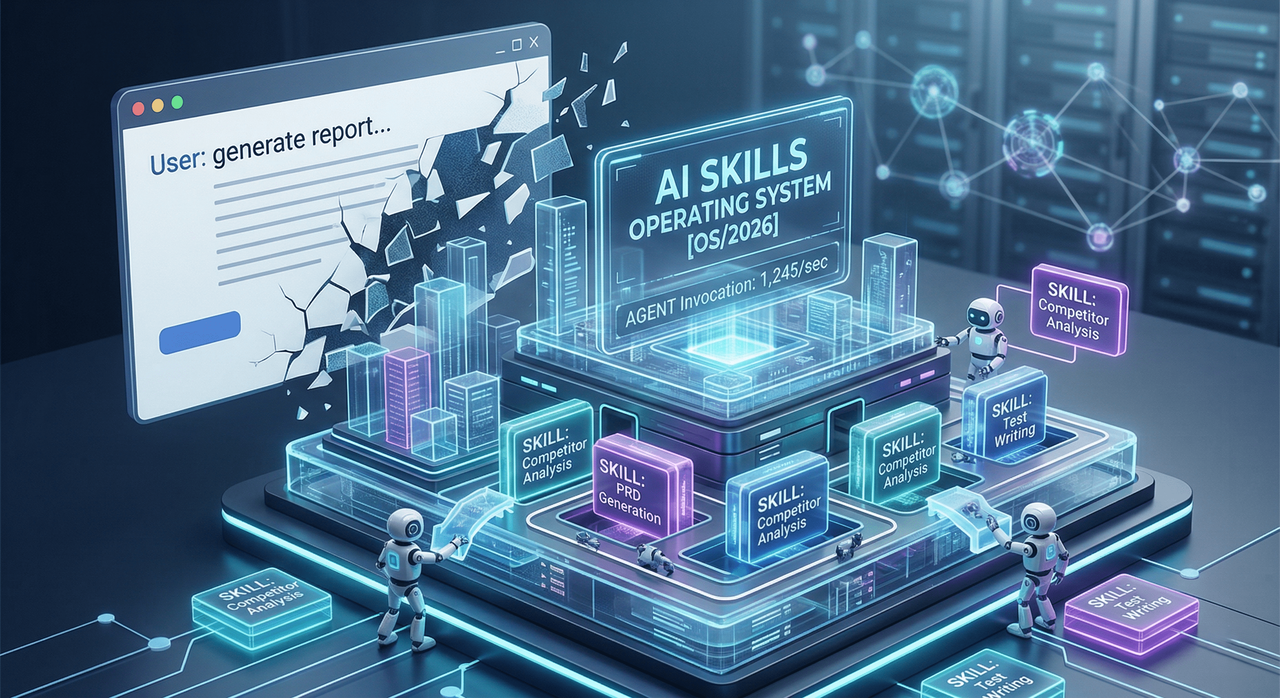
Perhaps the most overlooked change is the identity of the "caller." In late 2025, humans were the primary callers of skills. But as we move deeper into 2026, the majority of skill calls are made by agents.
Consider the scale: a human might invoke two or three specialized skills during a 30-minute session. An autonomous agent, however, can make hundreds of skill calls in a single run to complete a complex objective. As the transcript aptly puts it: "The math just doesn't math for humans." We must design skills that are agent-first, optimized for high-frequency, automated invocation.
The Anatomy of a High-Performance Skill
At its core, a skill is deceptively simple: a folder containing a skill.markdown file. However, the difference between a brittle prompt and a "battle-hardened" skill lies in its internal logic.
1. The Description: The Routing Signal
The description is often where skills go to die. Vague descriptions like "helps with analysis" are useless to an LLM. A high-quality description acts as a routing signal. It should include:
- Specific Artifacts: Name the document types it produces (e.g., "Generates a Product Requirements Document").
- Trigger Phrases: Explicitly list phrases that should activate the skill (e.g., "Analyze our competitors").
- The Single-Line Constraint: A critical technical "gotcha"—the description must remain on a single line. If a code formatter breaks it into two, the model may fail to read it correctly.
2. Methodology: Reasoning Over Procedures
A skill that only lists linear steps is brittle. If the AI encounters a scenario it doesn't recognize, a step-by-step list provides no path forward. Instead, the methodology should include general-purpose reasoning and quality criteria. By giving the AI the principles behind a decision, you enable it to generalize across edge cases.
3. The Specialist Stack
We are seeing the emergence of the "specialist stack" in production environments. Developers now drop entire folders of skills into projects. One skill transforms vague ideas into a PRD; another decomposes that PRD into GitHub issues; a third writes the unit tests. This removes the "pain of prompting" and replaces it with a specialist substrate that works autonomously.
Case Study: Operations at Scale
Take the example of "Texas Paintbrush," a real estate operator who moved business logic out of human minds and into a repository of over 50,000 lines of skills. These skills cover everything from rent roll standardization to cash flow handling.
The benefit is twofold:
- Agent Execution: Agents can run these operations predictably 24/7.
- Human Onboarding: When a new human hire joins the team, they don't have to guess the "company way." The expertise is documented in markdown, providing an immediate context layer.
Skills vs. Prompts: Why Skills Compound
One of the most vital distinctions for 2026 is the compounding nature of skills. Prompts are ephemeral; once the conversation ends, the value often evaporates. You find yourself back in "copy-paste hell," digging through history to find that one prompt that worked.
Skills, however, are versioned. You refine them, you test them, and you update them. As you hone a skill file, it becomes a permanent asset. Moreover, skills benefit from the weight of industry investment. Because skills are becoming an open standard, a skill built for Claude is increasingly compatible with the broader ecosystem, including Microsoft and OpenAI tools.
The Three-Tier Model for Teams
For organizations looking to implement this, a three-tier approach to skill management is recommended:
| Tier | Type | Focus |
| Tier 1 | Standard Skills | Brand voice, formatting rules, and approved templates. Provisioned widely across the entire org. |
| Tier 2 | Methodology Skills | The "High Craft" of senior practitioners. How the best PMs or Engineers do their work. |
| Tier 3 | Personal Workflow | Individual "under-the-desk" hacks. These should still be documented to avoid "bus-factor" risks. |
Designing for the Agentic Future: Contracts and Composability
As we shift toward agent-led workflows, our design philosophy must evolve. We are no longer just writing instructions; we are writing contracts.
- SLA and Output Contracts: Think of a skill like an API. It should have a declarative agreement: "This is what I provide, this is what I don't, and this is the specific format of the result."
- Composability: In an agentic chain, the output of one skill is the input for the next agent. We must think through the end-to-end handoff. If the output isn't "clean" enough for the next agent to read, the chain breaks.
- Deterministic Hard-Wiring: While skills are powerful because they use plain English, they aren't always the answer. If a task requires 100% mathematical certainty, use a script. AI agents are general-purpose tools, but they should be empowered to invoke deterministic tools when necessary.
Conclusion: The Path Forward
The "Alpha" in the age of AI is no longer found in closed-source secrets, but in the speed of collective discovery. We are all discovering the "instruction book" for LLMs together.
If you are still relying on a library of copy-paste prompts, you are falling behind. The goal for 2026 is to free yourself from the manual labor of prompting and begin building a library of agent-readable skills. Start small: find a repetitive task you do three times a week, ask your AI to help you turn that conversation into a skill.markdown file, and start compounding your expertise.
Skills are the record of successful execution. They are what persists. It’s time to start building yours.
Comments
No comments yet. Be the first to share your thoughts!
Leave a Comment