

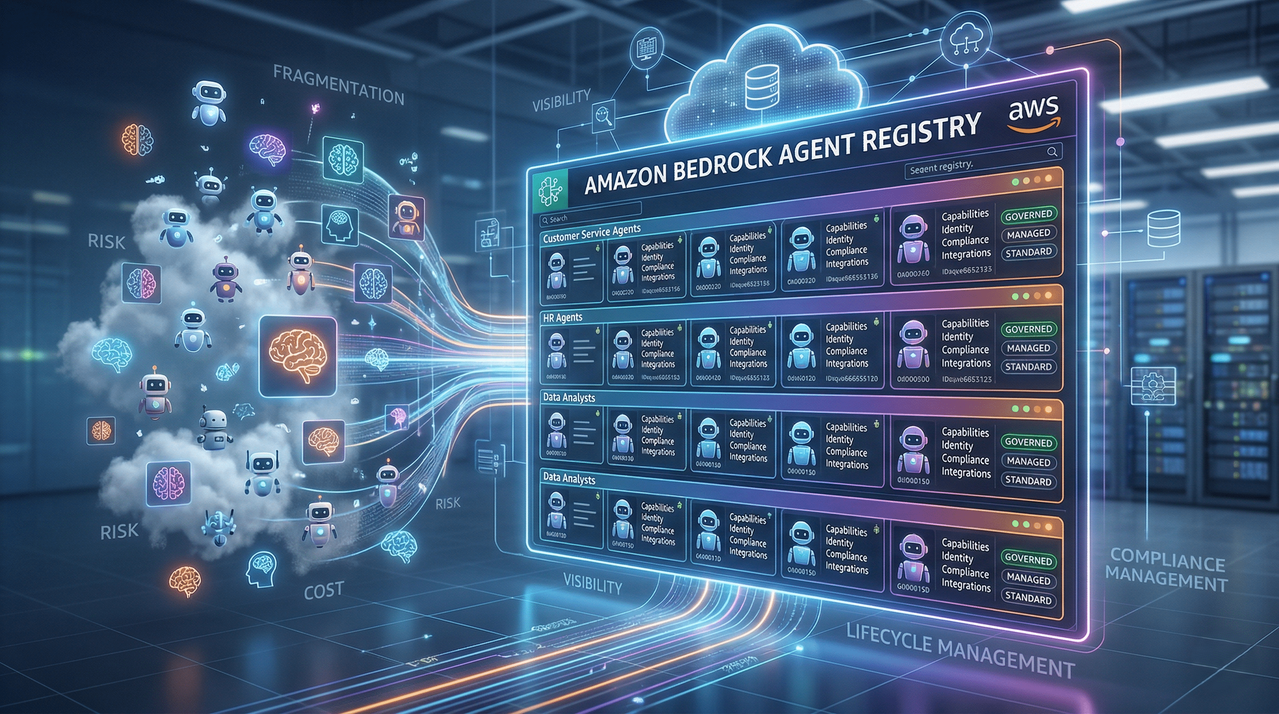
AWS Tackles 'Agent Sprawl': A Deep Dive into the New Amazon Bedrock Agent Registry
The enterprise AI landscape is shifting rapidly. If 2023 was the year of the Large Language Model (LLM) and 2024 was the year of Retrieval-Augmented Generation (RAG), 2025 and 2026 are undoubtedly the years of the AI Agent. However, as organizations move from isolated experiments to full-scale production, they are running into a chaotic new hurdle: Agent Sprawl.
In response, AWS has announced a significant expansion of its Amazon Bedrock AgentCore portfolio. The centerpiece of this expansion is Agent Registry, a managed service specifically engineered to help enterprises catalog, manage, and govern their growing fleets of autonomous AI agents. This move marks a pivot from simply providing the "brains" of AI to providing the "nervous system" for the enterprise autonomous layer.
The Rise of Agent Sprawl: Why Governance Can’t Wait
The core issue facing modern enterprises isn't a lack of AI tools, but rather an overabundance of them. Unlike traditional applications, which require significant development cycles, AI agents are relatively easy to spin up. This ease of creation is a double-edged sword.
According to Gaurav Dewan, research director at Avasant, "Agent Sprawl is an emerging structural problem. What we see consistently across enterprises is that agents proliferate much faster than traditional applications because they are easier to build."
When agents are created in silos across marketing, HR, finance, and engineering, ownership becomes ambiguous. This leads to:
- Redundant Costs: Multiple agents performing the same task using different (and expensive) tokens.
- Security Risks: Unmonitored agents with access to sensitive data via various integrations.
- Operational Friction: Finance or security teams only becoming aware of an agent's existence after an incident or a surprise bill occurs.
The AWS Agent Registry seeks to transform these agents from "isolated artifacts" into managed, composable enterprise assets.
What is AWS Agent Registry?
At its core, the Agent Registry acts as a unified directory. It provides a centralized control plane where developers and administrators can capture critical metadata about every agent in the ecosystem.
Key Metadata Tracked:
- Capabilities: What can the agent actually do?
- Identity: Who (or what) does the agent represent, and what are its permissions?
- Integrations: Which external systems (databases, CRM, ERP) is the agent connected to?
- Compliance & Ownership: Which department owns the agent and does it meet regional data privacy standards?
AWS has designed the service to be framework-agnostic. While it sits within the Bedrock ecosystem, it is built to support agents regardless of the specific models or frameworks used to create them.
The Competitive Landscape: A Battle of Control Planes
AWS is not the only cloud giant vying to be the "source of truth" for enterprise AI. We are currently witnessing a "Control Plane War" among the Big Three hyperscalers.
| Provider | Primary Governance Tooling | Strategic Approach |
| AWS | Amazon Bedrock Agent Registry | Integration with AgentCore and MCP for developer flexibility. |
| Google Cloud | Vertex AI Agent Builder / Apigee | Focuses on orchestration and monitoring via the Vertex AI governance layer. |
| Microsoft | Azure AI / Copilot Studio | Uses Entra Agent ID and Agent 365 for identity-first discovery and management. |
While AWS's offering is robust, analysts point out a strategic trade-off. Charlie Dai, principal analyst at Forrester, notes that this approach reinforces AWS’s position as the primary control plane. However, the registry operates natively within the AWS environment. For companies running a multi-cloud strategy, this creates a potential for "registry sprawl"—the very problem the tool was meant to solve, but on a meta-level.
Technical Deep Dive: Integration and Access
One of the most impressive aspects of the Agent Registry is its multi-access design. AWS realized that forcing developers to use a single console would hinder adoption. Instead, the registry is accessible via:
- AgentCore Console: For high-level management and visualization.
- APIs and SDKs: For programmatic integration into CI/CD pipelines.
- Model Context Protocol (MCP): Perhaps the most forward-thinking inclusion, allowing compatible clients and developer tools to query the registry directly.
Two Paths to Registration
Organizations can populate the registry using two distinct methods:
- Manual Registration: This is ideal for governance-heavy environments. Platform teams create records manually, ensuring that structured metadata—such as compliance attributes and usage documentation—is verified before the agent goes live.
- Automated Ingestion: For fast-moving dev teams, the registry can point to an Agent2Agent (A2A) or MCP endpoint. This allows the registry to automatically pull in agent details, reducing the manual burden and ensuring the directory stays up-to-date in real-time.
The Risk of Hyperscaler Lock-In
While the technical capabilities are impressive, Gaurav Dewan offers a word of caution regarding cross-cloud capabilities. Because the Agent Registry is so closely tied to AWS-native services—particularly regarding identity management and runtime—integrating agents that live on-premises or on competing clouds like Azure may require significant manual effort.
"Cross-cloud or federated discovery capabilities are not yet clearly established," Dewan warns. If an enterprise uses AWS for its customer service agents and Google Cloud for its data analytics agents, they may find themselves managing two separate registries.
Looking Ahead: Regional Availability and Future Features
As of now, the Agent Registry is in preview across five key global regions:
- US West (Oregon)
- US East (N. Virginia)
- Europe (Ireland)
- Asia Pacific (Tokyo)
- Asia Pacific (Sydney)
AWS has signaled that this is just the beginning. The roadmap includes support for external registries, which would theoretically allow enterprises to connect multiple directories and search across them as a single, unified "catalog of catalogs." This could be the "holy grail" for large-scale enterprise AI governance.
Final Thoughts: Why This Matters for Your Strategy
The launch of the AWS Agent Registry isn't just a technical update; it’s a sign of market maturity. We are moving away from the "wild west" of AI experimentation and into an era where accountability and visibility are just as important as the model's parameters.
For IT leaders, the message is clear: Start defining your taxonomies now. Whether you use AWS, Google, or Microsoft, the success of your AI strategy will depend on your ability to find, manage, and govern your agents before they become an unmanageable fleet of digital shadows.



Comments
No comments yet. Be the first to share your thoughts!
Leave a Comment