
Apple’s Urgent Security Patch: Why You Need iOS 18.7.7 Even If You Hate the New UI
In the rapidly evolving landscape of mobile security, the "update" notification is often viewed as a nuisance—a digital tap on the shoulder asking us to interrupt our day for a few minutes of downtime. However, Apple’s latest move proves that skipping these prompts is becoming a luxury we can no longer afford.
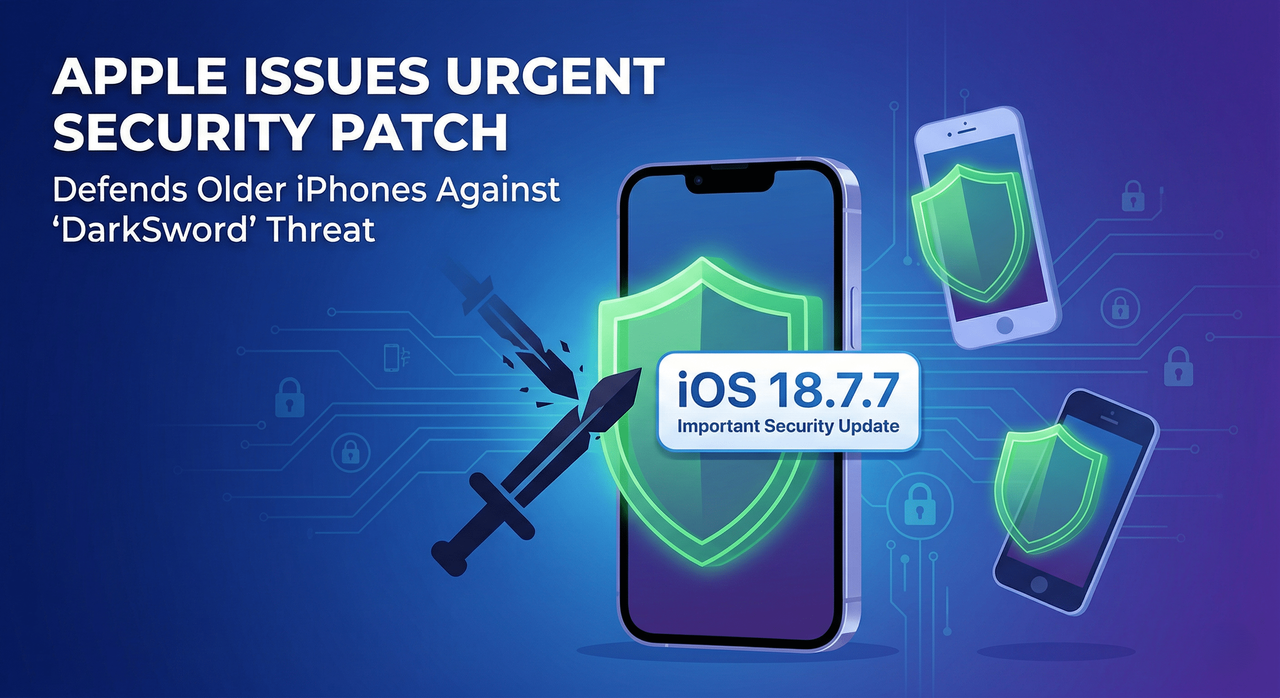
This Wednesday, Apple officially pushed iOS 18.7.7 and iPadOS 18.7.7, an essential security update designed for a specific and surprisingly large demographic: those still running older versions of Apple’s mobile software. This isn't just a routine "stability improvement." It is a vital shield against a leaked arsenal of professional-grade hacking tools known collectively as DarkSword.
The Anatomy of a Threat: What is DarkSword?
To understand why this update is critical, we have to look at the "DarkSword" toolkit. Unlike traditional malware that requires a user to download a suspicious file or click an obvious "phishing" link, DarkSword is significantly more insidious. It utilizes a series of web-based exploits (often called "drive-by" attacks).
In plain English? A user can have their device compromised simply by visiting a compromised website. These aren't just the "dark corners" of the internet, either; hackers often breach legitimate, high-traffic websites to host malicious code. Once a vulnerable iPhone or iPad (specifically those running iOS 18.4 through 18.7) hits one of these pages, the toolkit goes to work in the background.
The data exfiltration capabilities of DarkSword are comprehensive and terrifying. Once inside, the toolkit can steal:
- Private Messages: Intercepting conversations across various platforms.
- Browser History: Mapping out a user's digital life and habits.
- Location Data: Tracking the physical movement of the device in real-time.
- Cryptocurrency: Draining digital wallets by accessing stored keys or session data.
All of this information is then silently uploaded to a remote server controlled by the attackers. It is a "silent thief" that leaves very little trace of its presence until the damage is already done.
From Government Spyware to "Everyone’s" Problem
The history of DarkSword reads like a techno-thriller. Initially, these tools were observed in highly targeted attacks across specific regions, including China, Malaysia, Turkey, Saudi Arabia, and Ukraine. In these instances, the exploits were likely used by sophisticated actors for high-level surveillance.
However, the game changed when the toolkit was published online.
When professional hacking tools are leaked to the public, they undergo a "democratization" of sorts. You no longer need the resources of a nation-state to deploy them. Security researchers are now sounding the alarm: because the blueprint for DarkSword is available to the masses, any cybercriminal with a bit of technical know-how can now target people who have failed to patch their devices. This turns a surgical strike tool into a wide-net fishing expedition.
The "Liquid Glass" Dilemma: Why Users Aren't Updating
While Apple released iOS 26 weeks ago—a version that is natively immune to DarkSword—a significant portion of the user base has remained on the iOS 18 architecture. There are two main reasons for this.
First, there are the "Legacy" users. These are people with older iPhones and iPads that simply lack the hardware requirements to run the modern iOS 26. For these users, Apple’s release of 18.7.7 is a lifeline, ensuring they aren't left behind as "sitting ducks" for hackers.
Second, and perhaps more interestingly, is the group of "Resistance" users. These are individuals whose devices can run iOS 26, but who have actively chosen not to upgrade. The culprit? The "Liquid Glass" interface.
Since its debut, the Liquid Glass UI in iOS 26 has been a point of heavy contention. Critics argue that the hyper-minimalist, translucent aesthetics favor form over function, leading to navigation headaches and a steep learning curve. In an attempt to keep their familiar user experience, millions have stayed on the older iOS 18 software, inadvertently leaving their digital front doors unlocked. Apple’s release of iOS 18.7.7 acknowledges this reality, providing security for those who aren't ready to embrace the new aesthetic.
Defensive Layers: iOS 26 vs. Lockdown Mode
For those who have updated to iOS 26, the threat of DarkSword was neutralized weeks ago. Apple’s newest operating system was built with the foresight of these specific vulnerabilities, blocking the execution of the web-based code required for the exploit.
However, Apple provides an even more robust "nuclear option" for those at high risk: Lockdown Mode.
Apple recently informed TechCrunch that they are unaware of any successful government-level spyware attacks against a device with Lockdown Mode enabled. This feature essentially "hardens" the device by strictly limiting certain functionalities (like message attachments and certain web technologies) that are commonly exploited by tools like DarkSword. While Lockdown Mode is an extreme measure for the average user, it represents the gold standard of mobile defense.
Human Verdict: Is it Time to Click "Install"?
Let’s be honest: nobody likes the "Software Update Required" popup. It usually appears at the worst possible time. But the DarkSword leak represents a shift in the threat level for the average iPhone user. When tools this powerful become public knowledge, "security through obscurity" is no longer a viable strategy.
If you are one of the users currently holding out because you dislike the Liquid Glass interface, you no longer have an excuse to remain vulnerable. iOS 18.7.7 gives you the best of both worlds—the interface you prefer and the security you desperately need.
How to Stay Safe:
- Check Your Version: Navigate to Settings > General > Software Update. If you see iOS 18.7.7, install it immediately.
- Enable Automatic Updates: This ensures that as soon as Apple identifies a new threat, your phone is ready to fight back without you having to manually intervene.
- Practice Digital Hygiene: Even with the patch, avoid clicking links from unknown senders and be wary of "too good to be true" websites.
In the world of 2026, your smartphone isn't just a phone—it's your bank, your diary, and your GPS. Apple has provided the lock; all you have to do is turn the key. Don't let the "Liquid Glass" debate distract you from the fact that, in the digital age, being unpatched is a risk you simply shouldn't take.


Comments
No comments yet. Be the first to share your thoughts!
Leave a Comment