

Apple’s Internal AI Workflow Comes Under the Spotlight After Reported Claude Files Surface in Support App
Apple’s AI Development Strategy Faces New Attention
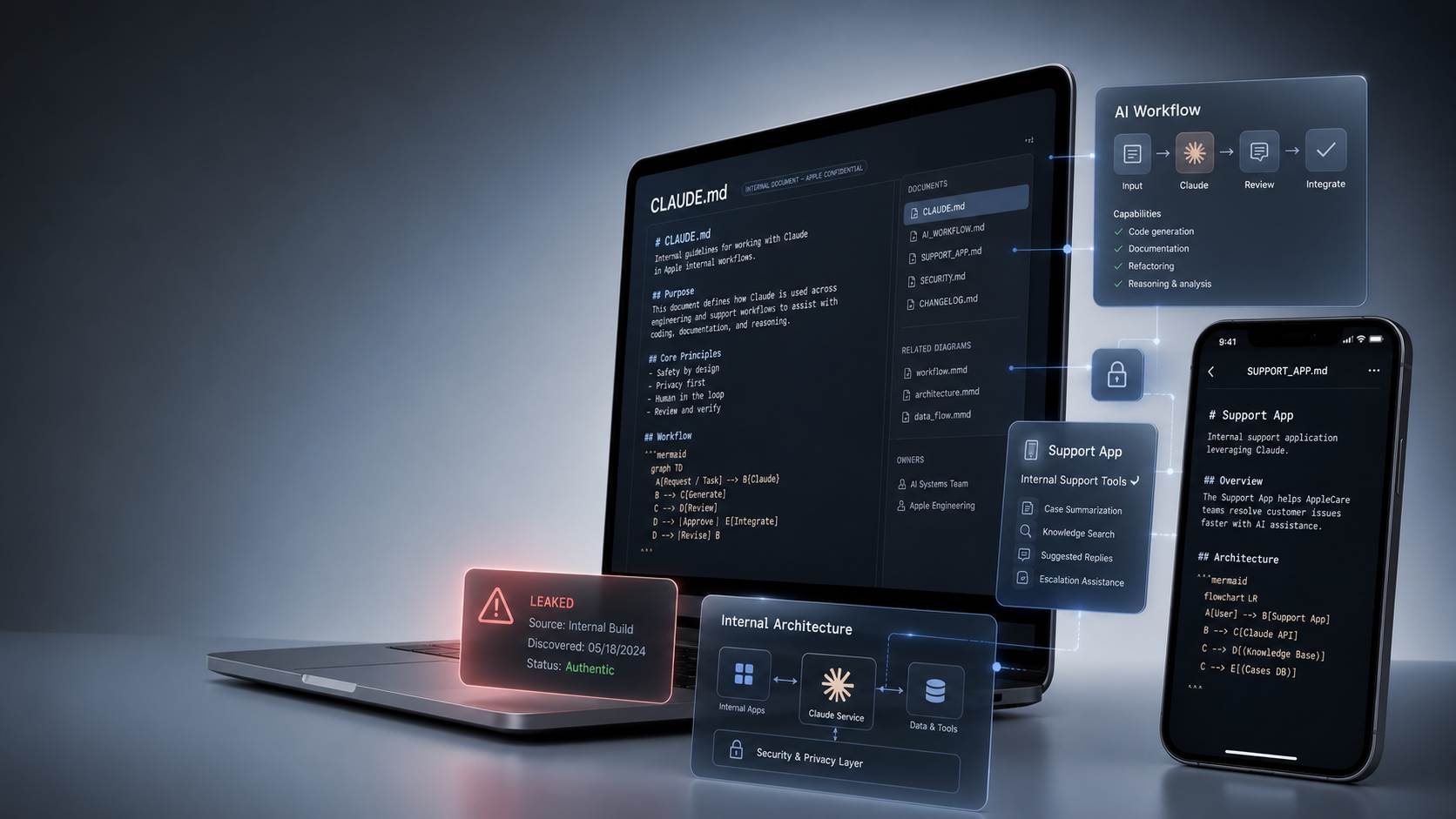
Apple’s relationship with artificial intelligence has entered a new phase of public scrutiny after reported internal CLAUDE.md files were discovered inside a recent version of the Apple Support app. The finding has sparked discussion across the U.S. technology industry because these files are closely associated with Claude Code, Anthropic’s AI coding assistant.
While Apple has not publicly confirmed that the files represent its full internal workflow, the discovery suggests that Anthropic’s Claude may be playing a role in how Apple engineers organize, document, and possibly accelerate software development. The timing is important. Apple has already moved toward deeper AI-assisted development in Xcode, including support for Anthropic’s Claude Agent and OpenAI’s Codex in Xcode 26.3.
For a company known for secrecy, vertical integration, and strict control over its hardware and software ecosystem, even a small accidental file exposure can become a major industry signal. The reported appearance of Claude-related configuration files inside a production app raises broader questions about how far Apple is willing to go in adopting third-party AI tools within its engineering environment.
What Are CLAUDE.md Files?
CLAUDE.md files are markdown-based instruction files commonly used with Claude Code. Developers place these files inside project directories so Claude can read them at the beginning of a coding session. They often define coding standards, repository structure, architectural rules, review expectations, preferred libraries, testing instructions, and other project-specific guidance.
In simple terms, a CLAUDE.md file acts like a project handbook for an AI coding assistant. Instead of requiring engineers to repeatedly explain how a codebase works, the file gives Claude persistent context about the project. This helps the assistant produce code that better matches the team’s expectations.
That is why the reported discovery matters. These files are usually meant to stay inside development repositories. They are not generally expected to ship inside public production apps. If they appeared inside the Apple Support app package, it may point to a packaging mistake during the release process rather than an intentional disclosure.
Reports about the Apple Support app files claim that one document referenced a chat module combining Apple’s Juno AI system with live human agents. It reportedly described message routing roles such as client, agent, and assistant. Another file reportedly documented SAComponents, a shared UI library supporting several Apple platforms, including visionOS.
Why This Matters for Apple
Apple has built its reputation around control. From the iPhone and Mac to iOS, macOS, and visionOS, the company manages the full product experience more tightly than most technology giants. That approach has helped Apple create a strong brand identity around privacy, security, quality, and polished user experiences.
Because of that reputation, any sign that Apple is relying on a third-party AI system inside its engineering workflow naturally attracts attention. The issue is not simply whether Apple uses Claude. Many leading technology companies now use AI tools to write, review, test, and document code. The more interesting question is how Apple manages sensitive source code, internal documentation, and engineering standards when AI agents are involved.
If Claude is being used internally, Apple would likely need strict safeguards around data access, model hosting, permission boundaries, logging, and confidentiality. A company of Apple’s scale could also negotiate customized deployments, private infrastructure, or enterprise controls that are not available to ordinary developers.
The reported files do not prove that Apple sends sensitive code to external servers. They only suggest that Claude-related workflows may exist inside Apple’s software development environment. Still, the discovery is significant because it gives outside observers a rare glimpse into how Apple may be adapting to the AI coding era.
Apple’s Public Connection to Anthropic Is Already Visible
The reported leak did not appear in isolation. Apple has already made public moves involving Anthropic’s technology. In February 2026, Apple announced that Xcode 26.3 supports agentic coding, allowing developers to use coding agents such as Anthropic’s Claude Agent and OpenAI’s Codex directly inside Xcode. Apple described the feature as a way for agents to work more autonomously toward developer goals, including breaking down tasks, making decisions based on project architecture, and using built-in tools.
Apple’s developer materials also state that Xcode 26.3 allows developers to harness coding agents like Claude Agent and Codex to build and test projects, search Apple documentation, and fix issues.
This public integration makes the reported CLAUDE.md files more plausible. Apple is not ignoring the AI coding movement. It is actively bringing agentic coding into its developer ecosystem. The difference is that public Xcode support is aimed at external developers, while the reported CLAUDE.md files suggest possible internal usage within Apple’s own software teams.
A Possible Packaging Error With Bigger Implications
If the files were accidentally included in a production release, the most immediate explanation is a packaging oversight. Modern apps are complex. Build systems can pull in documentation, configuration files, development assets, and internal references if exclusion rules are not properly configured.
For most companies, accidentally shipping internal development files would be embarrassing. For Apple, it becomes headline-worthy because the company is widely perceived as one of the most disciplined software and hardware organizations in the world.
The presence of conditional compilation flags such as JUNO_ENABLED and DEV_BUILD, as reportedly seen in screenshots, would further suggest that the files came from a live development environment. References to internal bug-tracking systems would also reinforce the idea that these were not generic public documents.
Still, the discovery should be interpreted carefully. Internal documentation does not necessarily reveal production behavior. A file may describe development-only features, experimental architecture, inactive flags, or internal testing systems. It can show how a team thinks about a project without proving exactly what is active in the shipped user experience.
AI Coding Tools Are Becoming Standard in Big Tech
The larger story is that AI coding tools are rapidly becoming part of mainstream software engineering. Tools like Claude Code, OpenAI Codex, GitHub Copilot, and other agentic assistants are changing how developers write and maintain software. They can help generate boilerplate, explain unfamiliar code, suggest tests, identify bugs, refactor components, and document systems.
For Apple, the attraction is obvious. The company maintains massive software platforms across iPhone, iPad, Mac, Apple Watch, Apple TV, Vision Pro, cloud services, developer tools, and support products. Even small improvements in engineering productivity can have enormous impact at Apple’s scale.
At the same time, AI coding tools introduce new risks. They may generate incorrect code, misunderstand architecture, introduce security issues, or rely on incomplete context. That is why files like CLAUDE.md are important. They show how engineering teams try to guide AI assistants with rules, constraints, and project-specific instructions.
Rather than replacing engineers, these systems increasingly act as structured collaborators. Human developers still review, test, and approve the work. The AI tool becomes part of the workflow, not the final authority.
What This Means for Developers and Apple Users in the USA
For U.S. developers, Apple’s movement toward AI-assisted coding is a major signal. If Apple is integrating Claude and Codex into Xcode while also experimenting with Claude-style internal workflows, it suggests that agentic development is no longer a niche trend. It is becoming part of the professional software development stack.
For Apple users, the impact may be less visible but still meaningful. Better internal tooling can lead to faster bug fixes, more consistent app experiences, improved support systems, and quicker iteration across platforms. However, users will also expect Apple to maintain its strong privacy and security standards, especially if third-party AI systems are involved anywhere in the development process.
The central question is not whether Apple should use AI. The industry has already moved in that direction. The question is whether Apple can use AI while preserving the trust, confidentiality, and product quality that define its brand.
Conclusion: A Small File Discovery Points to a Larger Shift
The reported CLAUDE.md files inside the Apple Support app may have been a simple release mistake, but the implications are much larger. They point to a future where even the most controlled technology companies use AI agents as part of their engineering workflow.
Apple’s public Xcode 26.3 announcement already confirms that the company sees value in agentic coding with tools such as Anthropic’s Claude Agent and OpenAI’s Codex. The reported internal files add another layer to that story by suggesting that similar AI-guided development practices may also be present inside Apple’s own teams.
For now, the safest conclusion is measured: the files do not prove everything about Apple’s internal AI operations, but they strongly indicate that AI coding tools are becoming relevant to Apple’s software workflow. In the U.S. tech market, where developer productivity, AI safety, and platform security are all major competitive issues, that is a story worth watching closely.

Comments
No comments yet. Be the first to share your thoughts!
Leave a Comment