

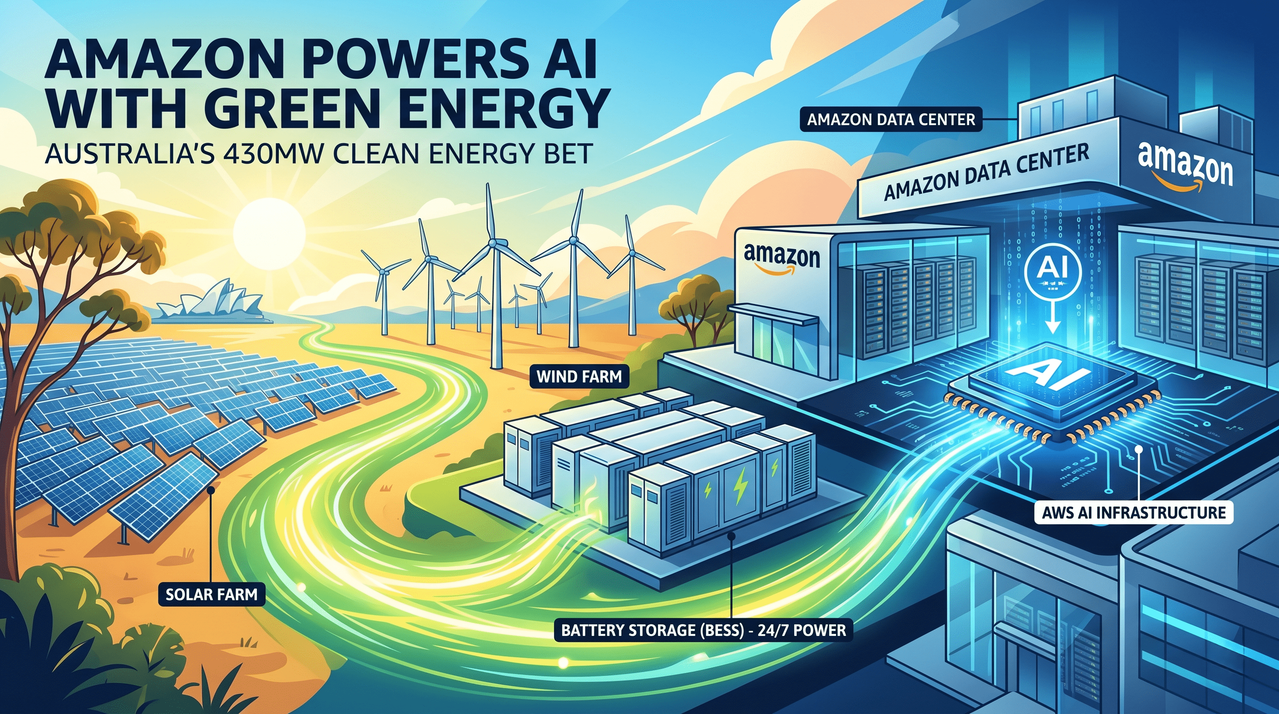
Amazon’s 430MW Clean Energy Bet: Powering the Future of AI Infrastructure in Australia
The artificial intelligence revolution is hungry. As the complexity of Agentic AI and large-scale machine learning models grows, so does the massive energy requirement to keep the servers humming. We are reaching a critical intersection where tech strategy cannot be separated from energy strategy.
Recently, Amazon made a monumental move to address this exact bottleneck, announcing a record-breaking investment of 430 megawatts (MW) in clean energy across Australia. This isn't just about reducing carbon footprints; it is a calculated infrastructure play to secure round-the-clock power for their rapidly expanding AI data centers.
Here is a breakdown of why this investment is a game-changer for cloud capabilities, grid stability, and the future of sustainable tech.
The 430 Megawatt Milestone
Amazon Australia has signed nine new power purchase agreements (PPAs) across New South Wales and Victoria. This latest injection of 430MW brings their total renewable energy capacity in the country to a massive 990MW across 20 projects—enough to power over half a million homes annually.
The portfolio is highly diversified, including:
- 1 utility-scale wind farm (part of the massive Golden Plains project in Victoria).
- 3 utility-scale solar and battery hybrid projects.
- 4 distributed solar-battery hybrids.
- 1 major battery storage installation at an existing solar farm.
The Battery Breakthrough: Solving the 24/7 Compute Problem
When configuring technical architectures and tracking AI development trends, one reality becomes immediately clear: AI server loads do not sleep. Training a complex model requires continuous, high-density power over weeks or months. You cannot simply turn off a data center when the sun goes down or the wind stops blowing.
This is what makes Amazon’s announcement structurally profound. Eight of the nine new projects incorporate Battery Energy Storage Systems (BESS). This marks Amazon's first venture into solar-battery hybrids outside of the United States. By storing excess solar energy generated during the day and discharging it at night, these battery systems provide the firm, dispatchable power required to keep enterprise-grade AI infrastructure running 24/7 without destabilizing the local electrical grid.
The Australian Context: From Coal to Cloud
Australia is rapidly becoming a premier hub for digital infrastructure. This 430MW energy procurement is directly linked to Amazon Web Services' (AWS) previously announced AU$20 billion investment to expand its data center footprint across Sydney and Melbourne by 2029.
Interestingly, these projects also highlight a geographic and environmental transition. For example, the Muswellbrook solar and battery farm is being constructed on rehabilitated brownfield land that was formerly a coal mining area. It is a literal transition from the fossil fuels of the past to the cloud compute power of the future.
Why This Matters for Tech Strategy
For those of us analyzing tech trends and building software architectures, infrastructure resilience is paramount. As AI scales, the cost and availability of electricity will dictate the pace of innovation.
Amazon's shift from merely purchasing standard renewable energy certificates to investing in complex, battery-backed hybrid projects signals a new era. It proves that to sustainably deploy advanced AI models at scale, tech giants must become active participants in modernizing the power grid.
By securing reliable, carbon-free energy, Amazon is future-proofing its capacity, ensuring that developers and enterprises have the reliable, continuous cloud environment needed to push the boundaries of AI.



Comments
No comments yet. Be the first to share your thoughts!
Leave a Comment