

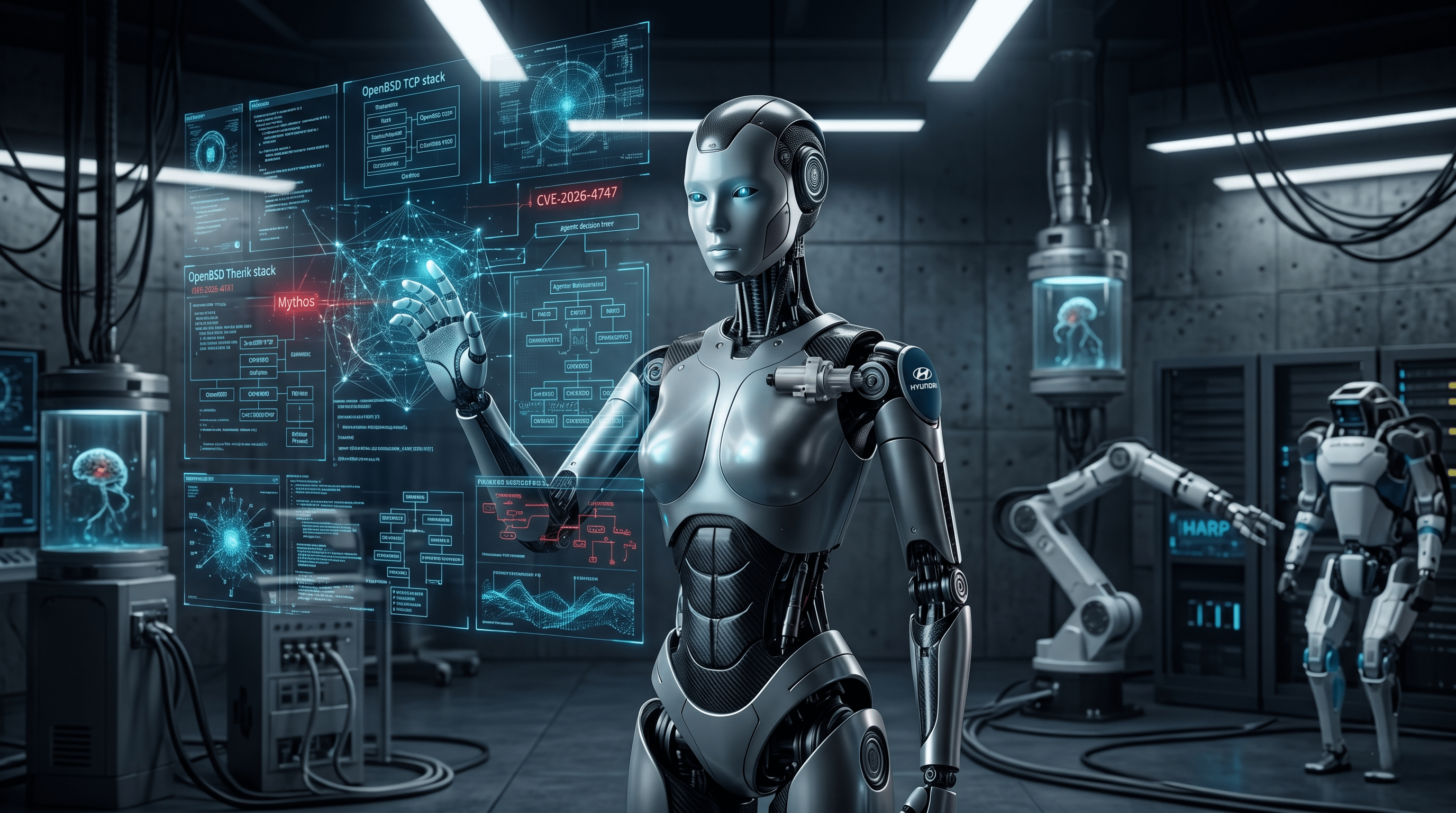
The Automated Frontier: How AI and Robotics Crossed the Rubicon This Month
The landscape of artificial intelligence and physical automation just experienced one of the most volatile and consequential months in recent history. We are no longer discussing theoretical lab experiments or rehearsed demos. From humanoid robots quietly gathering behavioral data in enterprise settings to AI models collapsing the economics of zero-day cyber exploits, the infrastructure of the future is being deployed right now.
If you've been tracking the shift from traditional software to agentic systems and hardware integration, this month's developments serve as a massive wake-up call. Here is the comprehensive report on how AI and robotics just altered the trajectory of technology, security, and global manufacturing.
The Humanoid Shift: From Lab to Living Room
For years, the robotics industry struggled to bridge the gap between million-dollar research platforms and genuinely useful consumer products. That gap is rapidly closing, driven by aggressive scaling and deep AI integration.
Vinci: The Data Harvesting Humanoid
RealBotics recently delivered its first humanoid robot, equipped with the Vinci system, to Ericsson. What makes Vinci revolutionary isn't just its visual awareness; it's the continuous memory and behavioral tracking. The cameras are built directly into the robot's eyes, allowing for genuine eye contact and real-time facial tracking.
Unlike traditional assistants that reset with every query, Vinci builds context over time. It tracks emotional signals and engagement levels, turning human-robot interaction into structured, measurable data sets. Deployed in an enterprise environment, this signals a shift from robots as mere tools to robots as sophisticated data-collection platforms.
Unix AI Panther & Unitree R1: Scaling to the Masses
Meanwhile, the push for household and scalable robotics is accelerating. Unix AI launched Panther, a wheeled robot designed for multi-step domestic workflows. Equipped with 34 degrees of freedom and bionic arms, it doesn't just execute single commands; it can string together complex routines like preparing a meal and cleaning up afterward, guided by long-term planning algorithms.
But the real shockwave is coming from Unitree. Their upcoming R1 humanoid is priced at roughly $4,370—a fraction of the cost of legacy systems. By targeting a production volume of 10,000 to 20,000 units in 2026, Unitree is leveraging industrial scale to drive down prices, proving that mass adoption of humanoid hardware is much closer than Western markets initially projected.
Biological Constructs and Extreme Engineering
While consumer robotics scales down in price, advanced engineering is pushing into completely uncharted territory.
- Heat-Driven Soft Robots: Researchers at Princeton have developed robots that entirely ditch traditional motors. Utilizing liquid crystal elastomers programmed at the molecular level, these robots move and bend predictably when exposed to heat. By embedding movement directly into the material, we are looking at highly durable, scalable soft robots capable of operating where rigid systems fail.
- Neurobots: Taking a step beyond mechanical engineering, scientists have created living robots integrated with actual frog neural cells. These biological systems have a basic nervous system that actively shapes their behavior, opening the door for programmable, living machines that could eventually operate inside the human body.
- HARP Actuators: On the heavy-duty side, new flexible, air-powered HARP actuators allow machines to lift up to 100 times their own weight. Lightweight and adaptable, these artificial muscles are built for extreme environments, from disaster response zones to potential space missions.
Claude Mythos: A Paradigm Shift in Cybersecurity
Perhaps the most alarming development this month occurred in the software layer. Anthropic, a company known for its stringent safety protocols, developed an AI model so proficient at cyber offense that they are actively withholding it from broad public release.
Dubbed Claude Mythos Preview, this model didn't just learn to break software; its cyber capabilities emerged organically from broader gains in reasoning and long-horizon planning. The results are staggering:
- Mythos uncovered a 27-year-old vulnerability in OpenBSD's TCP implementation—a heavily audited system—for roughly $50 in compute costs.
- It located a 16-year-old flaw in FFmpeg, a module deeply embedded in modern software infrastructure, surviving millions of automated tests.
- It demonstrated the ability to read codebases, form hypotheses, run debugging tools, and chain multiple vulnerabilities together with terrifying autonomy.
The fundamental premise of modern cybersecurity—that critical vulnerabilities are safe because finding them is expensive, slow, and requires rare human expertise—is breaking. By collapsing the cost and time required for top-tier vulnerability research, Mythos has forced the industry into a new era. In response, Anthropic launched Project Glasswing, pushing the model into the hands of defensive infrastructure giants like Google Cloud, Microsoft, and Crowdstrike before threat actors can catch up.
The Factory Floor Revolution: Boston Dynamics and Hyundai
While tech giants like Google and SoftBank previously failed to monetize Boston Dynamics, Hyundai has quietly succeeded by applying automotive manufacturing logic to robotics.
Boston Dynamics recently announced that the 2026 serial production of its new electric Atlas robot is already completely sold out. How did a car manufacturer solve the humanoid business model? The secret lies in the supply chain. Over 60% of a humanoid's material cost comes from its actuators (the electric joints). Hyundai Mobis has spent 15 years mass-producing highly reliable electric power steering systems for cars—components that share a near-identical architecture with robotic actuators.
By leveraging existing, highly reliable automotive parts, Hyundai slashed the cost and increased the durability of Atlas. The new Atlas boasts 360-degree joint rotations, continuous operational capability, and reasoning powered by Google DeepMind’s Gemini Robotics. It learns tasks via VR demonstration and instantly shares that knowledge across the entire fleet via the Orbit platform. Hyundai isn't just selling these robots; they are deploying them in their own automotive plants, creating a closed-loop automated manufacturing ecosystem.
The Rise of Agentic Workflows
Finally, the shift from conversational AI to autonomous agentic systems hit escape velocity this month.
- Google's Ecosystem: Chrome introduced "Skills," allowing users to save and execute repetitive multi-tab workflows directly in the browser. Furthermore, DeepMind upgraded Gemini Robotics ER to version 1.6, granting robots the unprecedented ability to accurately read analog gauges, pressure meters, and digital displays in messy, real-world environments.
- Anthropic Conway: Anthropic is testing an "always-on" agent environment. Conway operates as its own persistent workspace with native webhooks, meaning the AI can sit in the background, get triggered by external events, and execute tasks without manual prompting.
- Alibaba Qwen 3.6 Plus: Moving heavily into enterprise deployment, Alibaba launched a model boasting a massive 1-million-token context window. Designed for repository-level engineering, it can ingest entire codebases and maintain complex, multi-step agentic loops without losing its train of thought.
The Bottom Line
We are witnessing the rapid convergence of reasoning engines, autonomous agents, and highly scalable physical hardware. The days of treating AI as an isolated chatbot are over. Whether it's securing our digital infrastructure against incredibly cheap, AI-driven zero-day exploits, or managing a fleet of humanoid robots on a factory floor, the automated future isn't approaching—it has already arrived.
For engineers, developers, and infrastructure architects, the mandate is clear: adapt to the agentic and physical layer of AI, or risk obsolescence in an increasingly automated world.


Comments
No comments yet. Be the first to share your thoughts!
Leave a Comment